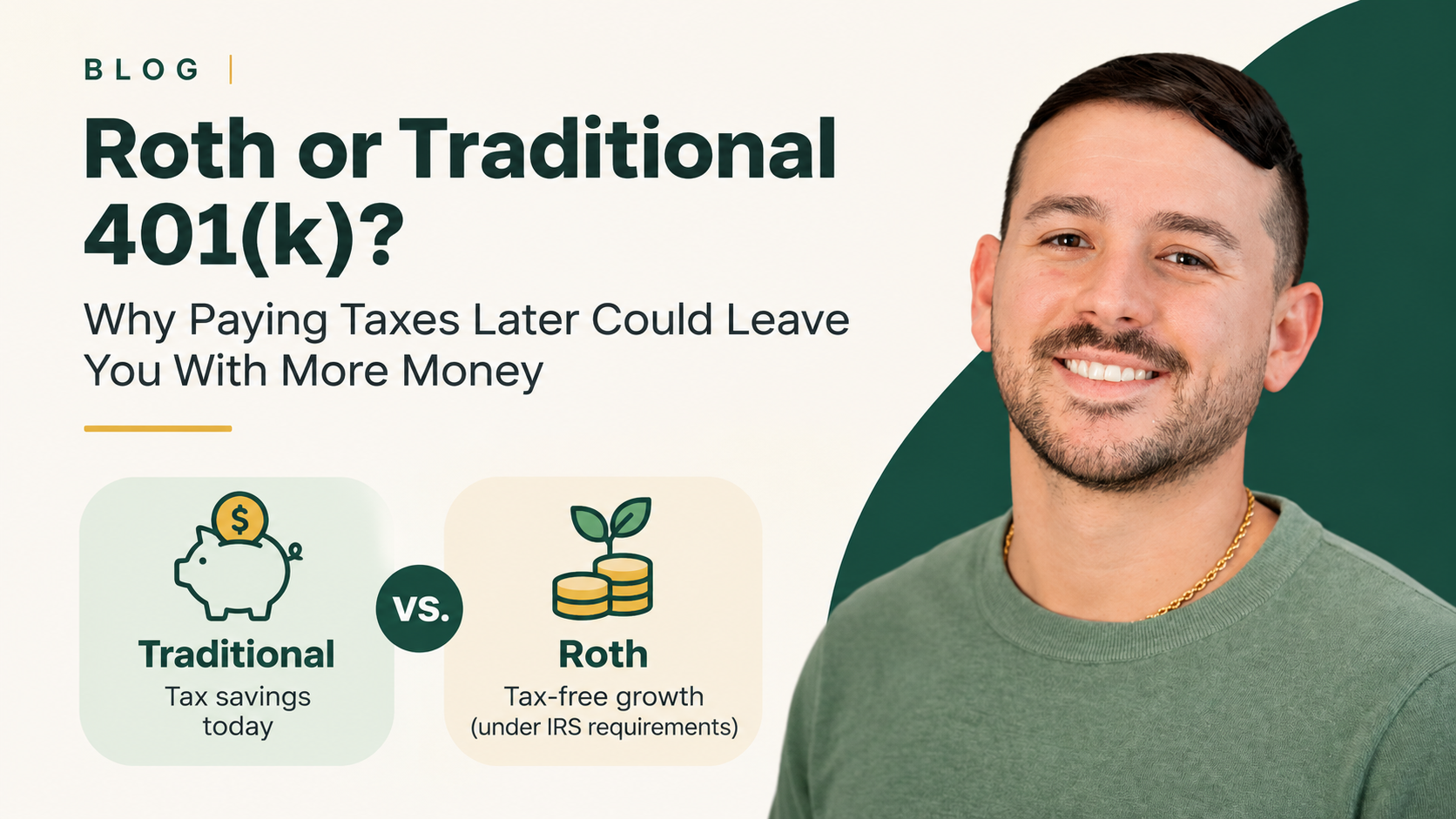
Roth or Traditional 401(k)?
Choosing between Roth and Traditional 401(k) contributions isn't just about whether tax rates will rise. Learn how your current marginal tax rate, retirement income, and withdrawal strategy can influence which option is more tax-efficient, and why pre-tax contributions may deserve a closer look.
Why paying taxes later could leave you with more money
A straightforward explanation of tax brackets, marginal rates, and effective rates—with 2026 federal tax figures.
The key idea: save taxes at your marginal rate; withdraw across multiple brackets
When you contribute to a Traditional 401(k), you reduce your taxable income today. If your last dollars fall in the 22% bracket, a $10,000 pre-tax contribution can save $2,200 in federal income tax. With a Roth 401(k), you give up that current tax benefit, but qualified withdrawals generally are not subject to federal income tax.
Qualified Roth 401(k) distributions generally are not subject to federal income tax if applicable IRS requirements are met, including the five-tax-year holding period and qualifying distribution conditions. Nonqualified distributions may be subject to income taxes and applicable penalties. Generally, qualifying distribution conditions include reaching age 59½, disability, or death.
Here is what changes the comparison: in retirement, the tax on Traditional withdrawals depends on the standard deduction, progressive tax brackets, and how much other income is already filling those brackets. Not every dollar withdrawn is necessarily taxed at your highest marginal rate.
Example: a married couple filing jointly
Assume a married couple filing jointly (MFJ) has $200,000 of taxable income in 2026 before the contribution and contributes $10,000 to a 401(k). In this illustration, the entire contribution falls within the 22% marginal bracket.

To compare both options using the same out-of-pocket cost, the starting point is $10,000 contributed to Traditional versus $7,800 contributed to Roth, assuming all $10,000 receives a 22% tax benefit. When comparing equal nominal contributions instead, you must also account for what happens to the $2,200 saved with Traditional.
What if Traditional withdrawals fund retirement?
In the next example, the couple’s Traditional 401(k) withdrawals are their only taxable income. We apply the 2026 federal brackets and the $32,200 MFJ standard deduction to each hypothetical retirement year, expressed in 2026 dollars. We exclude Social Security and age-related additional deductions.
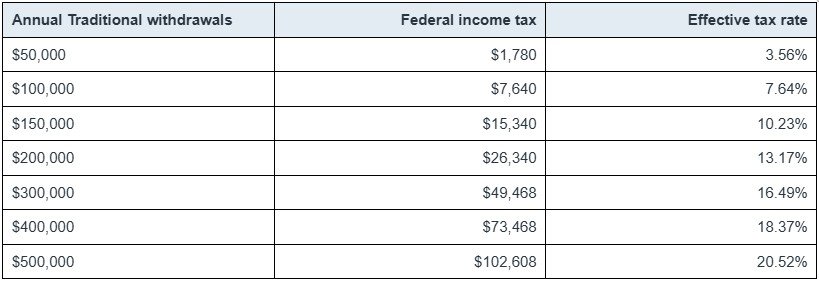
Effective tax rate here = federal income tax / total Traditional withdrawals. It does not measure the incremental tax on the next withdrawal.
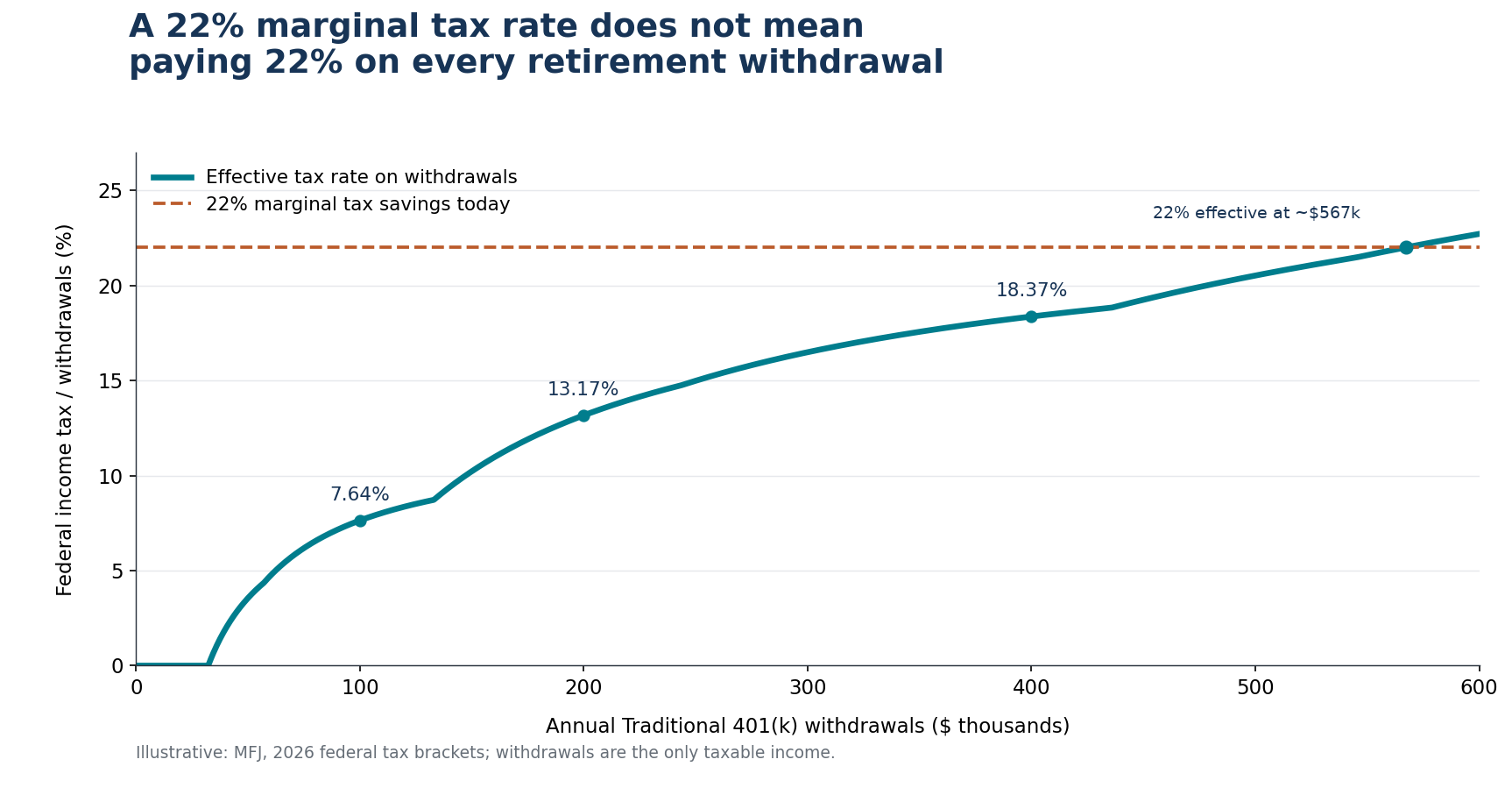
Chart 1. The effective tax rate rises as annual Traditional withdrawals increase. The dashed 22% line shows today’s marginal tax-savings rate, not an average retirement tax rate.
Tax rates shown are illustrative and based on the assumptions presented, including withdrawal amounts, filing status, applicable deductions, and federal income tax brackets. Actual tax liabilities will vary based on individual circumstances and applicable tax laws.
With $100,000 of annual Traditional withdrawals, the effective federal rate would be about 7.64%; at $200,000, it would be 13.17%. A 22% marginal rate today does not automatically translate into a 22% effective rate on Traditional withdrawals. In the chart, the effective rate reaches the 22% reference line at approximately $567,000 of annual withdrawals, above the highest amount listed in the table. This is one reason pre-tax contributions can be so valuable for many households.
What if future tax rates increase?
Now keep the 2026 bracket income thresholds and standard deduction unchanged, but hypothetically raise every marginal rate by 3 or 5 percentage points. This is not a forecast or a prediction of future tax law; it isolates the effect of higher rates.

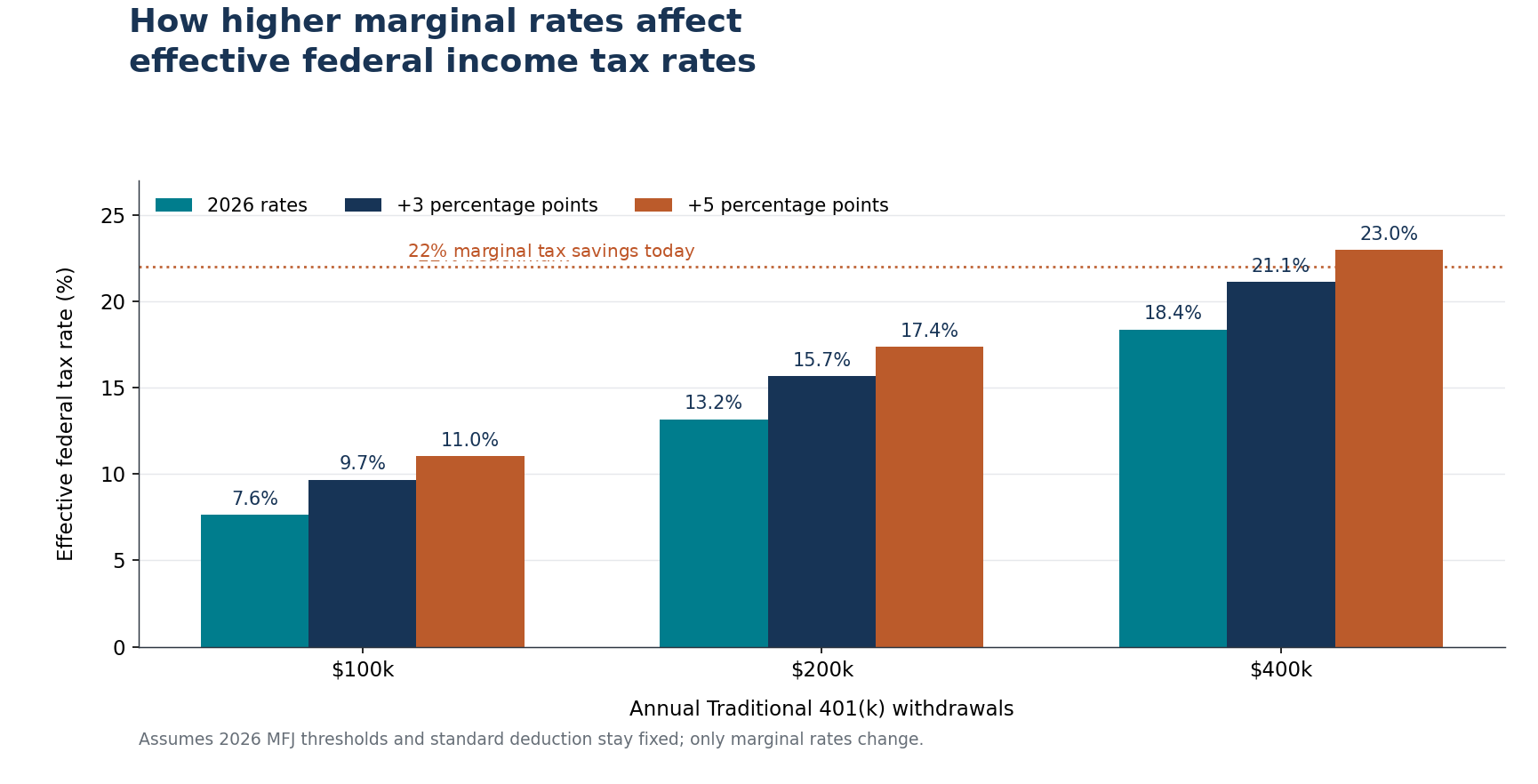
Chart 2. Raising marginal rates does not tax income covered by the standard deduction.
For example, with $200,000 in annual Traditional withdrawals, the effective rate would rise from 13.17% to about 17.37% even if every marginal rate increased by 5 percentage points. In other words, “taxes will be higher someday” does not automatically make Roth the better choice.
The important caveat: overall effective rate is not incremental tax cost
This is where the distinction matters. The effective rate on all retirement withdrawals may be relatively low, while an additional withdrawal can face a much higher rate because other income and earlier withdrawals already occupy the lower brackets.
For example, if a couple already has $200,000 of taxable income from other sources and takes an additional $40,000 distribution from a Traditional 401(k), that distribution produces $9,372 of additional federal income tax under 2026 brackets. Its incremental effective rate is 23.43%, higher than the 22% tax benefit assumed for today’s contribution. In that specific situation, Roth could be more attractive.
That is why there is no single universal break-even rate based on a household’s overall effective tax rate. When deciding where to direct the next contribution, estimate the incremental tax that those contributed dollars and their growth may face when distributed.
So should you prioritize pre-tax contributions before Roth?
For many households, pre-tax deserves to be the first option evaluated—especially when today’s marginal rate is relatively high and future withdrawals are expected during years with less taxable income. Choosing pre-tax today may also create opportunities for Roth conversions during lower-income years.
But maximizing pre-tax is not a universal rule. Roth may offer more value if you expect higher incremental tax rates in retirement, substantial pension income, large required minimum distributions (RMDs), or want greater tax diversification. Roth can also be attractive when you can afford to maximize the same nominal 401(k) contribution limit, since a maximum Roth contribution represents more after-tax retirement savings than a maximum pre-tax contribution. For 2026, the employee elective deferral limit is $24,500 before catch-up contributions, shared between Roth and Traditional 401(k) deferrals.
What to review before deciding
Your marginal tax bracket today—and how much of a pre-tax contribution would actually fall into that bracket.
Your other retirement income sources, and when each is expected to begin.
How much you might withdraw from Traditional accounts each year, rather than assuming one huge withdrawal.
Whether you may have lower-income years available for Roth conversions after leaving work.
State taxes, Social Security taxation, Medicare IRMAA, credits, changes in filing status, and estate-planning goals.
The bottom line
Do not assume that the federal income tax treatment of qualified Roth withdrawals determines the best overall tax decision. The real question is not simply whether you prefer to pay taxes now or later—it is which tax rate applies to the relevant dollars at each point in time. For many professionals and families, pre-tax contributions are a sensible starting point. The right mix of Traditional and Roth, however, calls for a view of your entire retirement tax picture—not just one tax rate.
Sources and assumptions
IRS — 2026 federal income tax brackets and standard deduction (Rev. Proc. 2025-32)
IRS — Roth contributions and qualified distributions in employer plans
IRS — 2026 retirement plan contribution limits
Illustrative only. All figures use 2026 dollars and exclude Social Security, inflation, age-based deductions, state taxes, IRMAA, penalties, and other tax interactions. Not individualized tax or investment advice.
Investment advisory services offered through Fiduciary Financial Advisors, LLC, a registered investment adviser. The views expressed represent the opinion of Fiduciary Financial Advisors, LLC. Information does not constitute investment, tax, or legal advice.

Moving Back to Puerto Rico? How to Prepare Financially After Building a Life in the States
For Puerto Ricans who left home to pursue opportunities, and hope to return someday.
For many Puerto Ricans, moving to the mainland United States wasn't necessarily about wanting to leave home.
It was about opportunity.
Maybe you left for college. Maybe you accepted a job that offered better pay, career growth, or opportunities that were difficult to find on the island. Maybe what started as a temporary move turned into five, ten, or fifteen years of building a life somewhere else.
Along the way, you established a career, started saving for retirement, invested in the stock market, perhaps bought a house, and maybe even started a family.
But somewhere in the back of your mind, there's still that thought:
"Algún día quiero regresar a Puerto Rico."
I'm from Puerto Rico myself, and I understand that feeling. Moving to the mainland can open doors professionally and financially, but it doesn't necessarily change where you consider home.
The challenge is that returning to Puerto Rico isn't quite as simple as reversing the move you made years ago.
Your financial life may look completely different now.
You may have a 401(k), Roth IRA, brokerage accounts, employer benefits, a mortgage, or a career that depends on opportunities available in the States.
And while coming home can be an exciting goal, the decisions you make before returning can have a lasting impact on your financial future.
Here are some important areas to consider when building a financial plan around your eventual return.
1. Start by turning "someday" into an actual financial goal
One of the biggest challenges with moving back to Puerto Rico is that the goal often doesn't have a clear timeline.
You know you want to return, but you're not exactly sure when.
Perhaps you're waiting until you reach a certain salary, accumulate enough investments, pay off your student loans, or find a job that allows you to work remotely.
That's understandable. But without a plan, "someday" can easily become another decade.
Instead, consider exploring different scenarios:
What would returning in three years look like?
What if you stayed in the mainland for another five or ten years?
How much would you need to save or invest before returning?
Could you afford to return earlier if you had a remote job?
What if your salary decreased significantly?
The objective isn't necessarily to choose an exact moving date today.
It's to understand what would need to happen financially for you to have the option.
Financial planning can help turn the idea of moving back into something measurable and achievable.
2. Your career and income might be the biggest factors
For many professionals, the decision to leave Puerto Rico was influenced by career opportunities and compensation.
And those same factors can make returning difficult.
Imagine that you're an engineer, healthcare professional, attorney, or someone working in technology who has spent several years building a career in the mainland.
You might now earn considerably more than you could expect from a comparable position in Puerto Rico.
Returning home could mean accepting a lower salary.
But that doesn't automatically mean returning is financially unrealistic.
The important question is:
How much income would you actually need to maintain the lifestyle you want in Puerto Rico?
Instead of comparing salaries alone, compare your entire financial picture.
Consider your take-home pay, housing costs, taxes, healthcare, transportation, retirement savings, and other expenses.
A lower salary doesn't necessarily translate into a proportionally lower standard of living. On the other hand, Puerto Rico shouldn't automatically be assumed to have a lower cost of living in every category.
What about keeping your mainland job and working remotely?
For some professionals, this might make returning significantly easier.
However, an employer allowing remote work within the mainland United States doesn't automatically mean it can employ someone working from Puerto Rico.
Payroll, tax withholding, benefits, retirement-plan eligibility, and employer registration may need to be addressed.
Before relying on remote employment as part of your relocation plan, confirm that the arrangement is actually supported by your employer.
3. Your taxes can change significantly when you return
This is one of the areas where planning ahead becomes especially important.
Puerto Rico has its own income tax system, separate from the federal income tax system that generally applies to residents of the 50 states.
Once you become a bona fide resident of Puerto Rico for federal tax purposes, Puerto Rico-source income may generally be excluded from federal gross income, subject to applicable rules and exceptions.
However, that doesn't mean all income becomes exempt from federal income taxes.
The rules depend on factors such as:
Whether you qualify as a bona fide resident of Puerto Rico
Where your income is sourced
The type of income you receive
Whether you continue earning income from the mainland
When certain investments were acquired or sold
Establishing bona fide residency also involves more than simply spending 183 days on the island. Federal rules generally consider presence, tax home, and closer connection requirements.
Your move may also create additional reporting obligations, including IRS Form 8898.
And if you are leaving a state that imposes income taxes, you may need to address that state's residency and domicile rules as well.
For example, someone returning from Michigan may face different state tax considerations than someone moving from Texas or Florida.
You can learn more about these rules in IRS Publication 570: Tax Guide for Individuals With Income From U.S. Territories.
The important takeaway: Don't assume that moving back to Puerto Rico automatically eliminates your federal tax obligations.
Ideally, your tax situation should be reviewed before choosing a relocation date or executing significant financial transactions.
4. What happens to the retirement accounts you've accumulated in the States?
If you've spent several years working in the mainland, there's a good chance that a meaningful portion of your savings is invested through retirement accounts.
You might have:
A 401(k) from your current employer
Old 401(k) accounts from previous jobs
A traditional IRA or Roth IRA
A Health Savings Account (HSA)
A taxable brokerage account
Returning to Puerto Rico doesn't automatically mean these accounts need to be closed or liquidated.
However, the move may affect how you should manage them.
Your 401(k) and IRA
A key consideration is how distributions from retirement accounts established while living in the mainland might be taxed after becoming a Puerto Rico resident.
Federal pension-sourcing rules can depend partly on where the underlying services were performed, among other factors.
Additionally, certain retirement arrangements may receive different treatment under Puerto Rico tax law than under federal tax law.
This is particularly important when considering Roth accounts, rollovers, Roth conversions, and future retirement withdrawals.
Before making changes, it's worth understanding how your retirement savings fit into your long-term financial plan.
You worked hard to accumulate those assets.
You don't want to make an unnecessary distribution or rollover simply because you're changing where you live.
5. Be intentional with investments and savings before moving
One financial advantage that some Puerto Ricans may have after working in the mainland for several years is the opportunity to accumulate savings and investments before returning home.
Perhaps you've built up investments in a brokerage account, accumulated equity in your home, or received company stock as part of your compensation.
These assets could help fund your transition.
But they also require planning.
For example, federal tax rules contain special provisions for certain appreciated investments acquired before becoming a bona fide resident of Puerto Rico.
That means moving to Puerto Rico before selling appreciated stocks doesn't necessarily eliminate federal tax on gains accumulated while you lived in the mainland.
Decisions about when to sell investments, how much cash to maintain, or whether to purchase property in Puerto Rico should be coordinated with your relocation timeline.
Keep your relocation savings separate from long-term investments
If you're planning to return in the next few years, consider establishing a dedicated savings goal for the move.
Potential expenses include relocation costs, housing deposits, buying or shipping a vehicle, furnishing a home, and unexpected expenses during the transition.
Money that you expect to spend in the near future generally shouldn't be exposed to the same investment risk as assets intended for retirement decades away.
The closer you get to your target date, the more important liquidity and stability become.
6. Buying a home in Puerto Rico deserves its own plan
For some Puerto Ricans living in the mainland, part of the dream is returning home and finally buying property on the island.
Maybe you've been thinking about buying land, building a home, or purchasing a house closer to your family.
But buying property can introduce another layer of financial complexity.
If you already own a house in the mainland, for example, you may need to decide whether to sell it, rent it out, or retain it for future flexibility.
You should also consider the costs associated with purchasing and maintaining property in Puerto Rico, including financing, insurance, utilities, maintenance, and property taxes.
Depending on the property, resilience-related costs such as generators, solar panels, batteries, or other backup systems may also deserve consideration.
And if you're considering purchasing property before moving, think carefully about how that decision affects your liquidity and flexibility.
You don't necessarily need to buy your forever home immediately after returning.
Sometimes renting while you transition can provide valuable flexibility.
7. Don't overlook the personal reasons you want to return
This is where financial planning becomes about much more than numbers.
For many Puerto Ricans, returning home isn't primarily a financial decision.
It's about family, community, culture, and the life you want to build.
Maybe you want to spend more time with your parents as they get older.
Maybe you want your children to grow up closer to their grandparents and experience the same culture you grew up with.
Maybe you're simply tired of only seeing your family during vacations, holidays, or special occasions.
Those motivations matter.
And they should influence the way your financial plan is constructed.
A financial decision that maximizes your income or net worth isn't necessarily the one that maximizes your quality of life.
At the same time, you don't want to return home only to find yourself under financial stress because you underestimated the transition.
The goal should be to create a financial situation that allows you to return to Puerto Rico without unnecessarily sacrificing the financial stability you've worked to build.
8. You don't have to wait until you're ready to move to start planning
If returning to Puerto Rico is something you hope to accomplish eventually, you can begin preparing well before the move.
Your priorities will depend on your timeline.
If your goal is still five or more years away
Focus on building financial flexibility.
That might include increasing your savings rate, investing for long-term goals, reducing high-interest debt, developing your career, and exploring employment arrangements that could eventually support relocation.
You can also begin estimating how much income and savings you would need to live comfortably in Puerto Rico.
If you're hoping to return within the next one to three years
Your plan may need to become more specific.
This is the time to evaluate employment options, develop a detailed relocation budget, review your tax situation, and determine how much money you'll need available for the move.
It's also a good time to reconsider the risk level of investments earmarked for near-term expenses.
If you're preparing to move within the next 12 months
The focus shifts toward implementation.
Before relocating, coordinate the timing of your move with tax professionals familiar with both federal and Puerto Rico tax rules.
Confirm employment and insurance arrangements, review investment transactions, organize required documentation, and make sure you have sufficient cash reserves.
This is where decisions made without proper coordination can sometimes become expensive.
Returning home should be part of your financial plan, not just a dream
Moving away from Puerto Rico can be a difficult decision.
For many of us, it meant leaving behind family, friendships, familiar places, and a way of life we love in pursuit of opportunities elsewhere.
And after spending years building a career and establishing financial stability in the mainland, returning can feel like starting over.
But it doesn't have to be.
The experience, savings, investments, and opportunities you've accumulated while living away from Puerto Rico can become the foundation for your next chapter.
The important thing is to plan intentionally.
You may not know exactly when you'll return.
You may not even know whether returning permanently will ultimately be the right decision for you.
But you can still build a financial plan that gives you that option.
Because sometimes financial freedom isn't just about being able to stop working.
It's about having the flexibility to choose where (and how) you want to live.
And for some of us, that means having the opportunity to come home.
Thinking about returning to Puerto Rico?
If you're a Puerto Rican professional living in the mainland and hope to return to the island someday, financial planning can help you evaluate what that transition might look like.
Through proper financial planning, I can you help bring together your career decisions, savings, investments, retirement goals, and potential relocation into a coordinated strategy.
This article is for educational purposes only and does not constitute individualized financial, investment, tax, or legal advice. U.S.–Puerto Rico tax matters are highly dependent on individual circumstances and applicable law.