
Why paying taxes later could leave you with more money
A straightforward explanation of tax brackets, marginal rates, and effective rates—with 2026 federal tax figures.
The key idea: save taxes at your marginal rate; withdraw across multiple brackets
When you contribute to a Traditional 401(k), you reduce your taxable income today. If your last dollars fall in the 22% bracket, a $10,000 pre-tax contribution can save $2,200 in federal income tax. With a Roth 401(k), you give up that current tax benefit, but qualified withdrawals generally are not subject to federal income tax.
Qualified Roth 401(k) distributions generally are not subject to federal income tax if applicable IRS requirements are met, including the five-tax-year holding period and qualifying distribution conditions. Nonqualified distributions may be subject to income taxes and applicable penalties. Generally, qualifying distribution conditions include reaching age 59½, disability, or death.
Here is what changes the comparison: in retirement, the tax on Traditional withdrawals depends on the standard deduction, progressive tax brackets, and how much other income is already filling those brackets. Not every dollar withdrawn is necessarily taxed at your highest marginal rate.
Example: a married couple filing jointly
Assume a married couple filing jointly (MFJ) has $200,000 of taxable income in 2026 before the contribution and contributes $10,000 to a 401(k). In this illustration, the entire contribution falls within the 22% marginal bracket.

To compare both options using the same out-of-pocket cost, the starting point is $10,000 contributed to Traditional versus $7,800 contributed to Roth, assuming all $10,000 receives a 22% tax benefit. When comparing equal nominal contributions instead, you must also account for what happens to the $2,200 saved with Traditional.
What if Traditional withdrawals fund retirement?
In the next example, the couple’s Traditional 401(k) withdrawals are their only taxable income. We apply the 2026 federal brackets and the $32,200 MFJ standard deduction to each hypothetical retirement year, expressed in 2026 dollars. We exclude Social Security and age-related additional deductions.
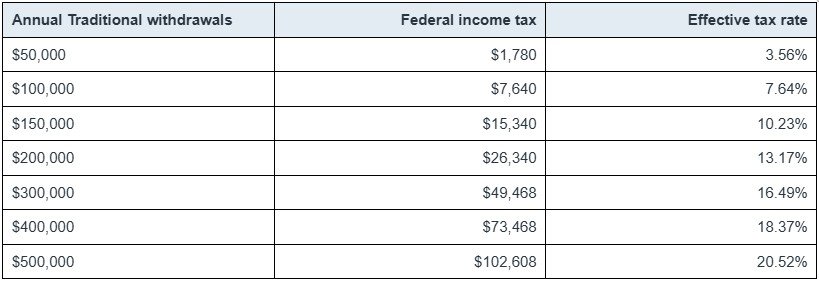
Effective tax rate here = federal income tax / total Traditional withdrawals. It does not measure the incremental tax on the next withdrawal.
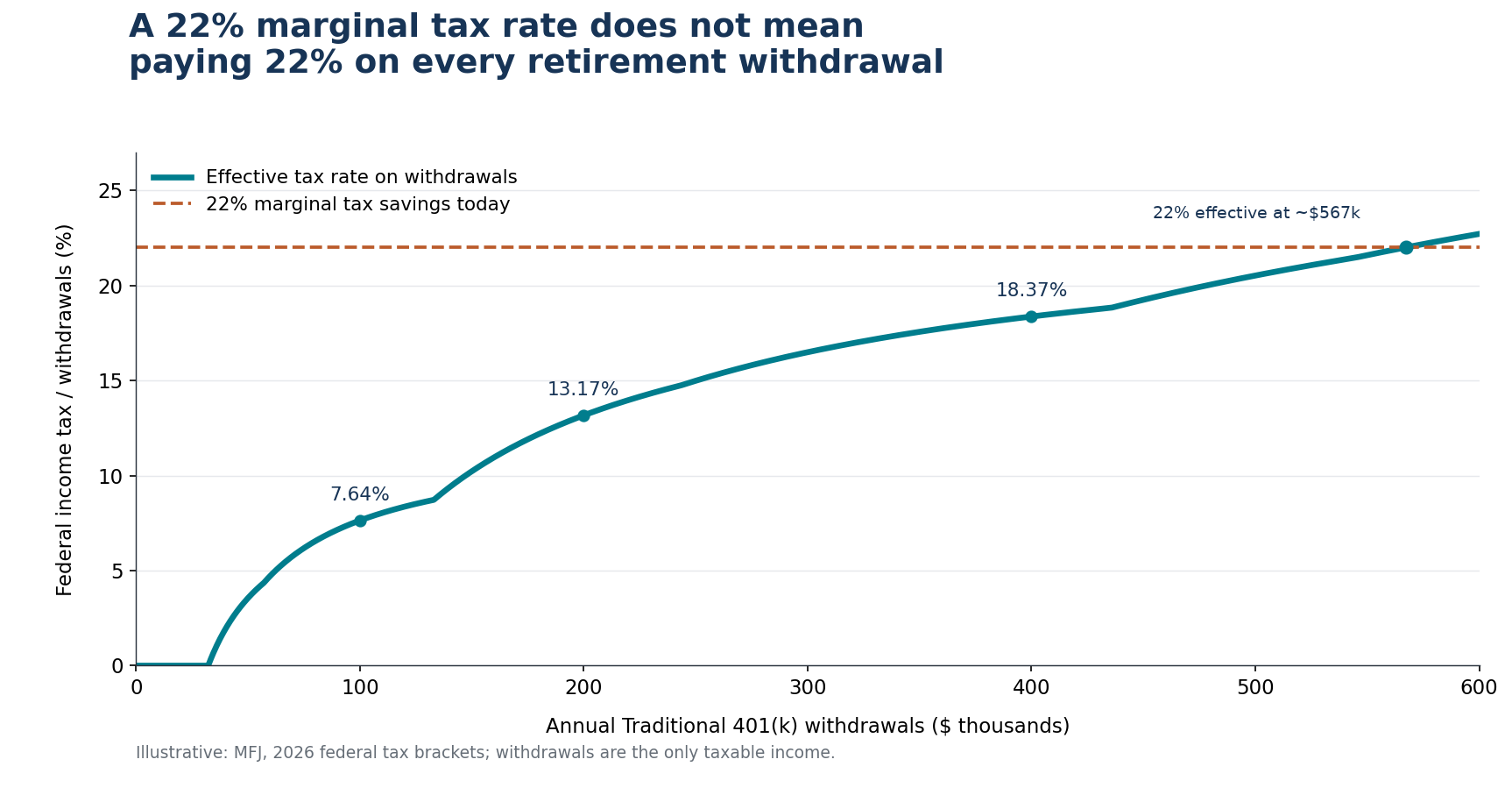
Chart 1. The effective tax rate rises as annual Traditional withdrawals increase. The dashed 22% line shows today’s marginal tax-savings rate, not an average retirement tax rate.
Tax rates shown are illustrative and based on the assumptions presented, including withdrawal amounts, filing status, applicable deductions, and federal income tax brackets. Actual tax liabilities will vary based on individual circumstances and applicable tax laws.
With $100,000 of annual Traditional withdrawals, the effective federal rate would be about 7.64%; at $200,000, it would be 13.17%. A 22% marginal rate today does not automatically translate into a 22% effective rate on Traditional withdrawals. In the chart, the effective rate reaches the 22% reference line at approximately $567,000 of annual withdrawals, above the highest amount listed in the table. This is one reason pre-tax contributions can be so valuable for many households.
What if future tax rates increase?
Now keep the 2026 bracket income thresholds and standard deduction unchanged, but hypothetically raise every marginal rate by 3 or 5 percentage points. This is not a forecast or a prediction of future tax law; it isolates the effect of higher rates.

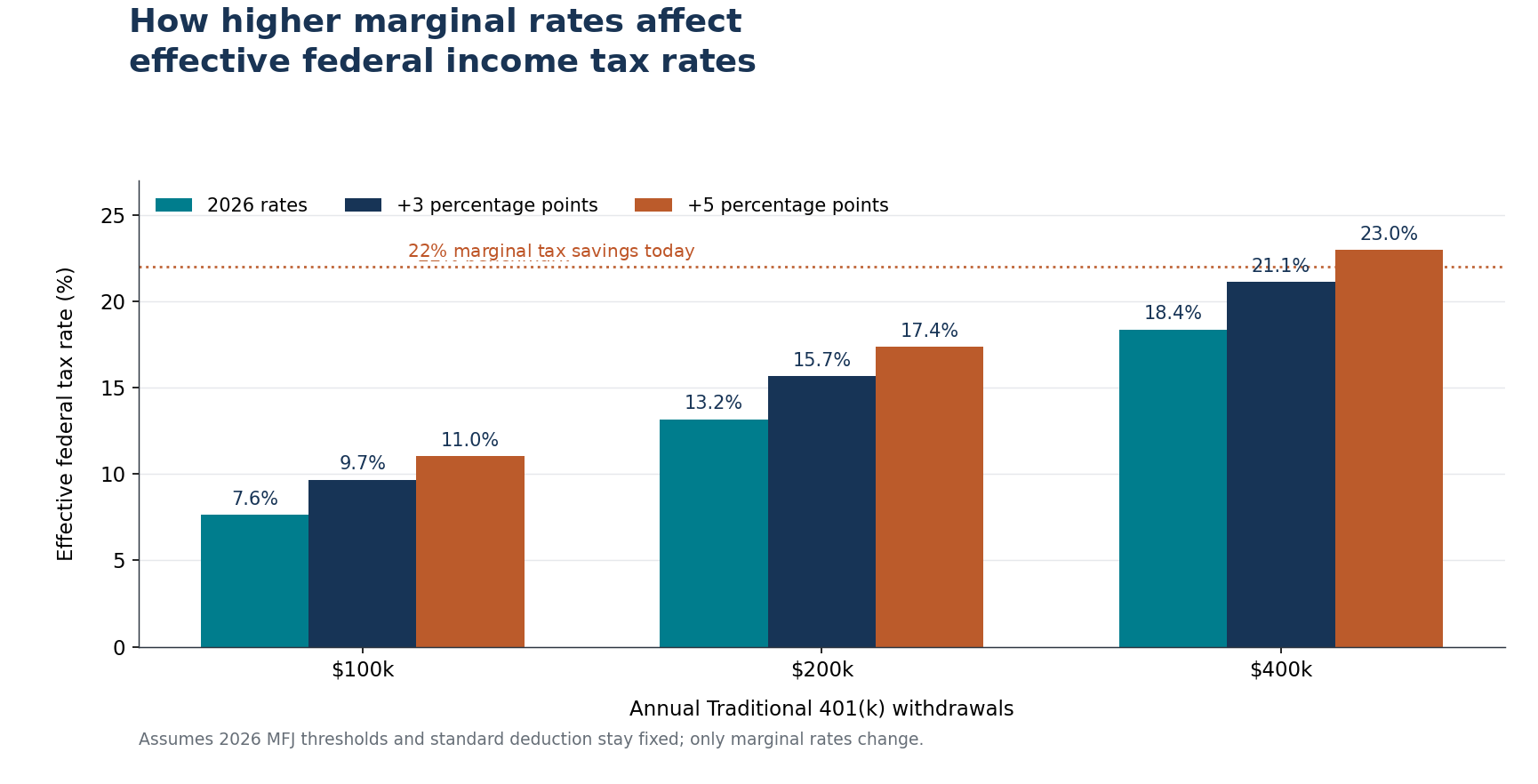
Chart 2. Raising marginal rates does not tax income covered by the standard deduction.
For example, with $200,000 in annual Traditional withdrawals, the effective rate would rise from 13.17% to about 17.37% even if every marginal rate increased by 5 percentage points. In other words, “taxes will be higher someday” does not automatically make Roth the better choice.
The important caveat: overall effective rate is not incremental tax cost
This is where the distinction matters. The effective rate on all retirement withdrawals may be relatively low, while an additional withdrawal can face a much higher rate because other income and earlier withdrawals already occupy the lower brackets.
For example, if a couple already has $200,000 of taxable income from other sources and takes an additional $40,000 distribution from a Traditional 401(k), that distribution produces $9,372 of additional federal income tax under 2026 brackets. Its incremental effective rate is 23.43%, higher than the 22% tax benefit assumed for today’s contribution. In that specific situation, Roth could be more attractive.
That is why there is no single universal break-even rate based on a household’s overall effective tax rate. When deciding where to direct the next contribution, estimate the incremental tax that those contributed dollars and their growth may face when distributed.
So should you prioritize pre-tax contributions before Roth?
For many households, pre-tax deserves to be the first option evaluated—especially when today’s marginal rate is relatively high and future withdrawals are expected during years with less taxable income. Choosing pre-tax today may also create opportunities for Roth conversions during lower-income years.
But maximizing pre-tax is not a universal rule. Roth may offer more value if you expect higher incremental tax rates in retirement, substantial pension income, large required minimum distributions (RMDs), or want greater tax diversification. Roth can also be attractive when you can afford to maximize the same nominal 401(k) contribution limit, since a maximum Roth contribution represents more after-tax retirement savings than a maximum pre-tax contribution. For 2026, the employee elective deferral limit is $24,500 before catch-up contributions, shared between Roth and Traditional 401(k) deferrals.
What to review before deciding
Your marginal tax bracket today—and how much of a pre-tax contribution would actually fall into that bracket.
Your other retirement income sources, and when each is expected to begin.
How much you might withdraw from Traditional accounts each year, rather than assuming one huge withdrawal.
Whether you may have lower-income years available for Roth conversions after leaving work.
State taxes, Social Security taxation, Medicare IRMAA, credits, changes in filing status, and estate-planning goals.
The bottom line
Do not assume that the federal income tax treatment of qualified Roth withdrawals determines the best overall tax decision. The real question is not simply whether you prefer to pay taxes now or later—it is which tax rate applies to the relevant dollars at each point in time. For many professionals and families, pre-tax contributions are a sensible starting point. The right mix of Traditional and Roth, however, calls for a view of your entire retirement tax picture—not just one tax rate.
Sources and assumptions
IRS — 2026 federal income tax brackets and standard deduction (Rev. Proc. 2025-32)
IRS — Roth contributions and qualified distributions in employer plans
IRS — 2026 retirement plan contribution limits
Illustrative only. All figures use 2026 dollars and exclude Social Security, inflation, age-based deductions, state taxes, IRMAA, penalties, and other tax interactions. Not individualized tax or investment advice.
Investment advisory services offered through Fiduciary Financial Advisors, LLC, a registered investment adviser. The views expressed represent the opinion of Fiduciary Financial Advisors, LLC. Information does not constitute investment, tax, or legal advice.
