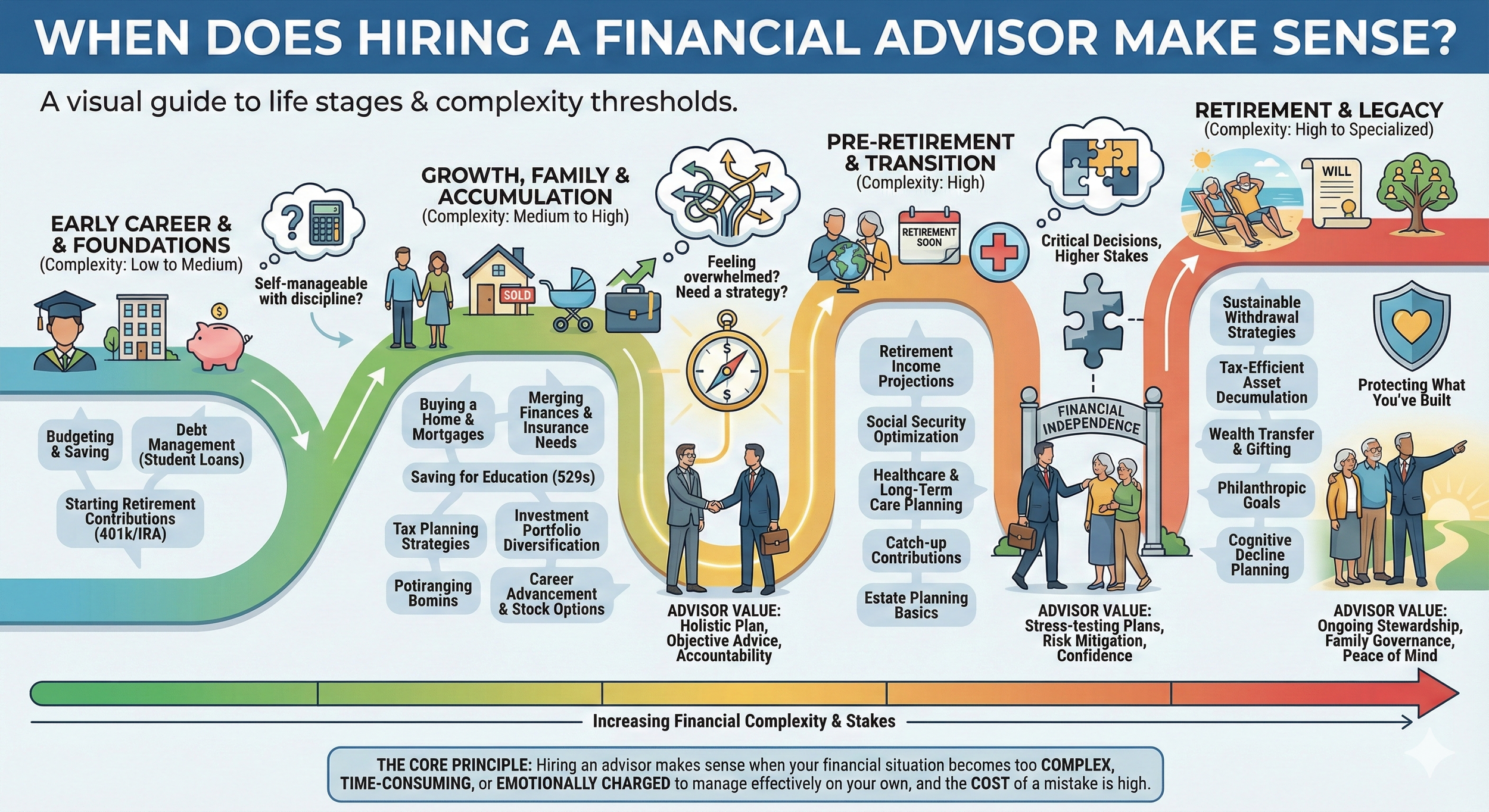
When Does Hiring a Financial Advisor Actually Make Sense?
A fact-based guide to identifying the inflection point between doing it yourself and a professional partnership.
Stop spending your valuable time on administration.
A quick, 30-minute intro to see if we're a good fit.

Read Andrew’s Story
For many successful professionals and business owners, "Do-It-Yourself" investing is a point of pride. You're smart, you're capable, and you've managed well to get to this point.
But success creates complexity.
The "when" for hiring an advisor isn't a magic number. It's an inflection point where the complexity of your assets, taxes, and legacy goals exceeds the time and specialized knowledge you have available.
This isn't about intelligence; it's about specialization. You’ve proven that you’re an expert in your field. The question now is whether you also have the time and desire to become a part-time expert in tax law, estate planning, and global markets.
If your financial life includes any of the following facts, you may have crossed the threshold where hiring an advisor now makes sense.
Key Takeaways From This Article:
Hiring an advisor makes sense when your financial success creates gaps that DIY management can no longer effectively or efficiently fill.
The Competence Gap:
Your finances now involve complex issues (like RSUs, business ownership, or multi-year tax strategies) that may benefit from a specialist with tax, equity-comp, or business-owner planning experience.
The Convenience Gap:
Your time has a higher, measurable ROI when spent on your profession or business, rather than on the second job of managing your own portfolio.
The Coaching Gap:
You recognize that disciplined, objective guidance is essential to help reduce the likelihood of costly, emotion-driven decisions such as ‘performance chasing’, with an understanding that no approach can fully prevent losses or investor mistakes.
The Continuity Gap:
You need a formal, structural plan: not just a will - to protect your family and ensure your legacy transfers efficiently across generations.
Your Compensation and Tax Picture Is No Longer 'Standard'
The first sign is that your tax return no longer resembles a "simple" filing. You've graduated from a straightforward W-2 to a mix of complex equity and business income.
It's time to seek specialized competence when your balance sheet includes:

Executive Compensation: You're managing a schedule of Restricted Stock Units (RSUs), Incentive Stock Options (ISOs), Non-Qualified Stock Options (NQSOs), or Employee Stock Purchase Plans (ESPPs), each with different tax treatments and grant dates.
Concentrated Equity: More than 10-15% of your net worth is tied up in a single company stock; or worse yet, the stock is that of the company you work at or own. This creates a significant, undiversified risk.
Business Ownership: You're dealing with K-1 distributions, buy-sell agreements, succession planning, or structuring a tax-efficient exit.
Complex Tax Liabilities: You are subject to the Alternative Minimum Tax (AMT), pay state taxes in multiple states, or are looking for advanced, multi-year tax-optimization strategies; not just minimizing a single year’s tax bill.
Alternative Investments: You're vetting private equity, venture capital, or real estate syndications and need to understand their risks, tax implications, and role in your portfolio.
These aren't "DIY" problems; they are sophisticated legal and tax strategies. This is also where an advisor's philosophy is critical. When solving these problems, is their incentive to a cost-aware and suitable solution for you? Or is it to sell you a specific, high-fee product (like a complex insurance vehicle or proprietary fund) that their firm incentivizes? A fiduciary is legally bound to the first approach; a broker-dealer is not.
Your Time Has a Higher and Better ROI Elsewhere
This is a straightforward, mathematical calculation of convenience. Your most valuable asset is no longer your investment portfolio; it's your time and your ability to earn in your own profession or business.
Calculate the hours you spend per month on:
Investment research, analysis, and rebalancing.
Coordinating phone calls and emails between your tax preparer, and your estate attorney.
Tracking cost-basis, managing cash flow, and reviewing insurance policies.
Understanding and executing your equity compensation.
Now, multiply those hours by your effective hourly rate. In most cases, the cost of the time you spend doing this work often exceeds the fee for delegating it. Consider comparing your hourly value with an advisor’s fee to see if delegation makes sense for you.
But this calculation only works if you can trust the person you're delegating to. True convenience isn't just offloading tasks; it's offloading the mental energy and worry. That's only possible when you know your advisor is a fiduciary, legally bound to act 100% in your best interest. If you have to spend mental energy wondering if their advice is conflicted by a commission, you haven't truly bought back your time.
You Are Trying to Outsmart Yourself (And Failing)
This is the most painful sign because it’s not about a lack of intelligence; it's about human nature.
The greatest risk to your portfolio isn't a bad market; it's your own behavior in a bad market.
The most famous case study in this is Peter Lynch's Fidelity Magellan Fund. From 1977 to 1990, Lynch was arguably the greatest fund managers, posting an astounding 29% average annual return* (past performance does not guarantee future results). It would seem that anyone invested in that fund would have become incredibly wealthy.
But they didn't.
A study by Fidelity on its own fund revealed a shocking fact: the average investor in the Magellan Fund actually lost money during that same period.*
How is this possible? The data shows a classic example of what is commonly referred to as a "behavior gap." Investors, excited by the stellar returns, would buy into the fund after a period of strong performance. Then, when the fund hit an inevitable rough patch or a market correction, they would panic and sell at a low point.
They were chasing performance instead of practicing discipline. This is the coaching component, and it's a crucial philosophical test of an advisor: Is your advisor paid to help you stick to a plan, or are they paid by transaction? A fiduciary's incentive is 100% aligned with your long-term success. A non-fiduciary advisor’s incentive may be to encourage you to make a move, even if it's the wrong one, because trading is a component of how they get paid.
Your Legacy Plan Lacks Structural Continuity

If your entire financial strategy exists primarily in your head or a personal spreadsheet, you have a single-point-of-failure risk. This is the continuity component.
Your plan lacks continuity if:
Your spouse is not actively involved in the financial plan or prepared to take over if you are unable.
Your estate plan is a set of "what if I die" documents, rather than a "how-to" guide for your family.
Your children's engagement with the family’s wealth is undefined; risking conflict, mismanagement, and misunderstanding.
You have no formal plan to efficiently transfer assets, minimize estate taxes, or align your wealth with your philanthropic goals.
History is filled with case studies of significant wealth evaporating in 2-3 generations (the "shirtsleeves to shirtsleeves" phenomenon). The failure is almost always one of continuity. As you build this structure, be mindful of how it's being built. Is the plan centered around objective, flexible strategies, or is it built around high-commission products with long lock-up periods that may or may not be the most efficient way to achieve your goals? A fiduciary's incentive is to design the best plan for your needs; one that can pivot as new information is presented.
From DIY Manager to CEO of Your Wealth
Hiring an advisor is not an admission of failure. It’s a decision of practicality; to delegate a specialized function so you can focus on your highest-value work.
You want to find a professional partner whose incentives are 100% aligned with yours. This frees you to focus on what you do best: building your business, excelling in your career, and living your life.
If you've checked the boxes on any of these points, it's likely time to have a conversation.
You deserve a partner whose incentives are 100% aligned with yours.
Speak directly with a fiduciary. No sales pressure.
Other Recent Articles By Andrew:


Recent Publications Featuring Andrew:


Podcasts Featuring Andrew:


Fiduciary Financial Advisors, LLC is a registered investment adviser and does not give legal or tax advice. Information presented is for educational purposes only and does not intend to make an offer or solicitation for the sale or purchase of any securities. The information contained herein has been obtained from a third-party source which is believed to be reliable but is subject to correction for error. Investments involve risk and are not guaranteed. Past performance is not a guarantee or representation of future results.
Fiduciary Financial Advisors does not give legal or tax advice. The information contained does not constitute a solicitation or offer to buy or sell any security and does not purport to be a complete statement of all material facts relating to the strategies and services mentioned.

When couples combine finances, the real challenges are rarely about math. They're about autonomy, fairness, and trust. This guide walks through four approaches to merging money (from fully separate to fully joint), explains how financial needs shift across life stages, and outlines the legal risks of changing asset titling without professional counsel. Written for high-earning professionals navigating income disparity, career transitions, and the emotional weight of financial intimacy.