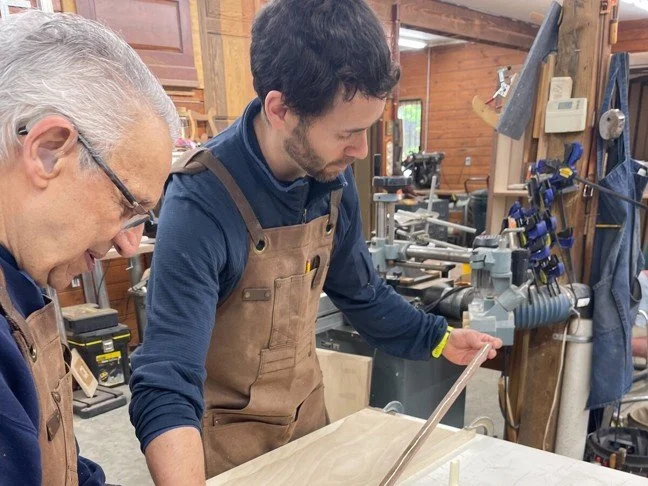
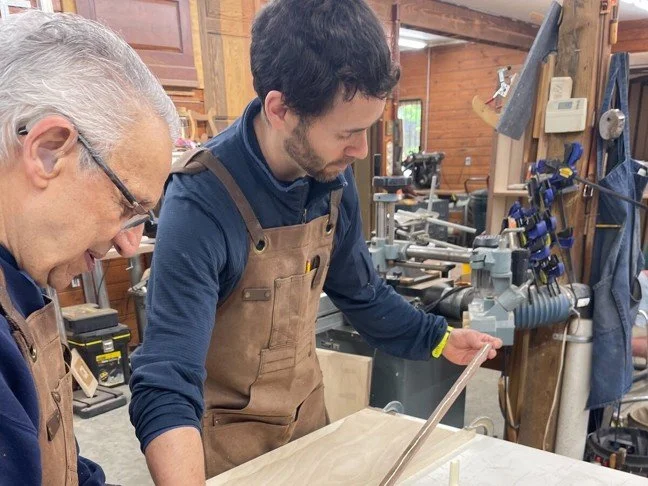
Working on a woodworking project with my friend Santo
Last week, I spent several hours in a woodworking shop with a ruler, a square, a pencil and a quarter-sheet of plywood.
We were not building anything yet.
We were thinking.
My friend and woodworking mentor, Santo, is designing a table. I was helping him develop the shape and proportions of its legs. We drew the design to scale, reconsidered the angles and erased portions that did not look right. We cut small pieces of wood to create a rough prototype, placed them on the drawing and made more adjustments.
In a world increasingly focused on speed, it might have looked like a very slow way to accomplish something.
That was precisely the point.
Learning from nearly 80 years of experience
After leaving Johnson & Johnson, one of the hobbies I took up was woodworking. Early in that journey, I was fortunate to begin learning from Santo, one of my wife's colleagues.
Santo is now in his mid-80s and has been woodworking for close to 80 years. He began learning as a child from a neighbor who was a first-generation German immigrant and a skilled woodworker.
His professional story is equally remarkable.
Santo retired from his career as a pathologist while in his 60s. After a few years, he returned to the hospital system to work with its medical school. Teaching has always been one of his passions, and more than 20 years later, he is still doing it.
His second career has lasted two decades.
Let that sink in.
He has found work that he enjoys, continues sharing what he knows and remains curious, active and engaged. I have been fortunate to become one of his many students - not in pathology, but in woodworking.
Thinking fast has its place
Our morning in the workshop reminded me of Daniel Kahneman's book, Thinking, Fast and Slow.
There are many situations in which speed is incredibly valuable. Technology can perform calculations, organize information and compare alternatives faster than ever. Artificial intelligence can produce in seconds what might previously have taken hours.
I use these tools, and I appreciate what they allow us to accomplish.
But speed is not always the objective.
Some parts of a process require us to slow down, think carefully and understand what we are trying to build. If we move too quickly during that stage, technology may simply help us arrive at the wrong destination faster.
Santo could have started cutting the actual table legs immediately. That would have felt like progress. But if the proportions were wrong or the angles did not fit the table, we could have wasted valuable wood and spent even more time correcting the mistake.
The hours we spent with the plywood were not delaying the work.
They were part of the work.
Financial planning also needs a slow stage
I see an important parallel with comprehensive financial planning.
When someone first meets with a financial planner, there is a natural desire to get to the answers:
Can I retire?
Am I saving enough?
How should I invest?
Should I pay down my mortgage?
Can I afford to help my children?
Those are important questions. Financial-planning technology can help us model different possibilities and evaluate tradeoffs.
But before building the plan, the planner needs to understand the person whose life the plan is intended to support.
That requires a meaningful discovery process.
What does financial security mean to you?
What experiences shaped your relationship with money?
What are you afraid might happen?
What are you hoping money will allow you to do?
Which goals are truly yours, and which ones do you feel you are supposed to pursue?
How do you and your spouse think differently about money?
These questions cannot be answered by uploading an investment statement or entering numbers into financial-planning software.
Without that understanding, it is possible to create a plan that is mathematically impressive but personally wrong.
A planner might recommend saving more to someone who has already accumulated enough but remains afraid to enjoy it. The numbers might indicate that someone can retire, while overlooking how much purpose and connection that person receives from working. A strategy might reduce taxes but also eliminate flexibility that is more important to the client.
It would be like cutting a beautiful set of table legs before deciding what kind of table we are building.
Technology should support the decision
The choice is not between technology and human judgment. We need both.
Once Santo was satisfied with the design, modern tools could help us cut the pieces more accurately and efficiently. But the tools did not decide what the table should look like.
Financial-planning technology works the same way. It can calculate, organize and model. It can help a planner evaluate alternatives that would be difficult to compare manually.
But it cannot independently understand why leaving money to your children matters to you - or why someone who appears financially secure still feels uncomfortable spending.
Technology can help us build the plan faster.
It cannot decide what kind of life the plan is supposed to support.
Measure Twice and Cut Once
Woodworkers often say, "Measure twice, cut once."
Santo's process goes further than that. Before measuring the final pieces, he wants to be confident that he has designed the right piece in the first place.
A comprehensive financial plan should begin the same way.
Before calculating, listen.
Before optimizing, understand.
Before recommending, ask the questions that reveal what truly matters.
Slowing down at the beginning is part of the work. Without first understanding the client’s questions, priorities and tradeoffs, it is possible to build a technically sound solution to the wrong problem.
Our morning with the plywood did not produce a finished table leg.
It produced something more important: confidence that, when we finally begin cutting the wood, we will be building the right one.
Reference
Daniel Kahneman, Thinking, Fast and Slow, Farrar, Straus and Giroux, 2011.
Investment advisory services are offered through Fiduciary Financial Advisors, an SEC registered investment adviser. Registration with the SEC or a state securities authority does not imply a particular level of skill or training. This material is provided for general informational and educational purposes only and does not constitute personalized investment, tax or legal advice. Views expressed are current as of the date of publication and may change without notice. Market, economic and other information may be obtained from sources believed to be reliable; however, Fiduciary Financial Advisors does not guarantee its accuracy or completeness. Investing involves risk, including loss of principal. Past performance does not guarantee future results.
Financial Planning Insights
I enjoy exploring how financial decisions connect to the bigger picture—our careers, families, time, and the lives we want to build. Here are some of my recent articles on investing, financial planning, and making thoughtful trade-offs.