
Cruisin' or Bruisin'? Why I'm Pumping the Brakes on an Electric Whip...for now
To Buy or Not to Buy an Electric Vehicle
If you're here due to the catchy title, a big shout-out to Chat GPT for helping me craft it. Electric vehicles (EVs) have stolen the spotlight in recent years, with increasing popularity, advancing technology, extended range, and expanding infrastructure. While the perks of owning an EV have grown, let me share why I'm holding off on buying one for now.
The Charging Conundrum
Charging a vehicle differs from a quick gas fill-up. Though I have an attached garage for convenient overnight charging, Michigan needs more charging stations for me to feel at ease. I prefer a quick stop for gas; waiting 30 minutes for a full charge doesn't align with my lifestyle. As a single, one-car family, my decision becomes more nuanced. With two vehicles, an EV for local trips and a gas-powered one for longer journeys might be a consideration.
Solid-State Battery Technology on the Horizon
Current EVs boast a range of 200-400 miles, but Toyota's upcoming solid-state battery tech, expected by 2028, promises a staggering 745-mile range. While 200-400 miles may seem like a lot, weather conditions can significantly impact the range of EVs. Consumer Reports notes that cold weather can sap 25% of the range, and warm weather can sap 31%. (Source: Consumer Reports; link below)
Living in Michigan, where winters are harsh, a 25% drop would mean a range of only 150-300 miles. With future solid-state battery technology, a 25% decrease would still offer a substantial 559-mile range. The new technology is expected to improve performance in cold/warm temperatures and have faster charging capabilities.
Financial Implications
As a financial advisor, numbers matter. In July 2023, the average price of a new EV was $53,469, compared to $48,334 for a gas-powered vehicle. (Source: Kelley Blue Book; link below) The $5,135 difference could cover a lot of gas at $3.00/gallon—1,712 gallons, to be precise. Factoring in electricity costs, the payoff might not kick in until after 4.28 years, assuming you currently drive 10,000 miles a year at 25mpg.
Anticipating a potential drop in used EV prices when the new solid-state battery technology arrives, concerns arise about the long-term value of today's EVs. Battery replacement costs and additional tire wear are also negative factors; the absence of an engine, no oil changes, and fewer moving parts are positives when comparing EVs to traditional vehicles.
Reliability

Reliability is a crucial factor when I am choosing a vehicle. According to Consumer Reports, EVs have shown 79% more problems than gas vehicles, while plug-in hybrids have 146% more issues.
In contrast, hybrids have had 26% fewer problems than gas vehicles over the last three model years. (Source: Consumer Reports; link below) Better reliability gives me hope for less time and money getting things fixed in the future.
Hybrid Appeal
I currently drive a hybrid with an impressive 45-50 mpg, I find it to be the sweet spot between EVs and traditional gas vehicles. Slightly pricier than gas-powered vehicles, hybrids offer superior gas mileage, fewer gas station visits, better reliability, and no range anxiety. Their smaller, lighter, and less expensive batteries add to their appeal.
While EVs have made strides, a massive leap forward is anticipated in the next four years. From a financial perspective, sticking to a regular or hybrid vehicle for now, and re-evaluating the EV landscape when the new battery technology becomes available seems like a sensible choice.
References:
Consumer Reports https://www.consumerreports.org/cars/hybrids-evs/how-much-do-cold-temperatures-affect-an-evs-driving-range-a5751769461/
Kelley Blue Book https://www.kbb.com/car-advice/how-much-electric-car-cost/#:~:text=According%20to%20data%20from%20Cox,gas%2Dpowered%20vehicles%20at%20%2448%2C334.







Fiduciary Financial Advisors, LLC is a registered investment adviser and does not give legal or tax advice. Information presented is for educational purposes only and does not intend to make an offer or solicitation for the sale or purchase of any securities. The information contained herein has been obtained from a third-party source which is believed to be reliable but is subject to correction for error. Investments involve risk and are not guaranteed. Past performance is not a guarantee or representation of future results.

Ask an Advisor: I'm Having a Baby. How Should I Financially Prepare?
Leanne Rahn had the privilege to be featured in Financial Planning.com’s “Ask an Advisor” column to talk to readers about how parents can financially prepare for a baby.
As a mama of two herself, Leanne shares her tips and tricks on how to save money, minimize taxes along the way, her favorite child savings vehicles, and more. Check out the post below!








Invest Like a Sales Professional
Investing is confusing for many people. You are stuck trying to find the best strategies and performance, while still minimizing risk. On top of finding a strategy that is in line with your situation and goals, you have to be willing to ride the rollercoaster that is the stock market. If you work in sales, you have the added complexity of managing your variable income. Everyone has their opinions, but I firmly believe that there’s more than one way to achieve your financial goals. In this article, I aim to offer some principles that can simplify investing for sales professionals.
Employer Match
Many employers offer a contribution matching program, and taking advantage of it can feel like getting free money. For this reason, it is likely to be the first step in maximizing your investments. Nowadays, many plans even provide a Roth option, which can be a great perk to take advantage of. The employer contribution will be pre-tax, so putting your contribution into the Roth bucket allows for tax-free growth of your retirement assets. If you find yourself in a high-income position, make sure to keep your contribution below the annual limit, so that you can invest any additional money outside of your employer plan. The current employee contribution 401k limit for 2024 is $23,000 with a catch-up contribution of $1,000 if you are 50 or older, although the limit can change annually.
Tiered Approach
Once you’ve maximized the employer match, you should have a strategy for your next investment contributions. Your next step is likely to maximize your Roth or traditional IRA contributions. If you still have funds you want to invest, then this is where your options expand, depending on your financial goals and risk tolerance. Whether you plan to fund a taxable account or invest in real estate, this is the time to do it. There is no one-size-fits-all approach, so I highly recommend consulting a professional to walk you through the pros and cons of each option and help you find an approach that is aligned with your goal. One way to keep track of your tiered approach would be to follow the method I outlined in “End-of-Year Financial Checklist: 7 Steps for a solid Financial Plan”. This allows you to automate your plan and ensure everything is in order towards year-end.
Dollar Cost Averaging or Lump Sum
Most individuals enjoy the consistency that accompanies dollar cost averaging (DCA). This is an excellent approach for someone with a consistent income. During my time in sales, my income was never truly “consistent”, and I find that to be the case across the board for most sales professionals. Let me also be clear that the approach you should take is the one you will stick to. Research has shown that lump sum investing can be superior to DCA due to the time in the market, but DCA is still very effective and useful for risk-averse investors. Working in a heavily commissioned role will often result in using a lump-sum approach, and it is important to not shy away from it. Nobody has a crystal ball when it comes to the stock market and can know the best day to invest. With that being said, you are typically better off letting your money start working for you as soon as possible.
Tax Considerations
Tax-efficient strategies should be a key element of every sales professional's investment strategy. This could involve using a Roth IRA, doing backdoor Roth conversations, or tax loss harvesting. While being tax-conscious, you will still want to maximize investment performance. This is truly a balance and should be considered when deciding on an investment strategy. I recommend working closely with a certified public account (CPA) who works in tax preparation and can give advice on your tax efficiency.
While many investing principles are synonymous with most individuals, these are a few strategies to keep in mind for sales professionals who often have high, fluctuating incomes. These guidelines are intended to provide clarity to investing. If you want specific advice on investment strategies, consult a financial advisor that is willing to take your entire financial picture into account, and help you find an approach that is in your best interest.


References
https://www.irs.gov/newsroom/401k-limit-increases-to-22500-for-2023-ira-limit-rises-to-6500
Fiduciary Financial Advisors, LLC is a registered investment adviser and does not give legal or tax advice. Information presented is for educational purposes only and does not intend to make an offer or solicitation for the sale or purchase of any securities. The information contained herein has been obtained from a third party source which is believed to be reliable but is subject to correction for error. Investments involve risk and are not guaranteed. Past performance is not a guarantee or representation of future results.
2024 Financial Outlook
Dive into the financial landscape of 2024 with this comprehensive guide. From economic stability to tax changes, our guide provides strategic insights. Navigate the evolving landscape with confidence and stay ahead in your financial journey.

2024 Financial Outlook
As we embark on the new year, hopefully, your financial journey will take center stage. Here's a quick overview of what awaits you in 2024:
Economic Outlook

Domestically, we're not anticipating a full-blown economic recession, but certain sectors may face challenges. Globally, Europe and Asia might experience some bumps, but most economies should end the year strong.
Election Concerns
With more than half the global population in an election cycle, there's a concern about regulatory uncertainty. Companies are likely to address this in their earnings calls, impacting sales and expense forecasts as well as supply chain predictions.
Optimizing Your Investment Strategy with ETFs
Exchange-Traded Funds (ETFs) offer an efficient way to manage core portfolio positions. By minimizing fees and potentially offering superior returns compared to mutual funds, they present an attractive option. Additionally, they enable capturing returns from more aggressive, smaller positions as the opportunities present themselves to capture additional returns.
Fixed Income ≠ Fixed Position
Quality of credit continues to be a focal point in selection, especially amidst decade-long highs in interest rates. Adjustments in portfolio duration for domestic holdings are likely as a response to potential rate changes from the Federal Reserve. Additionally, cooling inflation will yield positive effects on fixed-income positions within portfolios.
Exploring Alternative Investments
The pool of appealing alternative investments is narrowing down, emphasizing quality within this sleeve of a portfolio. These opportunities are best used as a counterbalance to market volatility and risk. However, it's essential to note that the inclusion of such investments should be case-specific, not a general recommendation as is the case with most investment strategies.
Key 2024 Tax Changes
Expect inflation adjustments impacting various tax aspects:
Marginal tax brackets for different income categories.
Increased contribution limits for retirement plans and Health Savings Accounts (HSAs).
Changes in gift and estate tax thresholds.
Notable provisions from the SECURE 2.0 Act, including Roth accounts in 401(k) plans and Qualified Charitable Distributions.
Social Security Withdrawal Do-Over
If you regret claiming Social Security early and are receiving reduced benefits, the Social Security Administration offers options. Within 12 months of your application, you can withdraw your benefits application, though repayment could be substantial. You can also suspend your benefits up to age 70 to receive additional credits. Just be aware that while you will be able to receive more income when you do start back up, it will still not be the maximum amount you would have received if you never started receiving benefits in the first place.
If you would like to speak further on any of these topics, or any other financial concerns you have, let’s schedule a time to chat.
Fiduciary Financial Advisors, LLC is a registered investment adviser and does not give legal or tax advice. Information presented is for educational purposes only and does not intend to make an offer or solicitation for the sale or purchase of any securities. The information contained herein has been obtained from a third-party source which is believed to be reliable but is subject to correction for error. Investments involve risk and are not guaranteed. Past performance is not a guarantee or representation of future results.

How to Budget on a Sales Income
How can I budget when my income is variable? If you’ve asked yourself this question, you are in good company. Most sales professionals experience the challenge of figuring out how to plan for their fluctuating income. Let’s walk through tips on the basics of budgeting off of a variable income.
I’ve had the joy of working in sales and experiencing this firsthand, and now working with sales professionals as their financial advisor. Variable income will present itself in one of two ways; employees will be compensated with full commission on sales or a mixture of base salary plus commission. These principles will pertain to both individuals, with an added emphasis on those with fully commissioned roles.
Step 1: Estimate Minimum Expenses
Start by listing your monthly expenses, distinguishing between necessary and discretionary expenses. Necessary expenses would include housing, utilities, insurance, food (groceries, not eating out), and transportation. You can do this on paper, excel, or through an app. This will give you a budget that is broken down by normal expenses and bare minimum expenses. Understanding your bare minimum expenses is crucial when developing a safety net.
Step 2: Establish Safety Net
This amount will be different for everyone but ultimately is based on the security of your job, income, and lifestyle. If you feel like you have a very secure job and a lower-cost lifestyle, you could stretch this amount to a low end of 3-4 months' worth of expenses. If your job is highly competitive and your company has been known to frequently replace underperformers, it might be a good idea to have closer to 6 months' worth of expenses.
The other piece of this safety net revolves around how easily you can find another job, should you leave or be let go from your current role. If you have confidence in your ability to get a new job within a month, then we can stretch to the lower end. If you work in a specialty sales market with a longer timeline to hire. I always recommend that you take whatever you think makes sense for your current situation and add a 1-2 month buffer. This safety net is in place so that you have options in case of job loss.
Step 3: How to Budget
You should have already created a complete budget in step one. If not, add the rest of your non-essential expenses to your bare minimum budget. This is what you can plan to live off of once your safety net is established. If you have a base salary as part of your compensation structure, I recommend making sure your salary covers your entire budget. This way you won’t depend on sales commissions and will have massive financial flexibility.
This can be a bit more challenging if you’re someone who is in a 100% commission role. First things first, I would attempt to have a 6-9 month safety net. Sales can be a rollercoaster of a profession, and the compensation tends to follow. Even if it rarely comes, you need to be prepared for the worst-case scenario. To create a budget off an entirely fluctuating income can be done in two ways. The first way is to take your previous year's income and budget off of that. This can be a useful strategy, especially if your previous year was more of an “average” year. The method I prefer to use is based on forecasting. To do this, you need to have a good understanding of your company's payout structure and project forecast. Take your projected sales target and assume you will hit exactly 100%, or 90% if you want to be conservative. Multiply the amount of sales by your commission percentage to get your yearly income, and don't forget to take taxes off of that number. Either way, it's crucial to add some extra room when making these estimations.

Step 4: How to Manage When You Get Off Track
While I wouldn’t wish this on anyone, I understand that volatility of sales doesn’t play favorites. On the rare occasion that you hit a major dry spell with your commission, don't panic and remember the safety net you established. Although it can be challenging, temporarily reducing your expenses to cover only the essentials might be necessary. This will ideally be a short-term adjustment, and that is why it is important to have your bare minimum budget.
Balancing a variable sales income can be challenging as every year is different. However, utilizing this approach will provide the necessary safeguards to protect you and your family. Along with financial protection, implementing these suggestions will come with a level of stress reduction that can often be associated with a fluctuating income.
Fiduciary Financial Advisors, LLC is a registered investment adviser and does not give legal or tax advice. Information presented is for educational purposes only and does not intend to make an offer or solicitation for the sale or purchase of any securities. The information contained herein has been obtained from a third party source which is believed to be reliable but is subject to correction for error. Investments involve risk and are not guaranteed. Past performance is not a guarantee or representation of future results.
YahooFinance Feature: 13 Key Signs You’ll Always Be Middle Class
Ben Lex recently got a shout-out in a Yahoo! Finance article titled “13 Key Signs You’ll Always Be Middle Class”.
In it, he dives into the major signals holding people back from growing their wealth. Check out Ben’s insights - they’re golden nuggets for leveling up financially.

A Beginner’s Guide to Investing
If you’ve ever felt that the world of investing is confusing and intimidating, you’re not alone. There is a lot of information, but it can be a challenge to know where to start. Let’s explore the steps necessary to begin investing, simplify your approach, and figure out what is going to work for you.
Investor Types
There are three main types of investors. The first is someone who prefers to be hands-off and hires an advisor to manage their entire financial picture, like a personal CFO. The second person likes to take the DIY approach to financial management. The third individual falls somewhere in between, opting to hire a financial advisor for their investment management while staying informed on the strategy and approach being used. Each of these approaches has its pros and cons, but it is important to know that all can be effective at different times.
Establish an Emergency Fund
Regardless of your approach, before you start investing, it is wise to establish an emergency fund that will protect you and your family in case of… well, an emergency! Having this fund in place will allow you to start investing and stay consistent, even if you have major expenses arise. Once your emergency fund is established, you can sort out the remaining information needed to begin investing.
Goals and Risk
The first step to investing is to understand your individual goals and risk tolerance. This is entirely custom to your financial situation, so it is important to not take a blanket approach. Examples of financial goals might include saving for your child’s college education, retirement planning, or vacation. Each of these goals will come with its own timeline and risk tolerance. It is important to select accounts that will line up with your savings goals. For instance, if you are saving for a college education, you might choose to invest in a 529 plan since it is an education-specific account.
Once the account is established, you can determine the timeline of your investment, and what risk you are willing to absorb. You will often see longer investments placed into a more aggressive allocation because you have more time to absorb the fluctuations of the stock market. If your timeline is short, however, you may prefer to use a more conservative investment approach. It is important to continually adjust your risk tolerance over time, and if you are not confident in your ability to manage this, don’t hesitate to seek out a professional.
Investment Capacity
In this example, we will assume that you are already contributing to an employer plan to get the employee match, which can often be a great starting point for investing. Beyond that, you have to decide how much money you are willing to invest consistently, based on your current budget. I discuss this in my post, “Mastering Your Money: Budgeting Essentials and When You Need Them”. I am a fan of incorporating investment contributions into your monthly budget if possible, and automating those contributions. This eliminates the concern of “timing the market” and allows you to take advantage of time in the market.
Pick a Strategy
Now that you have your emergency fund, established goals, risk tolerance, and your investment capacity, you can now decide on your approach to investing. For the DIY investor, it is important to do your research and find a strategy that has historically performed consistently well. This is not the time to dump all your money into the newest investing “fad”. Find a good balance of investments that aligns with your goals and risk tolerance. The balance that you want to see here is called diversification. This means that you are intentional in picking funds that give you broad exposure to the stock market, as opposed to putting all of your eggs in one basket.
If the thought of picking investments, or even doing the research is intimidating, it might be time to seek out a certified investment advisor who can help guide you through everything I’ve outlined here. When doing so, make sure to find a fiduciary advisor who is not going to make commissions on your investment selection.
Stay the Course
The final piece, and perhaps the most important is to stay the course. Investing is a long-term play that will have fluctuations over time. Some people handle this fluctuation better than others. If you struggle with the fluidity of the market, try not to view investments on a weekly or monthly basis, but on a yearly basis or longer. As we saw in the graph above, avoiding the market is not the answer.
Keep in mind that there is no one-size-fits-all approach to investing, and what worked for someone may not be what is best for you. Have confidence in your approach, and stay the course.

Fiduciary Financial Advisors, LLC is a registered investment adviser and does not give legal or tax advice. Information presented is for educational purposes only and does not intend to make an offer or solicitation for the sale or purchase of any securities. The information contained herein has been obtained from a third party source which is believed to be reliable but is subject to correction for error. Investments involve risk and are not guaranteed. Past performance is not a guarantee or representation of future results.
Mastering Your Money: Budgeting Essentials and When You Need Them
The findings of a recent survey done by The Harris Poll found that 74% of Americans have a monthly budget. It’s a significant number, and one might assume that budgeting is the key to financial well-being. However, it raises questions about why consumer debt remains on the rise despite so many people budgeting. It’s a fair question to ask. Let’s explore the purpose of a budget, how to create it, and find out if everyone should be following one.
Why Budget?
A budget is a strategic plan to evaluate your income and expenses. People create budgets for various reasons, but they all boil down to effective money management. You might be saving for a vacation, working to pay off debt, or hoping to gain a better understanding of where your money is going. All of these are great outcomes we see from budgeting, and easier said than done. If we had to boil it down to one main reason, I’d say that you work too hard for your money to be unintentional with where your money goes.
How to Budget?
Budgeting can take shape in multiple ways, and there are a few steps to take regardless of your preferred method.
Collect your spending and income: Ideally, your income would exceed your spending. If this is not the case, now is the time to find areas where you can cut expenses to make sure you are living within your means. You can create your budget in a spreadsheet where you are in charge of tracking each expense or utilize an app that tracks everything for you.
Include goals: Once you have a good handle on your baseline budget, integrate any goals you have such as debt pay down, saving for large expenses, or retirement.
Track and Adjust: Your budget should be fluid, and will likely change every month. Give yourself the flexibility to make these changes as unforeseen expenses arise.
Stay Consistent: The true benefit of budgeting comes when you stay consistent over the long haul. Find an approach that suits you, and stick with it. As one goal is accomplished, start on your next one.
Do I Need to Budget?
While the benefits of budgeting are evident, not everyone will choose to implement one. If you're not going to budget, at the very least, consider tracking your income, expenses, and investments every month. For your financial health, it is necessary to know that your income is more than your expenses and that you are investing in your retirement.
Final Thoughts
In the second quarter of 2023, we saw credit card balances grow by $45 billion, consumer loans increased by $15 billion, and auto loans by $20 billion according to the Center for Microeconomic Data. The persistently growing consumer debt underscores the importance of budgeting for each household. While implementing a budget may not lead to overnight transformation, it can set you on a path to a better financial future and provide increased peace of mind.
References:
https://www.bls.gov/news.release/cesan.nr0.htm
https://www.bankrate.com/banking/create-a-home-budget/
https://www.newyorkfed.org/microeconomics/hhdc.html
OpenAI. (2023). ChatGPT [Large language model]. https://chat.openai.com

Fiduciary Financial Advisors, LLC is a registered investment adviser and does not give legal or tax advice. Information presented is for educational purposes only and does not intend to make an offer or solicitation for the sale or purchase of any securities. The information contained herein has been obtained from a third party source which is believed to be reliable but is subject to correction for error. Investments involve risk and are not guaranteed. Past performance is not a guarantee or representation of future results.
End-of-Year Financial Checklist: 7 Steps for a Solid Financial Plan
To enhance your financial situation, consider doing an end-of-year financial review. This doesn’t need to be a complex or time-consuming process, but it can set you up for success in the next year. Here are 7 steps to help guide you through your end-of-year review, and gain confidence in your financial plan.
1. Review Your Budget and Spending
Begin by assessing your spending habits. If you don’t currently use a budget, I would look at your expenses and make your best guess at creating one for the coming year. If you’re already dedicated to your budget, this is the time to figure out what worked well, and what needs to be changed. Think about these questions as you forecast for the next year.
Is my income going to remain the same?
Do I need to be more strict in one area, or loosen up in another?
What large expenses am I anticipating in the coming year that I can plan for?
Am I saving and investing enough of my income?
Remember that your budget should be a fluid tool to ensure you know where your money is going.
2. Prepare for Tax Time
Much of your tax planning will have to wait until next year, but it can be helpful to get a few items in order before tax season. You can collect business expenses, charitable giving receipts, childcare expenses, and other tax-deductible items.
The final piece of preparation for tax season would be to decide how you plan to prepare your taxes. You might do it yourself or prefer to hire it out. There is no wrong way to go about it, but now is the time to reach out and find a good CPA that you can work with to optimize your tax situation.
3. Max out your Contributions
The end of the year is the ideal time to review the contributions you have made to your retirement accounts. While doing this it’s important to know the maximum limits you can contribute to each account. When dealing with retirement accounts, we are typically talking about an employer-sponsored plan such as a 401k, 403b, and 457; or a brokerage account such as a traditional or Roth IRA. The employer plan limits for the year 2023 are $22,500 for employee contributions. It is important to note that this does not include the employer match. On top of this, if you are 50 years or older, you qualify for what is called a “catch-up” contribution that allows you to contribute another $7,500, bringing your total to $30,000 max for the year. The IRA options max out at $6,500, with a $1,000 catch-up contribution if you are 50 and older. Even if you can’t max out these contributions, adding to a Roth IRA can still benefit your financial future.
4. Review Investments
If you work with a financial advisor, now is the time to reach out and see if you can sit down with them for a year-end review meeting.
If you are a DIY investor this is still a great time to reconfirm your approach, assess performance, and rebalance your portfolio. It may be time to consider working with an advisor, if so, opt to find a fiduciary advisor who has your best interest in mind.
5. Consider a Roth Conversion
Roth conversions are done by transferring pre-tax dollars into a Roth account which will then grow tax-free. This approach can be great for someone nearing retirement who has a large amount of their wealth in pre-tax accounts. It can also be beneficial for young professionals with plenty of time for the investment to grow. This does not make sense for everyone, so consult a financial professional to weigh the pros and cons of this option.
6. Open Enrollment
Open enrollment occurs at different times of the year and is dictated by your employer. It is most commonly presented around early November and allows you to review or change your employee benefits options.
This is a good time to ensure you’re getting the best value on your insurance plans. You may even find that you qualify for additional plans such as term life insurance or disability coverage at little to no cost to you and your spouse.
7. Confirm Beneficiaries
While this is not something that changes often, it is necessary to make sure that they are up to date. Here are some accounts that should have a beneficiary associated with them.
Retirement accounts (401k, 403b, 457, and IRAs)
Investment Accounts
Bank Accounts
Life Insurance Policies
Having beneficiaries properly assigned can help you have peace of mind that your loved ones will be taken care of.
Walking through this checklist can give you a clear picture of your current financial situation, and set you up for success in the coming year.

Fiduciary Financial Advisors, LLC is a registered investment adviser and does not give legal or tax advice. Information presented is for educational purposes only and does not intend to make an offer or solicitation for the sale or purchase of any securities. The information contained herein has been obtained from a third party source which is believed to be reliable but is subject to correction for error. Investments involve risk and are not guaranteed. Past performance is not a guarantee or representation of future results.

Maximizing Tax-Smart Charitable Giving: 4 Strategies to Consider
If you are passionate about supporting your favorite charities while optimizing your tax liabilities, this blog post is tailored for you. We will explore four tax-smart strategies that could help you maximize your charitable giving. It's essential to consult your tax professional before implementing these strategies, as everyone's financial situation is unique.
1. Bunching Your Contributions
The standard deduction for 2023 varies depending on your filing status: $13,850 for Single Filers, $27,700 for Married, and $20,800 for Head of Household. To benefit from itemizing your tax return, your total deductions should exceed the standard deduction. Otherwise, choosing the standard deduction might be more straightforward.
For example, if you are married and plan to donate $15,000 annually to your preferred charity, and your standard deduction is $27,700, donating $15,000 alone wouldn't surpass the standard deduction. In this case, opting for the standard deduction makes more sense.
However, consider an alternative approach: accumulate $15,000 in year 1, year 2, and year 3, totaling $45,000. During the first two years, take the standard deduction, and in year 3 donate the $45,000 and itemize your tax return to deduct the charitable donations. This three-year "bunching" strategy could help minimize your overall tax burden.
"In general, contributions to charitable organizations may be deducted up to 50 percent of adjusted gross income…" (Source: IRS; link below)
2. Using a Donor Advised Fund (DAF)
A Donor Advised Fund (DAF) is a specialized account designed for charitable donations. When you make an irrevocable donation to a DAF, you become eligible for a tax deduction in that year. The funds in the account can be invested and directed to specific charities in the future.
You can combine the bunching strategy with a DAF, which can be especially useful if you donate to multiple charities. It simplifies tax recordkeeping and may be appreciated by your CPA.
3. Giving Appreciated Investments Instead of Cash
Donating appreciated investments from a taxable brokerage account directly to a charity can be advantageous. When you sell an investment in such an account, you typically incur capital gains taxes. However, donating the investment directly to a charity may allow you to avoid capital gains tax. Ensure you've held the investment for at least one year to qualify for long-term capital gains treatment and claim the deduction if itemizing. (Source: Fidelity; link below)
The cash you initially intended to donate can be used to repurchase the investments, effectively resetting your cost basis. This can lead to lower capital gains when you eventually sell the investments, resulting in reduced future tax obligations.
4. Qualified Charitable Distribution (QCD)
As you approach retirement, you'll be required to take Required Minimum Distributions (RMDs) from your traditional retirement accounts, typically starting between 70.5 and 75 years old, depending on your birth year.
If you wish to allocate some or all of your RMDs to charity to avoid paying taxes on them, consider a Qualified Charitable Distribution (QCD). You can direct your RMD to your chosen charity, provided it's the first withdrawal of the year. This strategy is beneficial if you are already planning on being charitable while facing RMD requirements.
Utilizing these strategies for charitable giving can significantly reduce your tax liability. Supporting charitable causes is admirable, and doing so while optimizing your tax situation is even better.

Jurgen Longnecker
Action Tax & Accounting, PC 616.422.3297 actiontaxandaccounting.com
I'd like to extend my thanks to Jurgen Longnecker for his contributions to this blog post. Having insights from a CPA regarding charitable contributions and taxes is always incredibly valuable.
References:
https://www.fidelity.com/viewpoints/personal-finance/charitable-tax-strategies


Fiduciary Financial Advisors, LLC is a registered investment adviser and does not give legal or tax advice. Information presented is for educational purposes only and does not intend to make an offer or solicitation for the sale or purchase of any securities. The information contained herein has been obtained from a third party source which is believed to be reliable but is subject to correction for error. Investments involve risk and are not guaranteed. Past performance is not a guarantee or representation of future results.

SavvyMoney Feature: 6 Tips For Teaching Your Kids to Save
Leanne Rahn had the privilege to be featured in SavvyMoney to talk to readers about “6 Tips For Teaching Your Kids to Save”.
Leanne shares tangible tips and steps parents can implement to create a positive environment around money for their littles.


Fiduciary Financial Advisors, LLC is a registered investment adviser. Information presented is for educational purposes only and does not intend to make an offer or solicitation for the sale or purchase of any securities. Investments involve risk and are not guaranteed. Be sure to consult with a qualified financial adviser and/or tax professional before implementing any strategy discussed herein.


MoneyGeek Feature: Women’s Guide to Making Financial Moves After College
Leanne Rahn had the privilege to be featured in MoneyGeek to talk to readers about “Women’s Guide to Making Financial Moves After College”.
Leanne discusses challenges women face as they begin their financial journey after college and what they can do to set themselves up for a fruitful financial life.


Fiduciary Financial Advisors, LLC is a registered investment adviser. Information presented is for educational purposes only and does not intend to make an offer or solicitation for the sale or purchase of any securities. Investments involve risk and are not guaranteed. Be sure to consult with a qualified financial adviser and/or tax professional before implementing any strategy discussed herein.


Is a Financial Advisor Worth It?
If you have extra time, are interested in finances, and are willing to research the actions needed to become successful financially; then you might not need a financial advisor. There are a lot of great free resources available if you are willing and able to put in the time and effort. That being said, there are also many reasons why you might choose to work with a financial advisor.
You might:
Be too busy with work/life to complete research on your own
Deal with analysis paralysis and need some guidance on how or where to invest
Get nervous during periods of market volatility and need someone to give you reassurance and prevent you from making an emotional investing decision that could cost you a lot of money
Need someone to help keep you accountable and consistent with investing
Not be interested in finances/investing and would rather pay someone to help so you can spend more time on things that you enjoy
Whether you are currently working with a financial advisor or looking to work with a financial advisor, here is a review of some ways financial advisors could add value to your investing plan according to Vanguard. If you do not need/want a financial advisor you may still want to focus on these areas as you manage your own financial plan. (Source: Vanguard Advisor’s Alpha; link below)
Value a Financial Advisor Could Bring
As I review the seven modules that Vanguard presents, please keep these quotes from the paper in mind.
“Paying a fee to a professional who follows Vanguard’s Advisor’s Alpha Framework described here can add value in comparison to the average investor experience, currently advised or not. We are in no way suggesting that every advisor—charging any fee—can add value. Advisors can add value if they understand how they can best help Investors.”
“We do not believe this potential 3% improvement can be expected annually; rather, it is likely to be very irregular.”
“Some of the best opportunities to add value occur during periods of market duress or euphoria when clients are tempted to abandon their well-thought-out investment plans.”

1. Suitable Asset Allocation Using Broadly Diversified Funds/ETFs Value: >0.00%
Asset allocation is the percentage of investments you have in stocks, bonds, cash, and alternative investments. Factors to help determine your asset allocation are your risk tolerance, risk capacity, and the goals you have for that particular sum of money. Having the right mix of investments for your specific situation and goals is very important. Vanguard found this value add to be significant but stated it was too unique to quantify.
2. Cost-Effective Implementation (expense ratios) Value: 0.30%
After determining your asset allocation, the next step would be to decide what investments to invest in. One thing that you have a lot of control over is how much you pay to be invested in the stock market. The difference between the returns you achieve and the cost you pay is your net return. Vanguard recommends keeping your expense ratios low, and I agree. A high expense ratio for a fund could be greater than 1% whereas a low-cost index fund could be as low as 0.04%. Vanguard found this value add to be 0.30%.
3. Rebalancing Value: 0.14%
Your asset allocation can drift over time. Let’s say you originally invested 80% in stocks and 20% in bonds. One year later if stocks perform better than bonds, you might now be 90% stocks and 10% bonds. If you want to control your risk and stick within your risk tolerance, then rebalancing back to the original 80% stocks and 20% bonds may make sense for you. Rebalancing can also help you buy low and sell high. It forces you to buy the investment that underperformed and sell the investment that overperformed. This is easier said than done. If you had an investment that did really well, emotionally you may not want to sell some of it and buy the investment that underperformed. A financial advisor could do this automatically for you. Vanguard found this value add to be 0.14%.
4. Behavioral Coaching Value: 0.00%-2.00%
As human beings, we all have emotions. During periods of market volatility and downturns, having an advisor to help prevent you from changing your investment strategy could be very valuable. When COVID initially started, the market took a huge dive as the economy shut down. I know a few people who sold completely out of the stock market because of fear. Then when the market recovered they missed out on the huge gains that followed. They let their emotions get the best of them and ended up locking in their losses by selling. If they would have had an advisor to help them stick to a financial plan they might be in a better position today. Vanguard found this value add to be 0.00%-2.00%.
5. Asset Location Value: 0.00%-0.60%

There are three main types of accounts where you can keep invested assets: Tax-deferred accounts, Tax-free accounts, and Taxable accounts. Having the right investments inside of the correct accounts could help you pay less in taxes, which would leave more money left over for you. Here is a figure from the Bogle Heads forum which reviews which funds might be better for the three different account types. A financial advisor could help you decide which investments should be inside which accounts. Vanguard found this value add to be 0.00%-0.60%.
(Source: Bogleheads Wiki; link below)
6. Spending Strategy (withdrawal order) Value: 0.00%-1.20%

If you only have investments inside of one account type then this module wouldn’t bring any value to you. On the other hand, if you have some investments inside of a 401(k), a Roth IRA, a Health Savings Account, and a taxable brokerage account then which account you withdraw money from first could add a lot of value and help you save on taxes.
You might withdraw from your 401(k) for your required minimum distributions for that year first, then you might consider taking money out of your taxable brokerage account, after that you might decide to withdraw money from your Roth IRA, saving your HSA for later. Having money invested in different account types can allow you to adjust how much tax you pay during your retirement years. Withdrawing money in a sub-optimal order could cause you to pay more taxes! Vanguard found this value add to be 0.00%-1.20%.
(Source: Vanguard Advisor’s Alpha; link below)
7. Total Return Versus Income Investing Value: >0%
This includes helping investors decide what kind of bonds to include in their portfolio such as short-term, long-term, and high-yield. Guiding investors to not focus solely on retirement income with bonds but to also consider capital appreciation that could add value over the long term. This could also help decrease risk and increase tax efficiency. Vanguard found this value add to be significant but stated it was too unique to quantify.
So Is Having a Financial Advisor Worth It?

That is a value judgment, so only you can decide if having a financial advisor is worth it. Vanguard has shown that advisors can add up to, or exceed, 3% in net returns by following their Advisor’s Alpha framework. Over a long period that could add tremendous value to your financial plan. That’s if you are being charged reasonable fees for the services provided. This figure shows the median advisory fees based on account size.
If you want to do it on your own, make sure to do your research so that you can invest well
If you currently work with a financial advisor, make sure you what they are charging you and evaluate if they are following Vanguard’s best practices in wealth management
If you want to work with an advisor then feel free to reach out to as I would happily meet with you to explain how I would be able to help you with your financial plan
(Source: Kitces Blog; link below)
Sources: https://advisors.vanguard.com/content/dam/fas/pdfs/IARCQAA.pdf
https://www.bogleheads.org/wiki/Tax-efficient_fund_placement


Fiduciary Financial Advisors, LLC is a registered investment adviser and does not give legal or tax advice. Information presented is for educational purposes only and does not intend to make an offer or solicitation for the sale or purchase of any securities. The information contained herein has been obtained from a third party source which is believed to be reliable but is subject to correction for error. Investments involve risk and are not guaranteed. Past performance is not a guarantee or representation of future results.

MoneyGeek Feature: How to Start Saving and Investing
Leanne Rahn had the privilege to be featured in MoneyGeek to talk to readers about “How to Start Saving and Investing”.
Leanne answers the questions of how much should you invest, how you choose the best stocks and bonds, how to start investing while living paycheck to paycheck, and her take on investment apps.


Fiduciary Financial Advisors, LLC is a registered investment adviser. Information presented is for educational purposes only and does not intend to make an offer or solicitation for the sale or purchase of any securities. Investments involve risk and are not guaranteed. Be sure to consult with a qualified financial adviser and/or tax professional before implementing any strategy discussed herein.


MoneyGeek Feature: Finding the Right No Annual Fee Card
Leanne Rahn had the privilege to be featured in MoneyGeek to talk to readers about “Finding the Right No Annual Fee Card”.
Leanne discusses the pros & cons of no annual fee credit cards and what consumers should consider when paying for an annual fee credit card.


Fiduciary Financial Advisors, LLC is a registered investment adviser. Information presented is for educational purposes only and does not intend to make an offer or solicitation for the sale or purchase of any securities. Investments involve risk and are not guaranteed. Be sure to consult with a qualified financial adviser and/or tax professional before implementing any strategy discussed herein.

529 to Roth IRA Conversions Under New Cares Act 2.0 Rules
Under the Cares Act 2.0 passed in December, savings from 529 education savings accounts can now be rolled over to a Roth IRA (starting in 2024).
This is an important update for parents or grandparents saving for their children or grandchildren’s future. A major concern with 529 accounts has always been “what if my child/grandchild doesn’t end up going to college”? Previously this would have triggered income tax and a 10% penalty to distribute that unused money. Under these new rules, the balance could now be rolled over to a Roth IRA for the beneficiary of the 529 (in this example the child/grandchild).
Under the Cares Act 2.0 passed in December, savings from 529 education savings accounts can now be rolled over to a Roth IRA (starting in 2024).
This is an important update for parents or grandparents saving for their children or grandchildren’s future. A major concern with 529 accounts has always been “what if my child/grandchild doesn’t end up going to college”? Previously this would have triggered income tax and a 10% penalty to distribute that unused money. Under these new rules, the balance could now be rolled over to a Roth IRA for the beneficiary of the 529 (in this example the child/grandchild).
This new rule creates a few major opportunities for savers:
You can take advantage of 529 account tax advantages to save for a child’s future education without as much concern you may be penalized in the future.
You could use a 529 as a “stealth Roth account” for a child to get savings growing tax-free for them long before they have an income that would allow you to fund an actual Roth IRA for them. An extra 15 to 20 years of compounding gains is a powerful thing!
In the “stealth Roth account” situation you may get the dual-benefit of state income tax deductibility as a bonus (this applies for states with income tax that allow a deduction for 529 contributions and assumes they won’t tax 529 conversions which is yet to be determined).
Open a 529 account for a child immediately and fund it with $1 or $25. This gets your 15 year conversion clock going (details on this below).
If your child received grants or scholarships that cover most of their costs they can be rewarded with a head start to their retirement savings by converting their 529 balance to a Roth IRA.
If you’re fortunate enough to be able to pay for your child or grandchild’s college out of pocket without using all of their 529 account, you could choose to transfer up to $35,000 to a Roth IRA for them instead of using it for college expenses.
Because this is the US Congress and tax code they couldn’t let it be toooo simple… there are some important rules to understand:
Funds must roll to a Roth IRA for the beneficiary of the 529 plan. If the 529 beneficiary is your child, that means it must roll to a Roth IRA for your child. Quick note - changing the beneficiary of a 529 is quite easy, congress and the IRS still need to clarify whether you could get around this provision by making you or your spouse the beneficiary of the account thereby allowing you to roll the 529 funds to a Roth IRA for you or your spouse.
Funds must be moved directly from the 529 plan to the Roth IRA, you can’t take the distribution as a check from a 529 and then separately go deposit to a Roth for the beneficiary.
The 529 plan must have been maintained for 15 years or longer before funds can be rolled over to a Roth IRA. Because of this requirement, I would strongly recommend most people open a 529 for a child when they are born and fund it with the minimum amount allowed (for example $1 or $25). This “starts the clock” toward the 15 year requirement in case you ever need to use this provision in the future.
The maximum amount that can be moved from a 529 plan to a Roth IRA during an individual’s lifetime is $35,000. This means you still don’t want to “overfund” a 529 account if you’re worried the beneficiary may not end up using the money for college.
Any contributions made in the past 5 years (and the earnings on those contributions) are not eligible to be moved to a Roth IRA. This doesn’t mean you can never move those funds, you just have to wait until they’ve been in the account for 5 years until you do.
Conversions from a 529 to a Roth IRA count toward the annual contribution limit for Roth IRAs ($6,500 for 2023). So only $6,500 could be converted in one year and no “regular” Roth contributions could be made if $6,500 was converted. If only $5,000 was converted during the year for example, the beneficiary could still make $1,500 in “regular” contributions for the year. This means to convert the full $35,000 lifetime limit would likely take 5 or more years.
Income limits do NOT apply for these conversions. Even if the beneficiary is over the income limit to make “regular” Roth IRA contributions, a 529 rollover to their Roth IRA would be allowed.
The beneficiary must have earned income equal to or greater than the converted amount. For example, if you want to convert $6,000 from a 529 to a child’s Roth IRA they must have at least $6,000 in earned income. If they only have $2,000 in earned income you can only convert $2,000. These are the same rules that apply for “regular” Roth contributions. Many kinds of income can qualify including summer jobs, babysitting, etc. If in doubt, consult a tax professional.
I know, that’s a lot of fine print and may be a bit confusing! I’d strongly suggest reaching out to an advisor if you think a 529 to Roth conversion may make sense for you or if you have questions about how this may impact you. I’m always available to answer questions by phone at 616.594.6205 and email at ryan@ffadvisor.com.

3 Steps to Turbo Charge Your Health Savings Account (HSA)
One of my favorite tax strategies for college professors and others is a Health Savings Account (HSA) offered through your workplace. Read more about three steps to take full tax advantage of your HSA: 1) make maximum contributions, 2) invest in stocks and bonds, 3) delay withdrawals as long as possible.
One of my favorite tax strategies for college professors and others is to take full advantage of your Health Savings Account (HSA) offered through your workplace. These accounts are WAY BETTER at saving taxes than 401k and 403b retirement accounts. You probably know that contributions from your paycheck are tax deductible just like contributions to retirement accounts. However, unlike retirement accounts, withdrawals are tax free for qualified medical expenses. Another unique advantage of HSA contributions is that they are exempt from social security taxes. Here are three steps to increase the value of your HSA.
Step 1: Make Maximum Contributions. Many people set their annual contributions to match their annual insurance deductible. For example, your annual medical deductible might be $3,000 so you decide to contribute this amount to your HSA each year. After all, this is what you expect to pay out of pocket for healthcare. If you are lucky and healthy, you might even pay less during the year. So why save more each year? Answer, to build a healthy surplus. No pun intended 😊
Consider this example: Suppose you are married with a family income of $130,000. You choose to make the maximum contribution of $7,300 to your HSA (for 2023). The contribution is not subject to federal income tax (24%), state income tax (4%), social security tax (6.2%) or Medicare tax (1.45%). Your $7,300 contribution saves you $2,600 in taxes this year. But the story gets better!
Step 2: Invest in Stocks and Bonds. You may not realize that you can invest your HSA funds in stocks, bonds, and other investments. Your money does not have to stay in a boring savings account earning less than 1%. These investments will likely provide a better return over many years. Granted, you are restricted to the specific investment options available through your workplace, but it is worthwhile knowing your options.
Step 3: Delay HSA Withdrawals. The final step to really take advantage of tax-free growth is to keep these funds invested for as long as possible. Pay healthcare expenses out of pocket each year, if possible, and let your HSA account continue to grow. Think of your HSA to be a retirement account for healthcare that you let grow until age 65.
Consider the example of a married couple in their 40s who contribute $7,300 each year and invest the account in a conservative portfolio of index funds and exchange traded funds (ETF) that could earn 7% per year. The account would grow to almost $300,000 after 20 years. These funds are then withdrawn completely tax free to pay qualified healthcare expenses during your retirement years. Yes, this is a best-case scenario that will be difficult to achieve but the approach yields benefits even with less rosy assumptions. For example, you may still have a tidy $150,000 for healthcare during retirement by saving half of the maximum contribution each year.
Your Homework: As a college professor, my natural inclination is to assign homework to ensure students take positive actions. So here is your homework! Review your HSA investment options and consider increasing your annual contribution to the maximum. When possible, pay for healthcare out of pocket and let the HSA account continue to grow tax free. Consider your HSA as a retirement account for healthcare. You will have plenty of healthcare expenses later in life so why not start saving now?
I have been a college professor for almost 30 years and now I teach other professors how to graduate from academic freedom to financial freedom. Sure, investments are important. But it is just as important to minimize taxes, moderate personal debt, live below your means and use insurance wisely to prepare for the unexpected. Review my approach to financial advising and schedule a no obligation introductory call by clicking here. We will discuss your financial worries, answer questions, and then you can decide if working together makes sense.
Inflation Is MUCH Lower Than You Think
The media and the average person misunderstand and misinterpret inflation for two important reasons:
They focus on the ANNUAL reported inflation number which tells you what has happened over the past year but not where inflation is headed.
The SHELTER component of inflation which measures rents and home prices makes up about one third of overall inflation but lags real-time housing data by up to 12 months.
The most recent inflation report that was published on 12/13/2022 makes an excellent illustration of these two points. Understanding the nuance of inflation reports and where we are headed rather than where we have been is key for setting expectations for how much further and how quickly the Fed will continue to raise interest rates as well as how long rates will remain elevated.
The media and the average person misunderstand and misinterpret inflation for two important reasons:
They focus on the ANNUAL reported inflation number which tells you what has happened over the past year but not where inflation is headed.
The SHELTER component of inflation which measures rents and home prices makes up about one third of overall inflation but lags real-time housing data by up to 12 months.
The most recent inflation report that was published on 12/13/2022 makes an excellent illustration of these two points. Understanding the nuance of inflation reports and where we are headed rather than where we have been is key for setting expectations for how much further and how quickly the Fed will continue to raise interest rates as well as how long rates will remain elevated.
Annual CPI (consumer price index) tells us how much prices have gone up over the past year as a whole.
This is the figure most often reported by the media. As shown in the line chart below, this figure peaked in June of 2022 at just over 9% and has been trending downward ever since to its current level of 7.1% (as of November 2022). This annual figure is calculated by taking all of the monthly increases for the past year (each of the bars in the bar chart below) and adding them together. For example, if you take all of the bars in the bar chart and add them together, you get that 7.1% current ANNUAL inflation.
This is great for telling us what happened over the past 12 months, but it’s a very bad way to measure what is happening right now. On the way up, the annual figure lags the real-time situation making it harder to see inflation heating up, and on the way down it lags the real-time situation making it hard to see inflation cooling down. Later we’ll see how the lag in rent and home price data makes this problem even worse.
A better way to understand what is happening right now is to ignore the ANNUAL number and instead ANNUALIZE the most recent 3-6 months of data. A couple of examples. If you take the most recent 6 months of data (June through November) you get a 4.5% annualized inflation rate. That’s much lower than the 7.1% figure for the past 12 months. If you take 5 months of inflation data (July through November) you get a 2.4% annual inflation rate. If you take the last 3 months of data you get a 3.6% annualized rate. These examples tell us that for the past 3 to 6 months we have been MUCH closer to the Feds official target of 2% annual inflation than most people believe.
It works the other way too - if you had taken the last four months of data when inflation peaked in June, you would have had an annualized inflation rate of 11.4%! This is much higher than the reported 9.1% annual figure.

Chart of annual cpi from bls cpi bulletin december 2022

chart of monthly cpi from bls cpi bulletin december 2022
Looking through this lens and understanding how annual inflation data lags what is happening right now shifts the narrative surrounding inflation. It didn’t just burst onto the scene a year ago and it hasn’t remained “stubbornly high” as the Fed has taken measures to push it back down to an acceptable range. According to the data, what actually happened was:
Inflation accelerated quickly as our economy reopened following the pandemic, particularly after the vaccine rollout in early 2021. The 3 month annualized rate (red line below) reached its first peak at 9.2% in June of 2021 while the annual rate that is broadly reported (blue line below) had just surpassed 5%. The Fed and many economists believed inflation would be transitory and inflation was not yet a “mainstream” topic.
Inflation remained elevated through it’s eventual peak in June 2022 but it wasn’t resisting the Fed’s efforts, the Fed just wasn’t doing anything. As the annual inflation rate caught up to the 3-month figure and gas prices spiked in January 2022, inflation became a hot mainstream topic (as evidenced by google search data).
As the Fed began to raise interest rates (yellow line below) in earnest with it’s first 0.75% increase in July 2022, the 3-month annualized inflation rate plunged into the range of 3% to 4% while the annual rate has lagged substantially in the 8% to 9% range. Ignoring this dramatic near-term decline and focusing on the much higher annual number would lead you to believe the Fed has “a lot of work left to do” when in reality the work may be nearly finished and the (lagged) data just hasn’t caught up yet.

chart was created using data from bls cpi bulletins dec 2018 - dec 2022, fed funds rate data from st louis fed
Home and rent prices accounts for a massive one third of CPI - but the way they are measured lags reality by UP TO 12 MONTHS
This is according to a paper written by the Bureau of Labor Statistics in conjunction with the Cleveland Federal Reserve Bank. An excerpt from their paper explains how large of an impact this has and why it’s such a big deal:
“Shelter is by far the largest component of the Consumer Price Index (CPI), accounting for 32 percent of the index. Accurate inflation measurement therefore depends critically on accurate rent inflation measurement, which is the primary input to both tenant and owner equivalent rent. It is therefore concerning that rent indices differ so greatly. For example, in 2022 q1 inflation rates in the Zillow Observed Rent Index (ZORI; see Clark (2020)) and the Marginal Rent Index (Ambrose et al. (2022)) reached an annualized 15 percent and 12 percent, respectively, while the official CPI for rent read 5.5 percent. If the Zillow reading were to replace the official rent measure in the CPI, then the 12- month headline May 2022 CPI reading of 8.6 percent would have read more than 3 percentage points higher.” (emphasis mine)
As the authors explain, if CPI had accurately reflected real-time data on home and rent prices, inflation would have peaked near 12%! Piling this huge lag for such a major component of CPI on top of a focus on the annual vs. near-term inflation rate puts policy makers and investors very out of sync with economic reality. Had the Fed paid more attention to the shorter-term trend and real-time data on rent and home prices sky-rocketing in the spring of 2021, they may have moved to raise interest rates 6 to 9 months sooner and curbed inflation at a rate of 5% to 6% rather than the near 10% rate we ultimately suffered.
This home and rent price lag is now working in reverse to create the illusion of higher inflation.

chart from st louis “Fred” website - data is published with a lag - sep 2022 most recent reported
Taking the principle above and applying it to our current situation, the rent & home price component of CPI today largely reflects the economic condition one year ago. At that time, the Fed had not even begun to increase rates and the average 30 year mortgage was around 3%. From June of 2021 through June of 2022, US home prices shot up by nearly 20% per the Case Schiller Index. That massive increase (which in reality happened in the past) will continue to feed through into CPI data making the rate of inflation look much higher than it really is. The reality is that From June 2022 through September 2022, home prices dropped by 2.6% or an annualized rate of 10.4% (September is the most recent data published by the Fed - the irony of this lag is not lost on me). So while home prices in reality are dropping, CPI data will continue to show robust price increases for its hugely important “shelter” component.
If you adjust the annualized 3-month inflation rate using CURRENT home price data, you see that inflation has slowed much more than official CPI data indicates.
If you replace the high growth rates the official CPI data use with zero growth in home prices over the past 3 months, the 3.6% annualized CPI rate we discussed earlier drops to just 0.85%. If you include the drop in home prices that the Case Schiller Index shows, the 3 month annualized rate of inflation drops even further to 0.2%! Both of these are well below the Fed’s target inflation rate of 2%.
Even if you strip out the recent price decreases for gas, energy, and used cars… without the lagged shelter component you’re still at just a 2.4% annualized inflation rate. All of this tells us that while some contributors to inflation like food, transportation, and some service industries may prove stickier and harder to bring back below 2%, if the current trend continues and no major geopolitical event occurs REAL inflation (ignoring that pesky lagged real estate component) is likely to remain in the 2% to 4% range.
The economists at the Fed aren’t stupid, they’re aware of the lag and impact of the real estate component. Heck, their own team wrote a paper on it! This should mean they factor it into their policy decisions and look through the noise in the data to the REAL economy. If they do, I’d expect the upcoming 0.5% increase to be the last large hike with the “final” rate topping out around 4.5%. Coincidentally, this is what the bond market is also predicting based on the current yield curve (12/13/2022).
MORE TO COME - I’ll be following this post shortly with another breaking down what this could mean for stock and bond markets in the coming year. In the meantime, I hope you enjoyed this trip down the rabbit hole of Inflation and CPI. Always remember, the media is a business. They are out for clicks and traffic, not to educate you. Scary headlines and political narrative sell. I encourage everyone to seek out the data and let it speak for itself or rely on trusted advisors who do the digging for you.


Footnotes
All CPI data is from official Bureau of Labor Statistics bulletins
Case Schiller home price data and Fed funds rate data is from the St. Louis Federal Reserve website
My own calculations of annualized data modified by adding/removing/adjusting specific components is based on archived CPI bulletins published by the Bureau of Labor Statistics from 2018 through November 2022.
Current 3-month and 6-month annualized calculations were based on the November 2022 bulletin detailed categories data from the BLS.

Home Renovations & How to Get the Biggest Return on Your Investment
How to decide what to renovate, how much renovations cost, cash versus home equity loans, your realistic investment return, and so. much. more.
Shauna Speet, owner of Shauna Speet Interiors, and Leanne Rahn, Financial Advisor with Fiduciary Financial, have teamed up to tackle some of the most burning questions when it comes to your house renos and their corresponding investment returns.
Shauna and Leanne fill you in on all the things like how to decide what to renovate, how much renovations cost, cash versus home equity loans, your realistic investment return, and so. much. more.
Jump into the conversation with them and leave feeling informed, educated, and motivated (with just maybe, a demo hammer in hand).
//
How do I decide what to renovate in my home?
Shauna recommends making a master list - every house project that will require either time or money goes on the list. Then prioritize that list based on need vs. want, and the space that is functioning the poorest/or with the most worn-out materials gets the very top priority.
Other factors to consider when deciding what you want to renovate are:
How long do you plan to stay in the house?
What is the top value your house could be worth? You don’t want to out-renovate your neighborhood.
What are some tell-tale signs that I should renovate my space?
First, is it a want or a need? Does the space need to be renovated due to worn-out materials or poor function? If so, it would get top priority on Shauna’s list.
If the space functions well and the materials are in good shape overall, Shauna would recommend a purely cosmetic update and save the renovation budget for a more pressing area.
What if I don’t know if I’m going to stay in my house long-term? Does it still make sense to renovate?
If you aren’t planning on staying in your home for the long term, Shauna’s opinion is this: she does not think it’s worth the cost/life disruption to renovate if you plan to move in 5 years or less.
UNLESS - you can do a lot of the work yourself. If you need to hire out 90% of the labor, there goes your profit margin along with it! Sweat equity is what you can count on getting back.
Realistically, what is the return I can actually receive from renovating?
In Shauna’s experience, less than in the past. Things are more expensive now, and homes are selling for record highs even without the updates. So talk to your realtor before renovating the kitchen just to sell the home, it is probably not worth it. (BUT - if you are thinking of removing a wall to open up the kitchen, or ADDING a bathroom, those improvements yield a significant return.)
Is putting money into my home considered a good investment?
Leanne challenges you to ask yourself this: what are you after? Is it renovating to stay in the home longer? If yes, what is your current mortgage interest rate? It might make sense to renovate and stay in the home longer than to sell and buy a home with a higher interest rate.
Maybe is it renovating to add more value to your home to be able to sell it? If that is the case, how much will it add to the selling price? What is the market like?
These are just a couple of scenarios. This answer is definitely very situational. Investing in your home can be a very good investment! It really depends on what your goal is.
How can I estimate how much the renovation will cost?
Google! Google the average square footage of everything you can. Things like the Flooring/tile/counters/backsplash you want and then multiply that by the surface area of each material. That will get you a ballpark for materials.
Once you have that number, add 75% - 100% of the cost of materials for the labor to install all those items (if you plan to have a builder manage the project for you).
Lastly, add in the cost of the appliances/bathroom fixtures you want, as well as an approximate cost for cabinetry (also by googling!), and that gives you a rough preliminary budget.
Should I save up the full amount prior to starting a renovation or should I take out a home equity loan/HELOC?
This is a very situational answer and depends on what the alternative is. Maybe you have been in the home a few years and built up some equity, your mortgage rate is good, and renovating by utilizing a home equity loan/HELOC would allow you to stay in the home for a few years. Looking at today’s rates, Leanne might say it may make more sense to take out a home equity loan/HELOC and keep your current mortgage rate rather than go out and buy a home (which has a good chance of being priced higher) at a higher interest rate.
Maybe you are debt adverse and you have the extra cashflow plus your renovating timeline isn’t a rush. Then it may make sense to just aggressively save up for your renovations.
Overall, the main variables Leanne thinks affect this answer would be your timeline, your mortgage rate, the current housing market, the home equity loan/HELOC rates, your cashflow, your feelings toward debt, how much equity you have in your home, and your renovation estimated costs.
What are the steps to start saving for a renovation?
Know a rough estimate of costs (like Shauna mentioned, Google!).
Get on the same page as your spouse and be transparent about the all-in costs and your realistic savings timeline. Take a look at your budget and cashflow - are there ways to cut expenses to reach your goal sooner? If there aren’t ways, take that into consideration when determining your realistic timeline or be creative on how you can earn extra income to throw at your savings goal.
If you have a timeline longer than 3 months, consider chatting with Leanne about ways you can give your savings a chance to grow. If you have a more immediate timeline, look to utilize high-interest-earning checking accounts (think LMCU and Consumers Credit Union to name a few).
Stay motivated! A big savings amount can feel daunting and you may feel impatient with the thought of saving. Write out your goals and hang them on your fridge, create a mood board and hang it up in your office, schedule “money dates” with your spouse to go over your budget and get an update on your savings. Being intentional about this is key!
//
Maybe your demo hammer is staying in the garage a little bit longer or maybe it’s in hand right now. Either way, Shauna and Leanne are here to support you and give you guidance.
Be sure to check out shaunaspeet.com for renovation guides that walk you through the whole planning and hiring process of a renovation as well as a Custom Home Analysis. Shauna personally analyzes your answers you provide to a questionnaire she sends, as well as images of your home and your Pinterest boards. She then provides you with a custom report on your personal design style and the architectural style of your home.
Leanne is ready to build new relationships by giving you personal, tailored guidance on cash savings, home equity loans/HELOC, helping you grow your savings, and preparing for the short AND long term.
What are you waiting for? Dream like Joanna. Demo like Chip.
Fiduciary Financial Advisors, LLC is a registered investment adviser. Information presented is for educational purposes only and does not intend to make an offer or solicitation for the sale or purchase of any securities. Investments involve risk and are not guaranteed. Be sure to consult with a qualified financial adviser and/or tax professional before implementing any strategy discussed herein.

About Shauna…
Shauna Speet, owner of Shauna SpeetInteriors, is an interior designer focused on studying and educating homeowners on the function of a home. She has devoted her focus to identifying functional pain points and creating solutions to solve them.
Shauna lives in the lakeside town of Holland Michigan with her husband, two children, and their energetic golden retriever Coby. They all enjoy being on the sandy shores of Lake Michigan in any season - especially Coby! 🐶
About Leanne…
Leanne Rahn is a Fiduciary Financial Advisor working with clients all over the US. If you don’t know what a Fiduciary is, Leanne encourages you to look it up (or even better - check out her website!). She swears you won’t regret it. Women entrepreneurs, newlyweds & engaged couples, and families who have special needs children are Leanne's specialties.
She loves a good glass of merlot, spending time with her hubs and baby boy, and all things Lake Michigan. She could listen to the band Elevation Worship all day long and is a sucker for live music.


Here, at Fiduciary Financial Advisors, we take our fiduciary oath seriously. We hold these five principles:
I will always put your best interests first
I will avoid conflicts of interest
I will act with prudence; that is, with the skill, care, diligence, and good judgment of a professional
I will not mislead you, and I will provide conspicuous, full, and fair disclosure of all important facts.
I will fully disclose, and fairly manage, in your favor, any unavoidable conflicts
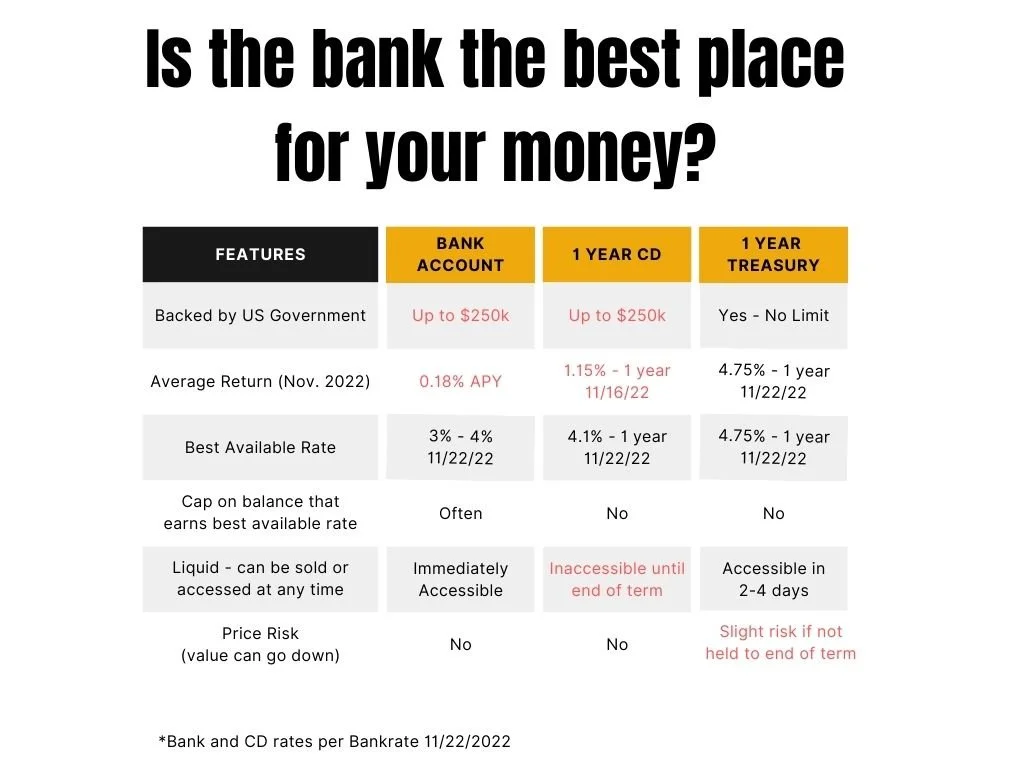
Why Is Your Cash In The Bank?
Typically, people keep money in the bank for three reasons: 1. Safety 2. Return (interest) 3. Accessibility. In the current environment, short-term bonds actually beat banks on two of those three criteria and aren’t far off on the third.
NET OUT - If you’re willing to hold a treasury bond until the end of it’s term, you know the minimum return you will receive, the only risk of loss is if the US government defaults on its debt, and your bond has the potential to do better than expected if interest rates drop.
Why is your cash in the bank? This question may sound absurd… where else would it go? Under my mattress? The truth is, few people understand bank deposits and bonds well enough to know that they have other options, and those options may actually (at the moment) be much better.
Typically, people keep money in the bank for three reasons: safety, return (interest), and accessibility. In the current environment, bonds actually beat banks on two of those three criteria and aren’t far off on the third.
SAFETY - Treasuries are even safer from default than bank accounts.

This is especially true if you have a large amount of cash. Don’t get me wrong, FDIC insured banks are a very safe place to keep your money. The FDIC automatically insures up to $250,000 per depositor with the full faith and credit of the United States government. However, above that limit, cash is only secured by the faith and credit of the bank institution itself.
In contrast, every treasury bond is backed by the full faith and credit of the US government with no limit.
What about all that debt our government is racking up, how can I trust that they won’t default? I won’t get into this argument other than to say that the US government is almost universally considered to be the least likely institution in the world to default. Further, if you don’t trust the US government to pay their debts, you shouldn’t trust FDIC insurance either. Remember, FDIC Insurance is just a promise by the government to pay depositors (up to $250k) if the bank fails to do so.
The net out is that for the first $250,000, banks and treasury bonds have essentially the same risk of default and above $250,000, treasury bonds have less risk of default.
RETURN - Bonds (finally) offer a decent return while interest paid by many banks has hardly increased.
As of 11/10/2022, the average savings account yielded 0.18% APY (per bankrate). Fortunately some banks pay a higher rate up to 3% or 4% but typically the amount allowed to earn this higher rate is limited to $10,000 or $15,000. These can also come with obnoxious requirements to have enough direct deposits or debit card purchases. CD’s are better, yielding on average 1.15% with the best available rate at 4.1% per bankrate.
In contrast, as of 11/22/2022, 1-month treasuries yielded 3.97% and 1-year treasuries yielded 4.75% (per treasury.gov). Unlike many high interest bank accounts, there is no limit on how much you could invest at those rates and no special rules or hoops to jump through.
ACCESSIBILITY - Bonds can be sold and converted to cash in a matter of days.
It’s hard to beat a bank account for convenient storage and access of your cash. That’s what modern checking and savings accounts are for. However, this convenience and accessibility comes at a price. Because you can demand your cash from the bank at any time, they must keep a large amount of money in reserve. They can’t lend or invest those reserves which means they can’t generate profit from them. This is at least part of the reason banks offer pretty stingy rates on your accounts or cap the amount that can receive a high interest rate (think LMCU or Consumers Credit Union).
CD’s take a different approach. You promise the bank you won’t touch your money for several months or years and, because they know when you will receive your money back, they can use your deposit to lend, invest, and otherwise make money. In return, they pay you a higher rate. The major drawback is the contract you make not to touch your money until the term is up. Your money is essentially locked up so you better know you won’t need it until the agreed-upon date.
This is where short term Treasuries at today’s rates shine. There is a large and highly liquid market for US treasuries, meaning they can easily and quickly be sold and turned into cash if needed. This process should take only a few days. So, not only do short term treasuries currently have a higher return than CD’s, they’re a much better investment if you may want or need your money within the next few months or years. Some typical situations that require this are cash set aside for a home purchase or business investment, for a future tax bill, or to generate some return while buying into the stock market over time (dollar-cost-averaging).
The value of your bonds can go down if they’re not held until the end of their term.
This is a major difference from bank accounts or CD’s where the value of your account doesn’t fluctuate based on markets or interest rates. When interest rates rise quickly as they have this year, bond prices drop. This is because new bonds being issued as rates continue to rise pay a higher rate than bonds issued 3 months, 6 months, or 1 year ago. Naturally, if you want to sell your old bond that’s paying a lower rate than bonds issued today, buyers demand to buy them at a discount so that their total return if they hold the bond until the end of its term is the same as a bond purchased today.
Here’s the good news, this risk of your bond dropping in value only exists if you sell it before the end of its term. If you hold your bond until it matures you know exactly what your return will be because the US government will pay you its initial value plus your interest. This is one reason holding actual bonds can be preferable to bond mutual funds or etfs. Bonds are more complex to buy and sell but you can lock in specific terms, return rate, and you are in control of if and when to sell a bond or hold it to maturity.
Some more good news, short-term bonds for 1 month, 3 months, or 6 months change much less dramatically in response to interest rates than longer term bonds like 10-year or 30-year treasuries. AND, to top it off, short term bonds are currently paying higher rates of return than long-term bonds (thanks to an inverted yield curve which is a somewhat rare phenomenon and a topic for another time).
Lastly, this price movement can also work for your benefit. If interest rates drop, the value of your bonds will increase meaning you could sell them prior to maturity for a better return than you expected. The net out is that if you’re willing to hold a treasury bond until the end of it’s term - you know the minimum return you will receive, the only risk of loss is if the US government defaults on its debt, and your bond has the potential to do better than expected if interest rates drop.
Don’t just throw away your investments and strategy to go buy short-term bonds!
Yes short-term bonds are currently a great option FOR A SPECIFIC PURPOSE. If you’re looking for a place to safely park cash that you may need in the next few months or years and make a decent return… short-term bonds sure seem to beat the bank. If you’re saving for a far-off goal, 4% to 5% return likely isn’t the best you can do. Over long periods of time, stocks and long-term bonds have historically outperformed short-term bonds. If you have a strategy, stick to it. If you’d like a strategy, please reach out. You can reach me by email at ryan@ffadvisor.com or cel phone: 616.594.6205.
Footnotes
Bank & CD Rates per bankrate on 11/22/2022
Bond rates per Daily Treasury Par Yield Curve Rates on treasury.gov - 11/22/2022