
The Power of a Family Bank
Discover the power of a family bank: transform your wealth management. Many American families face the challenge of preserving and growing their wealth across generations. The concept of a family bank offers a robust solution, providing a structured system to manage and utilize family wealth effectively.

Many American families often face the challenge of preserving and growing their wealth across generations. The concept of a family bank offers a robust solution, providing a structured system to manage and utilize family wealth effectively. Drawing inspiration from Emily Griffiths-Hamilton's "Build Your Family Bank" and James E. Hughes Jr.'s "Family Wealth," this guide introduces you to the philosophy and logic behind creating a family bank. Let us explore how this powerful strategy can transform your wealth management approach.
Initial Steps to Establish Your Family Bank
Establish Leadership and Oversight
Set up a governance framework with clear roles and responsibilities. Typically, this involves a family council or board of directors that oversees the bank's operations, makes key lending decisions, and enforces policies. A structured governance system ensures transparency, accountability, and consistent decision-making.
Develop Lending Policies
Set transparent lending policies, including who can borrow, for what purposes, interest rates, and repayment terms. Incorporate the Applicable Federal Rate (AFR) to ensure compliance with tax regulations of family loans. Family members should submit business proposals to acquire loans, fostering a professional and disciplined approach to borrowing.

Implement Family Financial Education Programs
Provide ongoing financial education to family members through family summits or retreats, educational resources, and mentorship programs with individuals outside of the family. These initiatives should be specifically tailored to different age groups and financial literacy levels, ensuring that everyone can learn and grow at the life stage they are in.
Continuous Improvement
Regularly evaluate the performance of the family bank, reviewing loan impacts, financial health, and policy adherence. This ongoing assessment allows for timely adjustments, ensuring the bank remains effective and aligned with its goals. An idea format for these meeting is at an annual family retreat.

Benefits of a Family Bank
Wealth Preservation
A family bank helps preserve wealth by keeping financial resources within the family, reducing reliance on external financial institutions, and retaining interest payments within the family circle. This internal circulation of funds strengthens the family's financial base.
Fostering Innovation
Family banks can be a crucial source of funding for entrepreneurial ventures. By providing capital to family members with innovative ideas, the family bank fosters a culture of entrepreneurship and business growth, encouraging family members to pursue their ambitions with the support of the family. This also improves the overall competencies of the family as they gain knowledge in these new ventures.

Strengthened Family Bonds
The collaborative nature of a family bank strengthens family bonds. By working together towards the overall health of the family and the family bank, family members develop deeper trust and cooperation, enhancing family unity.
Empowering Financial Decision-Making of Future Generations
The educational aspect of a family bank improves financial literacy among family members. This knowledge equips them to make informed financial decisions and manage their resources effectively, contributing to their personal and professional success.
Shifting Future Growth Opportunities to Younger Generations
A family bank allows for the strategic shift of financial risk to younger generations who are better positioned to manage it. This can include funding new ventures or investments, enabling older generations to safeguard the growth of their wealth while empowering younger members to take calculated risks.
Special Considerations
While a family bank offers numerous benefits, it also comes with potential risks and downsides that need careful management:
Family Dynamics
Managing financial relationships within a family can lead to conflicts, especially if there are disagreements over lending decisions or repayment issues. Establish clear policies and dispute resolution mechanisms through a family board comprised of multiple family members in addition to outside advisors to address conflicts promptly and fairly. In addition to the board, regular family meetings and transparent communication can also help in mitigating misunderstandings.
Risk of Family Loan Defaults
There is always a risk that family members may default on loans, which could strain family relationships as well as the bank's financial health. Implementing a family investment policy statement for lending policies in addition to requiring detailed business proposals for loans by all family members. The family should also establish plans for how they would like to manage defaults should they occur.
Governance Challenges
Ensuring effective governance can be challenging, particularly if family members lack the necessary experience or commitment. Create a strong governance structure with experienced members and include external advisors that have the family’s best interest at heart.
Maintaining Financial Discipline
Ensuring that all family members adhere to the established policies and guidelines can be difficult as a family grows and evolves. Continuously work to ensure family policies are being enforced consistently and conduct regular audits. Foster a culture of accountability through transparent reporting and setting clear consequences for policy breaches. This may include excluding family members from use of the family bank.

The Rockefeller Centre in New York City
A Real-Life Example of a Successful Family Bank
The Rockefeller family has long used family banking principles to preserve their wealth across generations. By focusing on stewardship and long-term planning, they have maintained their financial legacy. The Rockefellers emphasize financial education and mutual support, ensuring that each generation is equipped to manage and grow the family’s wealth. Their family bank supports entrepreneurial ventures, philanthropic efforts, and educational initiatives, reflecting their values and long-term vision.
Creating a family bank can be a transformative strategy for individuals looking to manage and preserve their wealth for future generations. By fostering a family-wide view of financial stewardship, education, and mutual support, a family bank can not only secure a financial legacy but also promote family unity and fiscal discipline. I hope this guide has provided you with valuable insights into the power and potential of a family bank. If you have any questions or would like assistance in establishing your own family bank, it would be an honor to help you.
Recent Articles Written By Andrew:



Recent Publications Featuring Andrew:
Podcasts Featuring Andrew:


Fiduciary Financial Advisors, LLC is a registered investment adviser and does not give legal or tax advice. Information presented is for educational purposes only and does not intend to make an offer or solicitation for the sale or purchase of any securities. The information contained herein has been obtained from a third-party source which is believed to be reliable but is subject to correction for error. Investments involve risk and are not guaranteed. Past performance is not a guarantee or representation of future results.
Fiduciary Financial Advisors does not give legal or tax advice. The information contained does not constitute a solicitation or offer to buy or sell any security and does not purport to be a complete statement of all material facts relating to the strategies and services mentioned.

Legacy Planning(c), A Resource Library: The 5 Pillars of Capital For Your Legacy
Andrew Van Alstyne had the privilege to be featured on the
Legacy Planning(c), A Resource Library’s Podcast with Angelina Carleton.
Andrew and Angelina discuss that while most families seek out management of their financial capital, it is important to remember financial capital is merely a tool that should be used to grow the qualitative forms of capital within the family.
Click the Links Below to Watch or Listen to the Full Episode:
Fiduciary Financial Advisors, LLC is a registered investment adviser. Information presented is for educational purposes only and does not intend to make an offer or solicitation for the sale or purchase of any securities. Investments involve risk and are not guaranteed. Be sure to consult with a qualified financial adviser and/or tax professional before implementing any strategy discussed herein.
Recent Articles Written by Andrew:


Recent Articles Andrew Has Been Featured In:
Recent Podcasts Andrew Has Been On:

Wealthtender Ask an Advisor Feature: Is $5.5 Million the Magic Number to Retire Comfortably and Pass Wealth to Your Children?
Andrew Van Alstyne had the privilege to be featured in Wealthtender’s “Ask an Advisor” for how much money is needed for retirement.
Andrew discusses that it is important to focus what you want retirement to look like when calculating the amount you’ll need. He also discusses a different way of thinking as to how to leave a legacy to your loved ones while still alive.
Click the Image Below to Read the Full Article:

Fiduciary Financial Advisors, LLC is a registered investment adviser. Information presented is for educational purposes only and does not intend to make an offer or solicitation for the sale or purchase of any securities. Investments involve risk and are not guaranteed. Be sure to consult with a qualified financial adviser and/or tax professional before implementing any strategy discussed herein.
Recent Articles Written by Andrew:
Recent Articles Andrew Has Been Featured In:
Recent Podcasts Andrew Has Been On:

Wealthtender Ask an Advisor Feature: How Can a 24-Year-Old Married Couple Strike a Balance Between Short-Term Saving and Long-Term Financial Security?
Andrew Van Alstyne had the privilege to be featured in Wealthtender’s “Ask an Advisor” for what to focus on financially as a young couple.
Andrew discusses the importance of planning ahead for major life events, communicating with your spouse, and optimizing your savings strategy to be tax efficient.
Click the Image Below to Read the Full Article:


Fiduciary Financial Advisors, LLC is a registered investment adviser. Information presented is for educational purposes only and does not intend to make an offer or solicitation for the sale or purchase of any securities. Investments involve risk and are not guaranteed. Be sure to consult with a qualified financial adviser and/or tax professional before implementing any strategy discussed herein.
Recent Articles Written by Andrew:
Recent Articles Andrew Has Been Featured In:
Recent Podcasts Andrew Has Been On:

KAJ Masterclass Live: Managing Multi-Generational Wealth
Andrew Van Alstyne had the privilege to be featured on the
KAJ Masterclass Live Podcast.
Andrew discusses the importance of early discussions amongst family members to instill financial literacy. Andrew also shares his insights on how these open discussions can prevent financial under-preparedness. He also talks about the role of including all family members in wealth management, the benefits of starting inter-generational wealth transfers before death, and how to overcome the tension of talking about money in families with difficult financial histories.
Click the Image Below to Listen to the Full Episode:
Fiduciary Financial Advisors, LLC is a registered investment adviser. Information presented is for educational purposes only and does not intend to make an offer or solicitation for the sale or purchase of any securities. Investments involve risk and are not guaranteed. Be sure to consult with a qualified financial adviser and/or tax professional before implementing any strategy discussed herein.
Recent Articles Written by Andrew:
Recent Articles Andrew Has Been Featured In:
Recent Podcasts Andrew Has Been On:

How Healthcare Professionals should use the Synergy of Health and Wealth to be Successful
Is it easier to be healthy when you are wealthy? Is it easier to be wealthy when you are healthy? I would say yes to both questions since health and wealth have synergy. Let’s explore a few habits that can assist healthcare professionals to be successful with both.
Downward Spiral versus Upward Spiral

Struggling to maintain both physical health and financial stability can be a common issue for many healthcare professionals. Health challenges can include poor diet, lack of exercise, insufficient sleep, or poor stress management. Wealth challenges can include overspending, low savings rates, poor investment decisions, or the absence of a financial plan.
Instead of focusing on health OR wealth, it is crucial to focus on BOTH since they are interconnected. Poor health can limit work capacity and increase medical expenses, reducing financial security. Conversely — limited finances can cause increased stress and decrease the time available for exercise/relaxation, which is detrimental to health. By focusing on both, you can create a positive feedback loop where improvements in one area support improvements in the other.
Habits to Adopt
The hardest part is usually just getting started. It takes a lot of hard work and dedication to move from out of shape to in shape. Once in shape, it is much easier to maintain and stay in shape. The same is true regarding finances. It takes a lot of hard work and dedication to pay off debt, balance the budget, and start setting money aside for the future. Once a financial plan is in place and followed, it is much easier to maintain and stay on track. Fortunately, the same habits can help enhance health and wealth.
Goal Setting: Setting clear and achievable goals
Example: Set a savings target for your retirement account for the year
Example: Set an activity goal for the number of times you plan to exercise every month
Discipline and Routine: Establishing and sticking to a routine
Example: Set up automatic monthly payments into your retirement account
Example: Carve out specific times each week for consistent exercise
Small actions every day can lead to significant results over a long period of time
Monitoring Progress: Regular check-ins and adjustments to stay on track:
Example: Review your budget and expenses regularly
Example: Calculate your net worth and update it every 6 months or every year
Example: Track your weight, strength, and cardiovascular health
Accountability: Seeking professional help when needed:
If you struggle with eating or exercise habits, consider working with a dietician or personal trainer to achieve your health goals
If you struggle with finances, budgeting, or expenses, consider working with a fee-only fiduciary financial advisor to achieve your financial goals
Having another person to assist with accountability and goal tracking can be immensely helpful
Encouragement Moving Forward

No one is perfect, but striving for continual improvement can lead to a healthier and more financially secure tomorrow. Here are a few key thoughts to remember.
Consistency is Key: Small, incremental changes can lead to significant improvements over time
Start Today: Don’t put things off until tomorrow. Make the harder first steps now so your future self will thank you
If you would like help improving your financial situation, please Schedule a Time to Meet. I would be happy to connect and assist.







Fiduciary Financial Advisors, LLC is a registered investment adviser and does not give legal or tax advice. Information presented is for educational purposes only and does not intend to make an offer or solicitation for the sale or purchase of any securities. The information contained herein has been obtained from a third-party source which is believed to be reliable but is subject to correction for error. Investments involve risk and are not guaranteed. Past performance is not a guarantee or representation of future results.

Money Talk with Skyler Fleming: How Family Conversations Shield You from Financial Under-Preparedness
Andrew Van Alstyne had the privilege to be featured on the
Money Talk with Skyler Fleming Podcast.
Andrew discusses the importance of family conversations in financial planning. Andrew also shares his insights on how open discussions can prevent financial under-preparedness. He also talks about the role of including all family members in wealth management, the benefits of inter-generational wealth transfers, and how to overcome the tension of talking about money in families with difficult financial histories.
Click the Links Below to Watch or Listen to the Full Episode:
Fiduciary Financial Advisors, LLC is a registered investment adviser. Information presented is for educational purposes only and does not intend to make an offer or solicitation for the sale or purchase of any securities. Investments involve risk and are not guaranteed. Be sure to consult with a qualified financial adviser and/or tax professional before implementing any strategy discussed herein.
Recent Articles Written by Andrew:
Recent Articles Andrew Has Been Featured In:
Recent Podcasts Andrew Has Been On:

Sales Gravy Podcast Feature: Personal Finance Strategies for Sales Professionals
Ben Lex had the privilege to be featured on the Sales Gravy Podcast.
Ben discusses the importance of personal financial well-being for sales professionals and how to improve their current circumstances with their variable income.
Click Below to Watch or Listen to the Full Episode:
Fiduciary Financial Advisors, LLC is a registered investment adviser. Information presented is for educational purposes only and does not intend to make an offer or solicitation for the sale or purchase of any securities. Investments involve risk and are not guaranteed. Be sure to consult with a qualified financial adviser and/or tax professional before implementing any strategy discussed herein.
Recent Articles Written by Ben


Recent Articles Ben Has Been Featured In


Recent Podcasts Ben Has Been On

Route 664 Podcast Feature: Wealth Planning
Andrew Van Alstyne had the privilege to be featured on the Route 664 Podcast.
Andrew discusses the significance that proper financial planning can have on multi-generational wealth and the importance of doing thorough, comprehensive financial reviews.
Click the Links Below to Watch or Listen to the Full Episode:
Fiduciary Financial Advisors, LLC is a registered investment adviser. Information presented is for educational purposes only and does not intend to make an offer or solicitation for the sale or purchase of any securities. Investments involve risk and are not guaranteed. Be sure to consult with a qualified financial adviser and/or tax professional before implementing any strategy discussed herein.
Recent Articles Written by Andrew:
Recent Articles Andrew Has Been Featured In:
Recent Podcasts Andrew Has Been On:

Financial Freedom and Wealth Trailblazers Podcast Feature: Financial Guidance and Planning
Andrew Van Alstyne had the privilege to be featured on the Financial Freedom and Wealth Trailblazers Podcast.
Andrew discusses the importance of finding an advisor that aligns with your needs and who understands your relationship with money. He also discusses the significance that proper financial planning can have on multi-generational wealth.
Click the Links Below to Watch or Listen to the Full Episode:
Fiduciary Financial Advisors, LLC is a registered investment adviser. Information presented is for educational purposes only and does not intend to make an offer or solicitation for the sale or purchase of any securities. Investments involve risk and are not guaranteed. Be sure to consult with a qualified financial adviser and/or tax professional before implementing any strategy discussed herein.
Recent Articles Written by Andrew:
Recent Articles Andrew Has Been Featured In:
Recent Podcasts Andrew Has Been On:

Yahoo! Finance Feature: Six Ways to Mitigate a Sudden Job Loss
Andrew Van Alstyne had the privilege to be featured in Yahoo! Finance to talk to readers about the importance of being prepared at all times for the possibility of a job loss.
Andrew discusses why it is important to have a dedicated emergency fund along with tax efficient ways of further upskilling and educating oneself.


Fiduciary Financial Advisors, LLC is a registered investment adviser. Information presented is for educational purposes only and does not intend to make an offer or solicitation for the sale or purchase of any securities. Investments involve risk and are not guaranteed. Be sure to consult with a qualified financial adviser and/or tax professional before implementing any strategy discussed herein.

Should You Hire a Bookkeeper for Your Business?

Today’s blog goes to my hustlin’ entrepreneurs out there who are ready to get their books organized, have a better grip on their business cash flow, and make tax time a loooooot smoother for themselves.
I get questions all the time from women and mama entrepreneurs about how they can clean up their books and systems, leaving them with confidence and structure. My answer? A bookkeeper. My role as a financial advisor differs from what a bookkeeper does and the services we provide tackle different obstacles.
As a financial advisor, I assist with investing, tax minimization, saving for retirement, insurance planning, and financial planning for your life - think inheritance, divorce, dream vacay, kids’ education, and the list goes on. Intentionally understanding how you (and your spouse!) think and feel when it comes to making financial decisions, allows me to tailor my advice to you. In addition to the specific services I provide, I bring tangible steps and direction to the table to accomplish your goals.
A bookkeeper is to keep your books in order so that you can focus on stewarding your business well. That includes the recording, organizing, and summarizing of all financial transactions within your business – money in, money out, and where it goes! From recording sales, purchases, and expenses to tracking invoices and receipts, maximizing deductions, and confirming business compliance, bookkeeping helps to ensure that your finances are detailed, accurate, and ready for analysis. Both myself as a financial advisor, specializing in women entrepreneurs, and a bookkeeper help you feel confident and at peace with your finances.
Now that you have a better understanding of the difference between my role and a bookkeeper, let’s see if hiring a bookkeeper makes sense for you. I had the privilege to sit down with Brittany DeMoss from Good Steward Bookkeeping to get the inside scoop on bookkeeping. Let’s dive into the conversation!
//
L: Brittany, SO good to connect. Can you share a little bit more about who would benefit from hiring a bookkeeper and when it would be beneficial?
B: Anyone who owns a business and doesn’t want to do their own bookkeeping! Bookkeeping has to be done, but it doesn’t have to be done by you. What might take up around 20 overwhelming hours of your valuable time each month could become an additional 20 hours taking on more clients, building your website, sourcing your materials, or spending time with friends and family. What might cost you $2,000 a month of your time could cost just $300 a month of a bookkeeper’s time. Hire it out!
In regards to when, outsourcing a bookkeeper isn’t necessarily dependent on how much income your business is bringing in. Instead of hiring a bookkeeper once you “finally reach $100k,” consider hiring a bookkeeper when you haven’t touched your books in a while. Or if you don’t know where to start, or you panic during tax season, or you don’t know if you’re compliant, or you aren’t paying yourself a dime. The best time to hire a bookkeeper is when you’re ready to be confident, at peace, and make informed business decisions that will increase your profit. Outsourcing this task will help you focus on stewarding your business as a CEO!
L: This is great. It seems like bookkeeping can be beneficial for any stage of business. One question I get often is what’s the difference between a bookkeeper and an accountant? Can you shed some light on that?
B: Absolutely! Accountants and bookkeepers perform different roles, so having both is best! Bookkeepers dive into the nitty gritty details of your books to give you a clear view of your finances, catch error and fraud, help you save and generate more money, and let you focus on stewarding the growth of your business. Once your books are ready, the bookkeeper hands them off to your accountant for tax returns and tax planning.
L: Super helpful. What about the DIYers of the audience? Software like Quickbooks is very common and many of my clients utilize this. Would there be a benefit for an existing Quickbooks/software user to outsource their bookkeeping?
B: My recommendation is yes, there would be a benefit! My favorite software to use for bookkeeping is QuickBooks Online (but Xero is a close second). Even if you use QuickBooks, you might not want to actually use QuickBooks. Let me manage your QuickBooks account for you with my monthly bookkeeping package!
L: You mentioned your monthly bookkeeping package. Tell me more! What levels of service do you offer clients?
B: My most popular (and my personal favorite) service offering is my monthly bookkeeping package. This package is intended for small and growing businesses who are seeking peace and confidence in their numbers! Monthly bookkeeping includes income and expense categorization, bank reconciliations, financial statements, and unlimited support. This package starts at $300/month.
I also offer clean-up and catch-up services for those of you who haven’t touched your books in a while, or maybe ever. It’s overwhelming! This service is a one-time fee to provide categorization and reconciliations for each missed month.
My DIY Bookkeeping Tracker is a bookkeeping tool for all of you DIY-ers! This spreadsheet is for entrepreneurs & side-gig CEOs who aren’t quite ready to hand over their books to a bookkeeper. With this tracker you’ll have: monthly income and expense tracking, a Profit & Loss Statement, goal setting, tax tracking, and pretty visual reporting! For a one-time cost of $89.00 and a few hours of your time each month, this is an economical way to do your own bookkeeping accurately and efficiently. Make sure to use Leanne’s code LEANNE15 for 15% off!
You can also find some free tidbits of bookkeeping tips and tricks on my blog!
L: I love the different scopes of engagement. Something for everyone! Can you share a little more about what communication looks like when an entrepreneur reaches out and you sign on a new client?
B: Full bookkeeping services require minimal monthly virtual communication (although we’re always open for 1:1 support!). We start with a discovery call to get to know each other and, once we commit to a contract, we will set up a meeting to officially transition your bookkeeping off of your plate.
After that, not much is needed from you! Once we work our bookkeeping magic, you will receive an email with any questions (usually just a few) we may have for you regarding your banking transactions for that month. Once answered, you can expect your simple and detailed (and dare I say FUN?!) financial reports in your inbox by the 15th of each month. If you have any questions regarding your monthly bookkeeping reports, we’re happy to hop on a call or explain via email!
L: You have me sold on your “bookkeeping magic”! Any other magical words to share with our readers today?
B: Accurate bookkeeping paints a picture of your financial health and is the foundation for success. It empowers you to make informed decisions about your business - knowing where to invest, how much to charge clients, understanding profits, and being tax-ready without the stress.
You’re making money, but you’re not sure where it’s all going? Bookkeeping. You need to purchase a new camera but you aren’t sure if you have enough in your account to do so? Bookkeeping. Are you unsure if you’re able to pay yourself during a slow month? Bookkeeping. Is your client demand high and you’re wondering if it’s time to raise your prices? Bookkeeping.
Bookkeepers are dedicated to making sense of your business finances for you! Whether it’s setting up systems, offering guidance, or handling the monthly bookkeeping process, my goal is to provide the support and organization you need to help you grow your business successfully and strategically.
//
AMAZING feedback from Brittany. Are you ready for your book’s spring cleaning or what? I know I am. You already know I’m going to share all the deets on how you can reach out to Good Steward Bookkeeping. Check out Brittany’s contact information below and here’s to organized books, paying yourself confidently, and clear cash flow!
Fiduciary Financial Advisors, LLC is a registered investment adviser. Information presented is for educational purposes only and does not intend to make an offer or solicitation for the sale or purchase of any securities. Investments involve risk and are not guaranteed. Be sure to consult with a qualified financial adviser and/or tax professional before implementing any strategy discussed herein.

About Brittany…
Brittany DeMoss is a bookkeeper, money-stewarder, owner of Good Steward Bookkeeping Co., and Kingdom builder. Photographers, web designers, wellness coaches, copy and grant writers, and coffee shops all over the country are Brittany’s specialties.
She loves serving small businesses, hosting book club (most recent read: Sense & Sensibility), making pottery at a local studio, and dreaming up ideas with her film & photography teacher husband.
W: https://www.goodstewardbookkeepingco.com/
E: brittany@goodstewardbookkeepingco.com
IG: @goodstewardbookkeepingco
About Leanne…
Leanne Rahn is a Fiduciary Financial Advisor working with clients all over the US. If you don’t know what a Fiduciary is, Leanne encourages you to look it up (or even better - check out her website!). She swears you won’t regret it. Women entrepreneurs, newlyweds & engaged couples, and families who have special needs children are Leanne's specialties.
She loves trying new recipes, spending time with her hubs and two littles, and all things Lake Michigan. She could listen to the band Elevation Worship all day long and is a sucker for live music.


Here, at Fiduciary Financial Advisors, we take our fiduciary oath seriously. We hold these five principles:
I will always put your best interests first
I will avoid conflicts of interest
I will act with prudence; that is, with the skill, care, diligence, and good judgment of a professional
I will not mislead you, and I will provide conspicuous, full, and fair disclosure of all important facts.
I will fully disclose, and fairly manage, in your favor, any unavoidable conflicts

Maximizing Your Financial Windfall: A Guide to Smart Wealth Management
Learn how to effectively manage a substantial financial windfall with this comprehensive guide. From prudent planning to long-term preservation, discover expert strategies to optimize your newfound prosperity.

Receiving a substantial financial windfall is an exhilarating experience, but it also comes with tremendous responsibilities. Whether it's an inheritance, lottery winnings, a sizable bonus, or a business sale, managing this influx of wealth correctly can prove crucial for securing your financial future. In this guide, we'll explore essential steps to take when you find yourself with a sudden windfall. From prudent financial planning to long-term wealth preservation, we'll cover everything you need to make informed decisions and optimize your newfound prosperity.
Press Pause
Before making any decisions, take a moment to pause and reflect on your newfound circumstance. Emotions can run high, but making decisions fueled by emotion often leads to regret. Reflect on your financial goals, values, and priorities. Consider how this windfall can align with your long-term aspirations and contribute to your overall financial well-being.
Seek Professional Guidance
Navigating a substantial windfall can be complex, and even if you haven’t felt the need for it in the past, seeking professional guidance will prove extremely useful. A wealth manager can offer invaluable insights tailored to your specific circumstances. They can help you assess your current financial situation, identify your goals, and develop a strategy that aligns all elements of life that are touched by financial matters. Look for an advisor who is a fiduciary and has a duty to act in your best interest.

Review Your Financial Plan
Revisit your financial plan to make informed decisions and maximize your windfall's potential. Work with your advisor to outline clear objectives which may include debt reduction, investment diversification, retirement planning, and philanthropy. Ensure your plan covers short-term needs and long-term wealth preservation.
Maximize Tax Planning and Efficiency
Strategic, year-round tax planning can significantly impact the longevity and growth of your newfound wealth. By implementing tax-efficient strategies, you can minimize tax liabilities, preserve more of your assets, and enhance overall financial returns.


Diversify Investments
Avoid overexposure by diversifying your investment portfolio. While high-risk ventures may be tempting, prioritize stable, tax-efficient assets to protect your windfall. Depending on the size of the windfall it will probably be more important to protect the amount received by investing in lower-risk assets with stable, tax-efficient returns.
Manage Debt Wisely
If you have existing debts, such as mortgages, student loans, or credit card balances, consider using a portion of your windfall to at least reduce their burden if not paying them off. Prioritize debts with high interest rates to minimize long-term financial strain. Balance debt repayment with preserving cash reserves for long-term financial flexibility.
Protect Your Wealth
Safeguarding your newfound wealth against unforeseen risks is essential for long-term financial security. Review your insurance coverage, including life, health, disability, and liability policies, to ensure adequate protection for you and your loved ones. Depending on the wealth you’ve stepped into, there are more specialized insurance coverages you may need to give thought to that can be reviewed you’re your wealth manager. Also, consider implementing or reviewing estate planning measures, such as wills, trusts, and powers of attorney, to effectively manage and transfer assets according to your wishes.
Stay Informed and Engaged
Financial literacy is a powerful tool for wealth preservation and growth. Stay informed about economic trends, investment opportunities, and tax implications relevant to your financial situation. Regularly review your financial plan with your advisor to adapt to changing circumstances and capitalize on new opportunities. Engage in ongoing education to deepen your understanding of personal finance and empower yourself to make informed decisions.
Establish Family Governance
When a substantial windfall affects multiple family members or spans across generations, establishing clear governance structures becomes essential. Family governance encompasses the policies, processes, and communication channels that guide decision-making, wealth management, and intergenerational transfer of assets.
Receiving a substantial financial windfall presents both opportunities and challenges. By following these steps and leveraging professional guidance, you can effectively manage your newfound wealth and position yourself for long-term financial success for years if not generations to come. Remember to approach the situation with careful consideration, thoughtful planning, and a commitment to preserving and growing your assets. Whether you're planning for retirement, supporting your family, or giving back to your community, smart wealth management is the key to realizing your financial aspirations. Approach the situation thoughtfully, commit to preserving and growing your assets, and take the first step toward a secure financial future by consulting with a trusted advisor today.
Other Recent Articles by Andrew:
Articles Andrew Has Been Featured in:


Fiduciary Financial Advisors, LLC is a registered investment adviser and does not give legal or tax advice. Information presented is for educational purposes only and does not intend to make an offer or solicitation for the sale or purchase of any securities. The information contained herein has been obtained from a third-party source which is believed to be reliable but is subject to correction for error. Investments involve risk and are not guaranteed. Past performance is not a guarantee or representation of future results.
Fiduciary Financial Advisors does not give legal or tax advice. The information contained does not constitute a solicitation or offer to buy or sell any security and does not purport to be a complete statement of all material facts relating to the strategies and services mentioned.

Pulse Check: Why Healthcare Professionals Should Monitor Their Credit Scores
What are Credit Scores?
Let’s start by first reviewing what a credit score is. It is a number assigned to you by a credit reporting agency that helps creditors obtain a quick snapshot of your creditworthiness. Equifax, Experian, and Transunion are the three main reporting agencies in the United States and the credit score number can range from 300 to 850. (Source: Experian; link below)
When you apply for a credit card, a car loan, insurance, or a home mortgage; the lender is going to look at your credit report & score to help determine if you qualify and meet their standards to get approved. By proactively understanding and taking steps to get your credit score high, you should have a better chance of getting approved for credit in the future.

There are 5 different ratings assigned based on your credit score number.
Poor is considered 300-579
Fair is considered 580-669
Good is considered 670-669
Very Good is considered 740-799
Exceptional is considered 800-850
I would recommend striving to get your credit score to at least Good and if you want the best rates and approval chances then keep going until you get to Very Good or Exceptional.
Factors Contributing to Your Credit Score
Your credit score number is calculated based on six different categories: Payment History, Credit Utilization, Derogatory Marks, Length of Credit History, Total Number of Accounts, and New Credit Inquiries. Payment history, Credit card usage, and Derogatory marks have the highest impact on your credit score so those areas would be the highest priority to focus on. Credit Age has a medium impact on your overall credit score. Total accounts and Hard inquiries have the lowest impact.
Payment History: Your goal should be to have as many on-time payments as possible. The higher the better.
100% on-time payments for excellent
99% for good
98% for fair
97% and below needs work
Credit Utilization: Your goal should be to not use all of the credit that is available to you. The lower the percentage the better
0-9% of credit utilized for excellent
10-29% for good
30-49% for fair
50-100% needs work
Derogatory Marks: These include accounts in collection, bankruptcies, civil judgments, and tax liens. Your goal should be to have as few as possible.
0 is excellent
1 is fair
2+ needs work
Length of Credit History: This is the average age of all your open accounts. This goes up over time but you should be cognizant not to close older accounts that have been open for years or this will decrease.
9+ years is excellent
7-8 years is good
5-6 years is fair
0-4 years needs work
Total Number of Accounts: This is just based on the number of credit accounts you have overall. Having more accounts gives creditors more history and data to evaluate you on.
21+ is excellent
11-20 is fair
0-10 needs work
New Hard Credit Inquiries: If you keep applying for a bunch of different accounts this could be a red flag. Limiting the number of accounts you apply to can help keep your credit score high. This usually looks back over the past 2 years.
0 is excellent
1-2 is good
3-4 is fair
5+ needs work
Why Your Credit Score is Important
Some people like Dave Ramsey are totally against any debt while other people like Robert Kiyosaki say you should take out as much “good” debt as possible. Both of these are extremes and most people probably fall somewhere in the middle, using credit and some debt wisely but not going overboard.
If you are going to use debt during your lifetime then knowing what your credit score is and keeping it high should help you when you apply for a credit card or car loan, get insurance, or buy a home with a mortgage.
I use credit karma to monitor my credit score since they were one of the first companies to offer it free years ago. Nowadays there are a plethora of options to pick from. You are also able to check your full credit report for free once a year at https://www.annualcreditreport.com/index.action
If you don’t know what your credit score is currently, take some time this week to figure it out and see if there is anything you should be doing to improve it.
Sources:

Shout out to Alex Kiel with Macatawa Bank’s Mortgage team for helping me co-write this blog post. She joined their team in 2016. Alex holds her Bachelor’s degree from Davenport University, where she double majored in Marketing and Finance, and played both basketball and golf. When she’s not fitting her customers with the perfect mortgage, Alex cheers on the Detroit Lions, who did quite well this year but unfortunately weren’t able to make it to the Superbowl…next year though! I have also had the privilege of competing with Alex in beach volleyball. 🏐😎
616.502.8044 akiel@macatawabank.com Website


Fiduciary Financial Advisors, LLC is a registered investment adviser and does not give legal or tax advice. Information presented is for educational purposes only and does not intend to make an offer or solicitation for the sale or purchase of any securities. The information contained herein has been obtained from a third-party source which is believed to be reliable but is subject to correction for error. Investments involve risk and are not guaranteed. Past performance is not a guarantee or representation of future results.
MoneyGeek Feature: Women’s Guide to Financial Independence
Leanne Rahn had the privilege to be featured in MoneyGeek to talk to readers about “Women’s Guide to Financial Independence”.
Leanne discusses challenges women face when it comes to their finances and how they can maximize their cash flow to support their financial independence.


Fiduciary Financial Advisors, LLC is a registered investment adviser. Information presented is for educational purposes only and does not intend to make an offer or solicitation for the sale or purchase of any securities. Investments involve risk and are not guaranteed. Be sure to consult with a qualified financial adviser and/or tax professional before implementing any strategy discussed herein.


Recessions Aren't Always a Roadblock - Consider These Benefits
Defining a Recession

Let’s begin by clarifying what a recession entails. “Most commentators and analysts use, as a practical definition of recession, two consecutive quarters of decline in a country’s real inflation-adjusted gross domestic product (GDP)- the value of all goods and services a country produces.” (Source: International Monetary Fund; link below)
According to the National Bureau of Economic Research (NBER), it’s a broader concept involving, “a significant decline in economic activity spread across the economy, lasting more than a few months, normally visible in production, employment, real income, and other indicators.” (Source: International Monetary Fund; link below)
Both definitions show the negative outcomes so let's dive deeper into what some of the positive outcomes could be.
Short-Term vs. Long-Term Views
Why would a decline in economic activity be considered a positive factor? The answer lies in the window of time you view it. In a free-market economy, businesses compete for customers. During a recession, consumers tend to spend their money more wisely, favoring businesses with lower prices or higher quality to make their money go further. While this may lead to short-term challenges such as job losses and business closures, it encourages efficiency. In the long run, recessions help eliminate less efficient companies from the market, allowing more efficient ones to thrive and take their place. In the long run, this helps improve the economy's overall strength.
How to Navigate a Recession by Being an Opportunist?
Instead of being scared of a recession, why not consider it an opportunity for growth and improvement?

Failed businesses can make way for new enterprises, offering better jobs, products, services, and prices.
Individuals facing job loss can use the opportunity to learn and grow new skills, making a more significant economic impact on society and for themselves.
Asset value declines can create opportunities for strategic financial moves like Roth conversions, portfolio rebalancing, or tax loss harvesting.
A recession could be a great time to invest in yourself. Warren Buffett famously said, “Whatever abilities you have can't be taken away from you. They can't actually be inflated away from you. The best investment by far is anything that develops yourself, and it's not taxed at all.”
Navigating Recessions with Confidence
When news of a recession emerges, it's vital to resist succumbing to fear. Much like weightlifters intentionally break down muscle fibers for greater strength or home renovators tear down outdated designs for improved homes, recessions play a role in eliminating inefficiencies within our economic system.
Avoiding the pitfalls of political rhetoric is equally crucial during these times. Recessions often trigger frustration and political finger-pointing so it can be beneficial to remember that the benefits of a recession could be better than the harm of government intervention trying to prevent the recession from happening. Echoing one of my favorite quotes by economist Thomas Sowell, "The first lesson of economics is scarcity: There is never enough of anything to satisfy all those who want it. The first lesson of politics is to disregard the first lesson of economics."
While recessions may bring short-term challenges, they are pivotal for maintaining a robust and growing economy in the long term. A recession might not fulfill every immediate desire, but it acts as a catalyst, paving the way for efficient businesses to address more needs at lower prices over time.
Sources:
International Monetary Fund https://www.imf.org/external/pubs/ft/fandd/basics/recess.htm#:~:text=Calling%20a%20recession&text=Most%20commentators%20and%20analysts%20use,and%20services%20a%20country%20produces.
International Monetary Fund

Fiduciary Financial Advisors, LLC is a registered investment adviser and does not give legal or tax advice. Information presented is for educational purposes only and does not intend to make an offer or solicitation for the sale or purchase of any securities. The information contained herein has been obtained from a third-party source which is believed to be reliable but is subject to correction for error. Investments involve risk and are not guaranteed. Past performance is not a guarantee or representation of future results.

Home for the Holidays Magazine - Seeking Peace with Leanne Rahn
Leanne Rahn had the privilege to be featured in Real Estate By Aubree’s Home for the Holidays Magazine to talk to readers about “Seeking Peace”.
With a Christmas twist, Leanne emphasizes the importance of initiating peace within your financial life and the costly price that can result without it. Leave feeling encouraged, motivated, and driven to seek peace and to stop procrastinating. Turn the corner into 2024 with peace at the top of your mind.
Leanne, Aubree, along with many other West Michigan businesses are wishing you a very Merry Christmas!


Home for the Holidays Magazine - Seeking Peace with Leanne Rahn
Leanne Rahn had the privilege to be featured in Real Estate By Aubree’s Home for the Holidays Magazine to talk to readers about “Staying the Course”.
With a Christmas twist, Leanne emphasizes the importance of not just your destination but your journey and the steps you take along the way. Leave feeling encouraged, confident, and motivated while understanding the value of remaining steadfast on your current course.
Leanne, Aubree, along with many other West Michigan businesses are wishing you a very Merry Christmas!



5 Ways to Fight Inflation as a Business Owner

Fiduciary Financial Advisors, LLC is a registered investment adviser. Information presented is for educational purposes only and does not intend to make an offer or solicitation for the sale or purchase of any securities. Investments involve risk and are not guaranteed. Be sure to consult with a qualified financial adviser and/or tax professional before implementing any strategy discussed herein.


5 Ways to Prepare Your Business For a Recession

Recessions, hard times, and slow growth are all things no small business owner wants to hear. But the reality is you will have times like these in your business. How do you prepare as a business owner? What can you do right now to go confidently through a natural phase of your business life? Let’s jump into five ways you can prepare your business for a recession:
1. Build That Emergency Fund
We often talk about emergency funds on the personal side but we can’t forget about the business side. Set a goal to build a business emergency fund that would cover 3-6 months’ worth of business expenses (things like office supplies, payroll, rent, software subscriptions, etc.). There is always going to be something else you’d rather spend your business dollars on, but trust me when a recession hits you will feel so much better knowing your business essentials are taken care of.
2. Pay Down Debt
Do you have a business credit card or a business loan that has reoccurring balances? Now’s the time to try and minimize that debt - especially debts with a high-interest rate. Being tied to a lender is never a good feeling and it’s even more challenging when business is hurting due to the economic surroundings. Once you have an established business emergency fund, chip away at that debt. Your future self will thank you.
3. Look Ahead
All businesses have some seasons that are slower than others. Look ahead at your expected business activity in the months to come. Are they usually slower or perhaps you're coming up on your busiest time of the year? Taking a glance forward will help you know what to prepare in the now. If you know the slow months are quickly approaching, it might be time to build that extra cash reserve (maybe even slightly larger than normal) to tackle the slow months and weather a recession.
4. Revisit Your Marketing Plan
It’s always a good idea to review your current marketing plan every so often to know what’s working and what’s not. Both your time and your potential leads are valuable - we want those two things to complement each other. Carve out an hour or two out of your time to do a deep dive into your marketing streams. Where are you getting most of your business? How much are you spending and are the dollars coming back to you in the form of new business? What type of marketing takes the most of your time and is it worth it? Are there new streams you could be taking advantage of? If and when a recession comes, you can confidently know your marketing strategy is at its best.
5. Review Your Current Expenses
With subscriptions being at the click of a button nowadays, it can be easy to forget what services you are paying for and how much you are actually paying. There are some expenses that definitely are worth paying for and help your business tremendously but it’s a good habit to often review your current expenses to decipher that. Clean up your business budget and make the most of your business dollars by staying on top of your monthly costs. On the other hand, is there a service or product that, if purchased, will increase your productivity/your time/your leads/your quality/etc.? Then click that “checkout” button! This tip isn’t just to cut back on all your expenses but to help your business and your revenue be the most efficient possible.
As I mentioned at the beginning of this conversation, talk of recession is never something a small business owner wants to hear. But coming to terms with this natural economic wave and knowing how you can prepare will allow you to ride the wave with ease. So get to work on building your emergency fund, minimizing business debt, looking ahead at your business activity, revisiting your marketing plan, and reviewing your current expenses. The storm is a lot less fearful when you have shelter and an umbrella in hand.
Fiduciary Financial Advisors, LLC is a registered investment adviser. Information presented is for educational purposes only and does not intend to make an offer or solicitation for the sale or purchase of any securities. Investments involve risk and are not guaranteed. Be sure to consult with a qualified financial adviser and/or tax professional before implementing any strategy discussed herein.

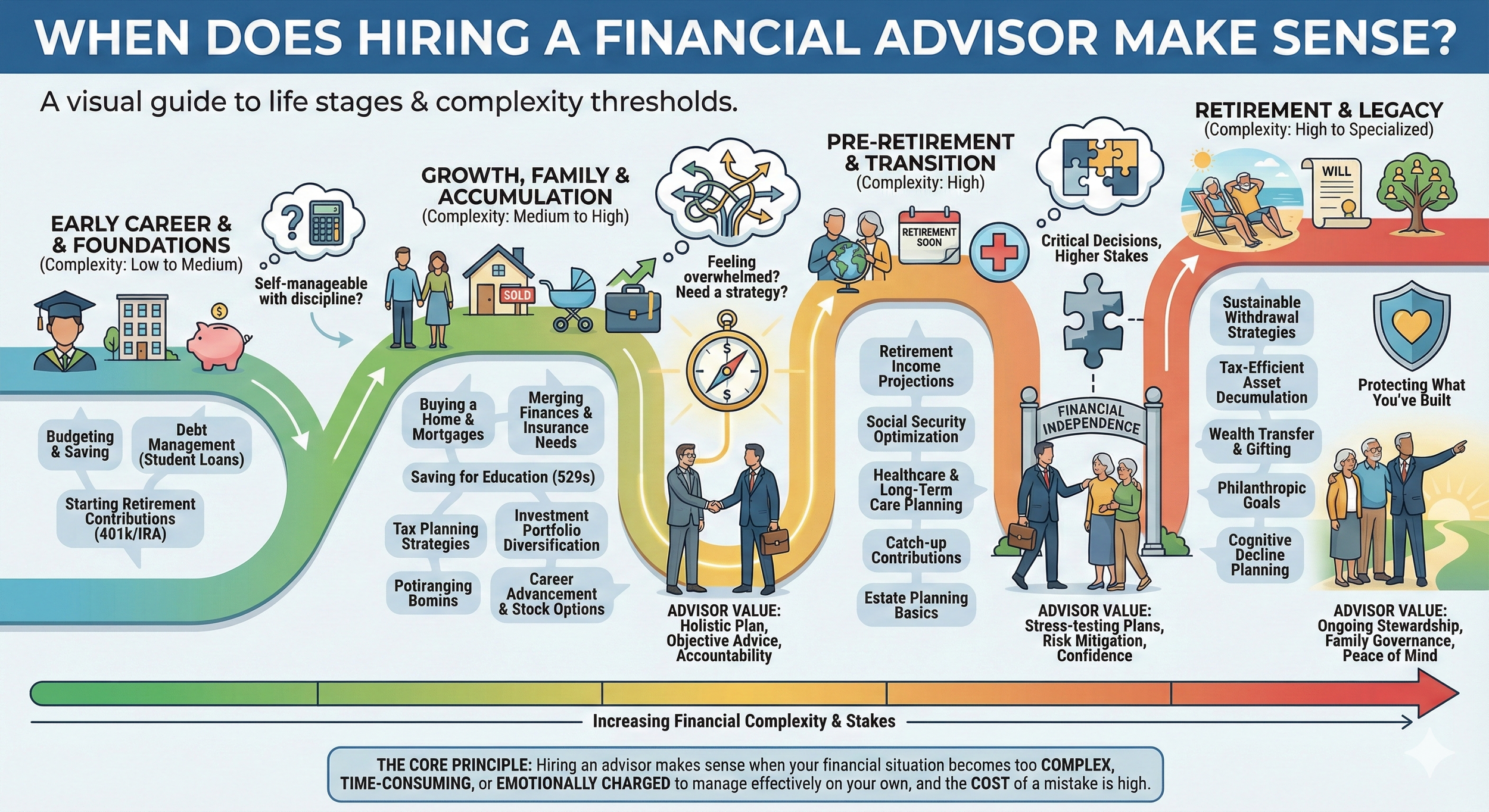
It’s not about a magic net worth number; it’s about the complexity of your life. Discover why high-earning professionals and business owners are moving away from DIY management and how to distinguish between a salesperson and a true fiduciary partner who is legally bound to put your interests first.