How to Find the Right Financial Advisor When You've Been Disappointed Before
Someone recently described the search for a good financial advisor as trying to find a dolphin in a sea of sharks. It is a memorable way to put it, and if you have hired an advisor before and come away underwhelmed, it probably lands.
Here is what I would gently offer, though. When people tell me about the advisors who disappointed them, the story is rarely about a shark. It is not usually that someone was dishonest or out to take advantage. It is that the advisor did not add enough value, or was not the right match for their situation, or simply was not that strong at the work. Those are valid frustrations. They are also a different problem than the metaphor suggests, and the difference matters, because it changes what you are looking for. This lines up with the research, too. When Morningstar asked investors who had left an advisor why they did it, the reasons they gave most often were the quality of the advice and the quality of the relationship, not investment performance [1].
If the problem were sharks, your job would be to spot the predator. But if the people who let you down were honest and just not a fit, then you are not hunting for the rare good one in dangerous water. You are screening for the specific advisor whose focus lines up with your life. That is a much more solvable search, and it helps to be clear about how to run it.
What sets the best advisors apart
A quick note on where I am coming from, because it shapes how I think about this. Alongside working with my own clients, I do contracted planning work for other advisors, which means I have seen the actual planning output behind dozens of practices. They are not all the same. And much of what separates the strongest advisors from the rest is not charisma, or a confident market call, or a good story. It tends to come down to whether there is a detailed analysis and a completed written plan, with concrete action items that move your situation forward.
That is the part a lot of people have never actually experienced. When I ask someone whether a past advisor built them a written financial plan (not a portfolio, not a product, a plan), the answer is often no. If that is your history, it is possible you have not yet tried the thing that tends to deliver the value you were hoping for. You may have been sampling investment managers while hoping to end up with a planner. Those are not the same job.
Types of advisors you might meet
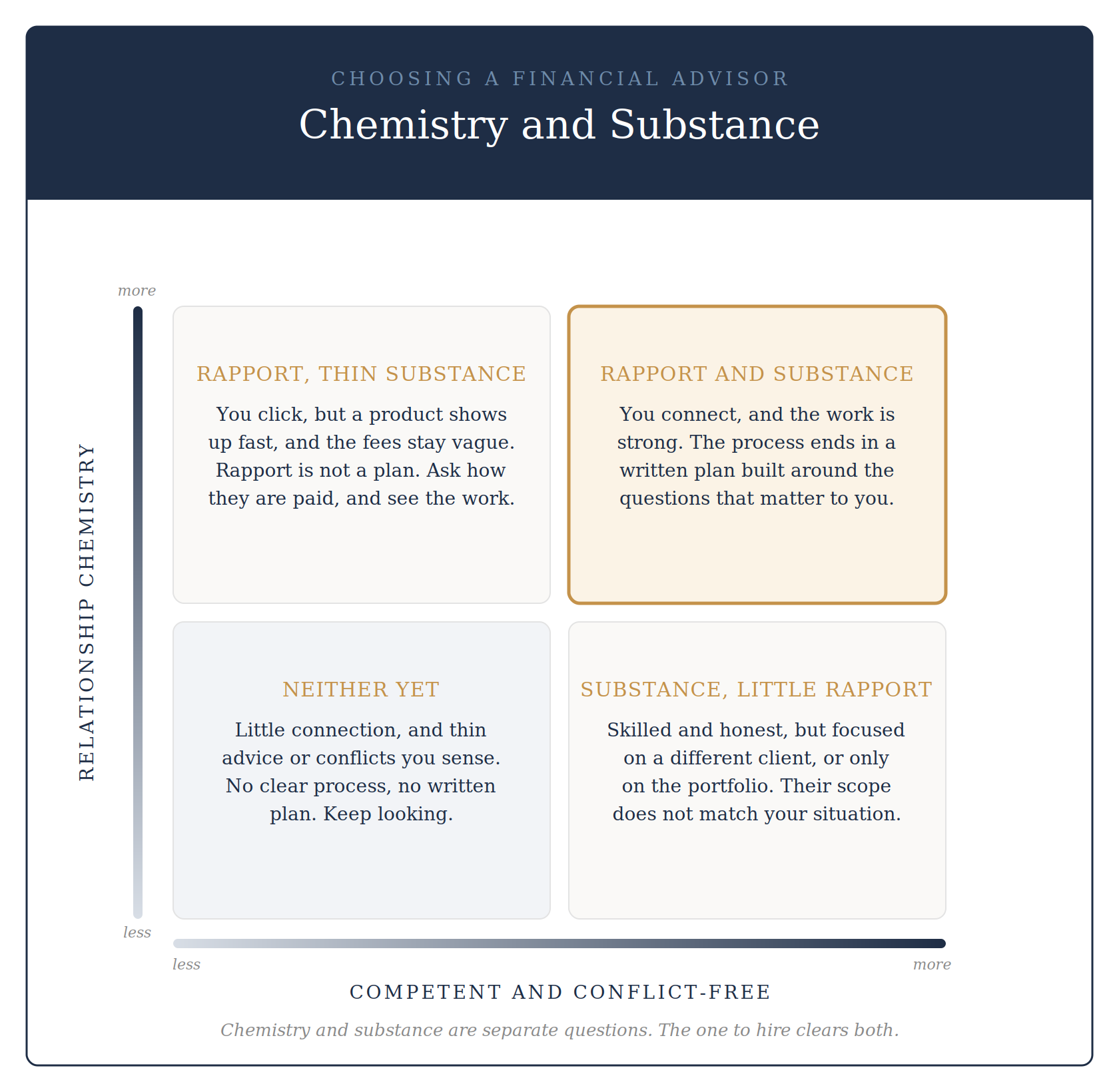
It helps to separate the advisor you should avoid from the three other situations people tend to lump in with them, because they call for different responses.
The one to avoid usually gives themselves away through structure, not dishonesty. Watch how they are paid, and how quickly a product enters the conversation. If the first answer for most people who walk in is a commission-based annuity, insurance policy, or REIT, that is a reason to slow down. Those tools can fit when a plan calls for them. They just should not be the default answer for everyone. Vague fees and an inability to describe their own process belong here too.
The ethical, competent advisor who will not add enough value for you often does solid investment management and stops there. If your situation is layered (taxes, equity compensation, a pension option election, business income), someone who only manages portfolios cannot reach far enough to help. Nothing is wrong with them. Their scope just does not match your needs.
The excellent advisor who is not your fit tends to specialize in a different kind of client, or to communicate on a different wavelength than the one you want. They may be very good at what they do. It just does not map onto the decisions in front of you.
The advisor who is likely to be exceptional for you is the one whose process ends in that written plan, who asks about your life before recommending anything, and whose focus lines up with your actual questions. Here is the single most useful screening move: ask an advisor to describe their ideal client, and who they are not a good fit for. The strong ones will happily tell you. That willingness to send you elsewhere is one of the better signals you will get.
What to look for, and what to avoid
The signals I trust most: a fee-only fiduciary, in writing, not just when it happens to be convenient. An advisor who asks far more than they tell in a first meeting, and who is curious about your goals and worries before mentioning a product. A defined process that ends in a written plan with concrete next steps, not just an account statement. Someone who can explain how they add value beyond returns, and who will coordinate with (or even help you find) your CPA and attorney rather than staying narrowly in their lane.
The warning signs, whether they point to mediocre or simply a poor fit: product and performance talk in the first conversation, dodging the “how do you get paid” question, one portfolio that somehow suits everybody, no written plan at all, urgency, and talking more than listening. None of those require bad intent. They just tend to predict disappointment.
What to stop focusing on, and what to watch instead
If I could change one habit, it would be the focus on performance and past returns. When you ask people why they hired an advisor in the first place, beating the market is rarely the reason. In that same Morningstar research, return performance accounted for only about 11% of the reasons people gave for leaving an advisor [1]. It is not reliably repeatable either, and using it as your scorecard sets you up to be unimpressed by good advisors and dazzled by ones who simply rode a rising market.
Two things deserve more of your attention, and the usual online checklists tend to skip both. First, whether this person will build you an actual written plan and help coordinate your whole financial picture, rather than sell you one slice of it. Second, whether you trust them to help you stay steady in a frightening market. A checklist can confirm that someone is a fiduciary and how they charge. It cannot tell you whether this is the person who helps you hold the line in the next downturn, which is one of the places the value lives.
Where to go from here
If you are weighing a few advisors right now, try this: ask each of them to walk you through their planning process, and to show you what a finished plan actually looks like. How they answer will tell you a lot, and it moves the conversation off performance and onto the work that tends to matter. If you would like to see what that kind of process looks like up close, I would be glad to walk you through how I approach it, and what a finished plan tends to include.
Sources
[1] Danielle Labotka and Samantha Lamas, “Why Do Investors Fire Their Financial Advisor?” Morningstar, 2023.
Disclosures
The views and opinions reflected in the content are subject to change at any time without notice. The content speaks only as of the date indicated. Some information was obtained from external sources. The information is believed to be accurate, but there is no guarantee that it is.
This content is for educational purposes only and does not constitute personalized tax, legal, or investment advice. Consult a qualified CFP®, CPA, or attorney before taking action.
Fiduciary Financial Advisors is a registered investment adviser. Nothing here constitutes individualized investment advice. Examples are illustrative only and not recommendations. No guarantee of future results. Third-party data is not independently verified.
CFP® and CERTIFIED FINANCIAL PLANNER® are certification marks owned by the CFP Board.
