
In my experience, Roth conversions are one of the more common topics new clients want to talk about. People have usually read an article or heard someone they know mention them. They suspect a conversion might help, and then they get stuck, because the answer to “should I do one?” depends on numbers that are hard to see without modeling your own plan year by year. It tends to be a hard decision to evaluate from the outside, and a general rule of thumb that does not fit your situation may point you the wrong way.
This article covers what a conversion is, the difference between your marginal bracket and your effective rate, the considerations and pitfalls that come with it, and a framework for gauging how relevant a conversion is likely to be for you.
What a Roth Conversion Is
A conversion moves money from a pre-tax retirement account, such as a traditional IRA or an old workplace plan, into a Roth account (frequently a Roth IRA). You pay income tax on the amount you move in the year you move it, and from then on it grows as Roth, with qualified distributions in retirement not subject to further federal income tax, provided the applicable Roth requirements are met [2].
A few mechanics before going further:
A conversion is different from contributing directly to a Roth IRA account. Direct Roth IRA contributions are capped and phase out at higher incomes; a conversion has no income limit, so having a high income does not prevent you from converting. How much you can convert, and how it is taxed, depends on your situation: an employer plan may not allow conversions while you still work there, and if you hold any after-tax basis in your IRAs, the pro-rata rule determines how much of a given conversion is taxable.
The tax is due for the year you convert. In most cases, the strategy tends to work better when you pay that tax from money outside the retirement account, rather than withholding it from the amount being converted.
Whether the earnings come out qualified depends on your age and how long you have had a Roth IRA open (generally five years, and generally after age 59½), so it helps to keep in mind when you might need the funds before you convert [2].
Here is the main idea when doing a Roth Conversion, you are choosing to pay tax now, at a rate you know, instead of later, at a rate you may be able to reasonably estimate (based on current tax law and your current trajectory) but cannot know for certain. Then the follow-up question is whether that trade favors you.
Effective Rate vs. Marginal Bracket
Your marginal bracket is the rate on your next dollar of income. In 2026 a married couple filing jointly sits in the 12% bracket on taxable income between $24,801 and $100,800, and steps up to 22% above that [3]. Your effective rate is the total federal income tax you pay divided by your income, which is lower than your top bracket, because the early dollars are taxed at 10% and 12% before any of your income reaches 22%.
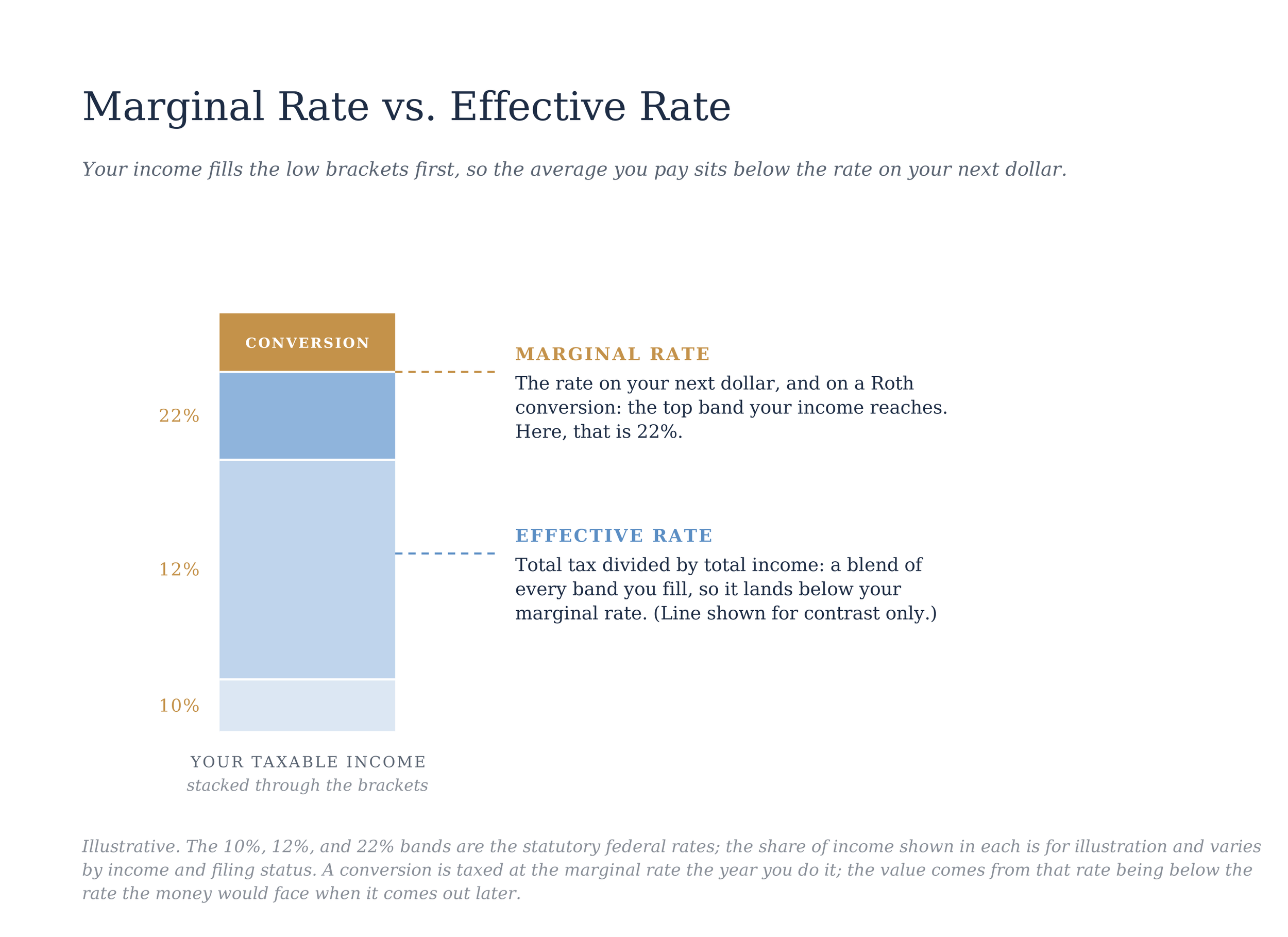
Income is taxed in layers. Your marginal rate is the rate on the top layer, and on a conversion; your effective rate is the blended average across every layer, which sits lower. The statutory rates are fixed; the share of income in each bracket varies by person/couple.
A conversion is taxed at the marginal rate. The dollars you convert stack on top of your other income (for simplicity, I’m ignoring capital gains tax), so they are taxed at your marginal rate and, if the conversion is large enough, they may push part of the converted amount into the next bracket up. The reason a conversion may help is that the marginal rate you pay to convert today is lower than the rate those same dollars would face when they come out later. So a conversion generally makes sense when you have reason to believe your tax rate today is lower than it will be in the future.
Filling a Bracket vs. Sitting Between Brackets
The common rule of thumb is to convert enough each year to reach the top of your current bracket, no more. When your future rate is clearly higher than your current one, that rule holds up reasonably well. The rule breaks down when your income already sits partway up a bracket and is likely to stay in that same bracket for the rest of your retirement (especially in wide brackets like the 22% & 24% brackets). In that case, the right amount usually sits somewhere in the middle: filling the bracket to its top may be overkill, while converting nothing may be a missed opportunity.
An illustration (round numbers, not a real client, and 2026 tax rates). Say a retired couple has about $70,000 of taxable income, which puts them in the 12% bracket with roughly $30,000 of room before the 22% bracket begins. The shortcut says: convert $30,000, fill the 12% bracket, then stop. Those conversion dollars are taxed at 12%, and the bracket has been ‘filled’.
The question that rule skips is what those dollars would have cost later. If you project this couple forward through the years when Social Security and required minimum distributions turn on, and their taxable income settles somewhere in the same 12% band, then it’s possible they may have incurred more in taxes than they otherwise would have paid by filling up the 12% bracket in earlier years. Filling the bracket to its ceiling, in that case, means pre-paying 12% today to avoid a future rate that is 12% or less. You have given up the use of the tax money for years and gotten little rate advantage in return.
However, that is different from a couple whose untouched pre-tax balance is large enough that future required distributions would spill over into the 22% bracket. For them, converting up through the top of the 12% bracket now heads off 22% dollars later, and the rule of thumb works in their favor.
So the useful question is not “how do I fill my bracket.” It is “does converting this next dollar cost me less in taxes now, than it would cost me (or my heirs) later.” When your income sits between two brackets and looks likely to stay there, the answer is often a moderate, steady conversion that nudges your effective rate up toward where it is headed anyway, smoothing the rate you pay across the whole retirement rather than topping off a bracket for its own sake. Smaller conversions of that kind may still make sense even when the pure rate arbitrage isn’t obvious.
The cheapest conversion years are often the “gap years” in early retirement, after you stop working but before Social Security and required distributions switch on, when your taxable income may be temporarily lower.
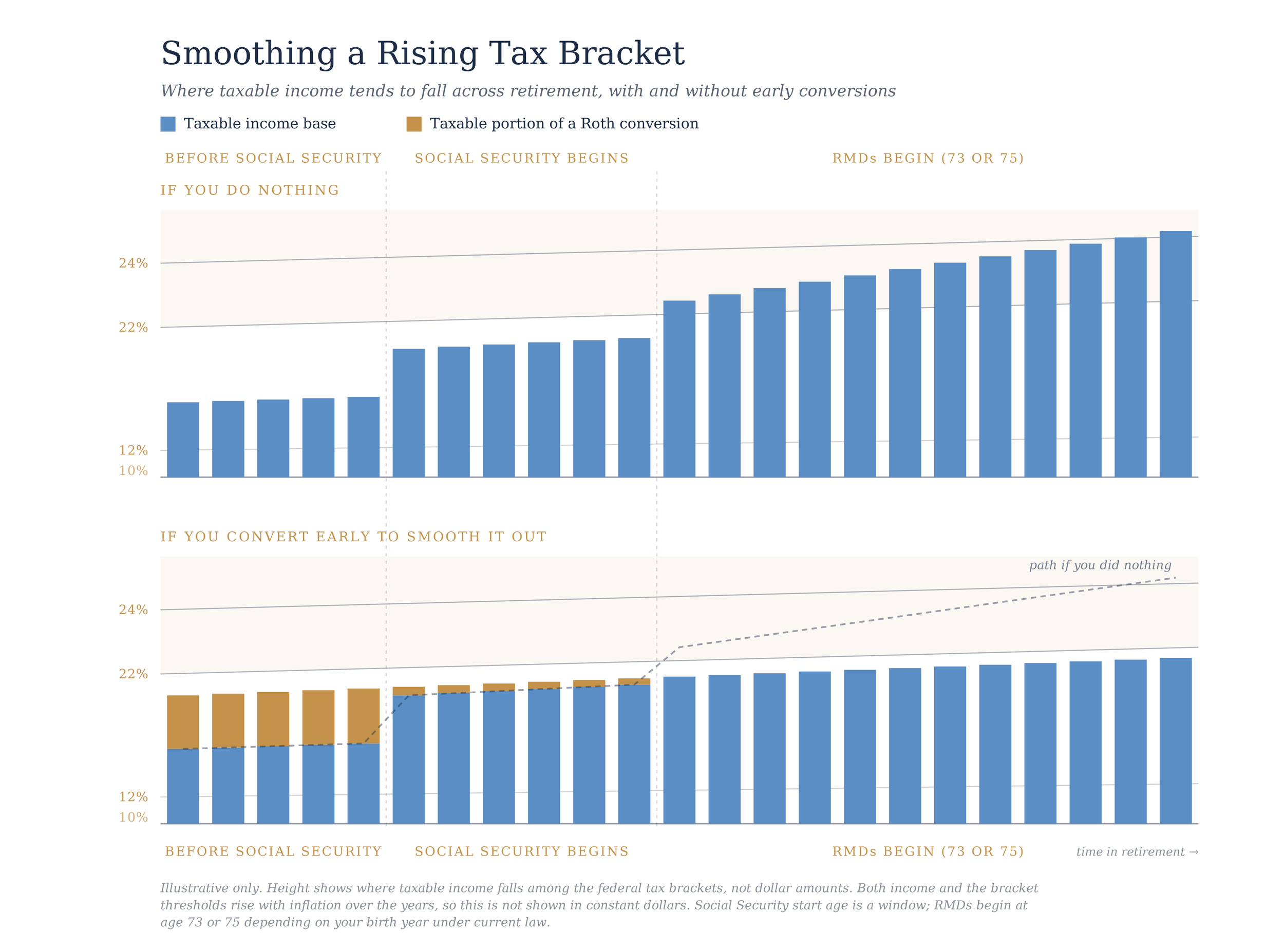
Illustrative. Both income and the bracket thresholds rise with inflation over time. Left alone (top), taxable income steps up when Social Security starts and again when RMDs begin, crossing into higher brackets. Converting early (bottom) uses the low-bracket room up front, so the income path stays smoother and inside a lower bracket. Height shows which bracket the income falls in, not dollar amounts.
Converting at a 0% Rate
Picture a retired couple whose income is mostly Social Security, with a little interest or a small pension on top. Only part of Social Security is ever taxable. A couple who are both 65 or older in 2026 and file jointly may qualify for a $32,200 standard deduction, an additional $1,650 for each spouse age 65 or older, and, through 2028, a $6,000 senior deduction per eligible spouse under the 2025 tax law [7]. Depending on their income and eligibility, these deductions could reduce their federal taxable income.
For a household like that, small conversions each year are inexpensive to make tax-wise. They convert an amount that keeps taxable income at or near zero, pay little or no federal tax on it, and move money out of the pre-tax account into a Roth. Done over a stretch of years (the aforementioned window), this chips down the pre-tax balance that would later drive required distributions, builds a Roth balance whose qualified distributions generally do not add to a future year’s taxable income (useful if a large one-time need ever comes up, so it does not push up their bracket or their Medicare premiums), and could leave their heirs Roth assets rather than a traditional IRA, whose distributions would be taxable to the heir as ordinary income.
The catch, and the reason this is a modeling question rather than a back of the napkin one, is Social Security’s own math. Adding conversion income raises the “provisional income” figure that determines how much of your Social Security is taxable, so past a point each conversion dollar may pull additional Social Security into the taxable column, and the marginal rate begins to climb faster than the bracket table alone may suggest [7]. The room to convert at a 0% rate may exist, but it tends to be smaller, and it is easy to potentially overshoot. This is a case where modeling the actual numbers is important. (One lasting benefit runs the other way: qualified Roth distributions later generally do not count in that provisional-income figure, so the Roth balance you build now is less likely to pull more of your Social Security into tax down the road.)
Deduction amounts reflect federal tax law for the 2026 tax year. The additional senior deduction is subject to eligibility requirements and income-based phaseouts. Actual deductions and taxable income depend on filing status, income sources, and individual circumstances. Consult a qualified tax professional regarding your specific situation.
Considerations and Pitfalls
Now that we have covered what a Roth Conversion is, and how to think about sizing them, it’s important to remember the conversion does not happen in isolation. There are a number of other factors to consider, with the following not being an exhaustive list (they are the more common ones that come to mind).
Medicare premiums (IRMAA). Once you are on Medicare, your premiums for Part B and Part D carry a surcharge (the income-related monthly adjustment amount, or IRMAA) once your modified adjusted gross income crosses certain thresholds. In 2026 the first threshold sits at $109,000 for a single filer and $218,000 for a married couple filing jointly [4]. Two features make it easy to mishandle when converting. First, it works on a two-year lookback, so a conversion you do in 2026 affects your 2028 premiums [4] (for example, your tax return at age 63 determines your age 65 rates when Medicare traditionally begins). Second, it is a cliff rather than a ramp: a single dollar over a threshold moves you into the next tier, and the surcharge applies per person for a couple. Poorly sized conversions in the years just before or during Medicare may create IRMAA surcharges for a stretch of years that intentional planning could have avoided. The mirror image is also true. Converting earlier, before required distributions push your ongoing income up, may keep you under an IRMAA threshold later, after Social Security and RMDs begin, when the surcharge would otherwise recur every year.
Withholding the tax before age 59½. When you convert, you can have the tax withheld from the amount being converted (which is generally not advised to do to begin with), but any portion withheld counts as a distribution rather than a conversion. Before age 59½, that withheld portion may be subject to the 10% early distribution penalty unless an exception applies, on top of the income tax. Paying the conversion tax from outside the retirement account avoids this and keeps the full amount growing in the Roth.
Your rate versus your heirs’ rate. If you expect to leave retirement accounts to your children, both of your respective tax rates are important to consider. Under current law, most non-spouse heirs must empty an inherited IRA within 10 years of your death [6]. Distributions from an inherited traditional IRA are ordinary income to the heir, stacked on top of whatever they already earn. An heir who inherits in the middle of their career, near their peak earnings, may pay tax on those distributions at a high marginal rate. Qualified distributions from an inherited Roth, by contrast, are generally not subject to further federal income tax, provided the decedent’s Roth met the five-year holding requirement; the 10-year window still applies, but the distributions themselves are not taxed as ordinary income the way traditional IRA distributions are. Converting during your own lower-rate years may move the tax off their higher-rate years. This depends on their situation and on tax law staying roughly where it is, so treat it as a factor rather than a certainty. (Surviving spouses are treated differently and generally have more options, so this point is mainly about children and other non-spouse heirs.)
Asset location. Doing some conversions gives you a Roth bucket (if you don’t already have one), and having at least two of the three tax treatments available (pre-tax, Roth, and taxable) opens up asset location: holding different types of investments in the account where each is taxed most gently. I wrote about this separately, and the interaction with conversions is one reason the two decisions should be discussed together. See: Asset Location Strategy.
The survivor’s brackets. When one spouse dies, the survivor usually begins filing as a single taxpayer the following year, and the single brackets are compressed (the 12% bracket for a single filer ends at $50,400 in 2026, versus $100,800 for a couple) [3]. The same income that sat comfortably in the 12% bracket as a couple may land in 22% for the survivor, and the IRMAA thresholds tighten too. The age gap between spouses influences this piece. The wider the gap, the longer the survivor is likely to spend filing single, which lengthens the stretch of years those compressed brackets and tighter IRMAA thresholds apply. Converting while both spouses are alive and filing jointly may reduce the pre-tax balance that would otherwise be taxed at the survivor’s higher single rates.
No required distributions on Roth accounts. Under current law, traditional accounts require you to start taking distributions at age 73 (rising to 75 for those born in 1960 or later), whether you need the money or not [5]. Roth IRAs have not required lifetime distributions from the original owner, and since 2024 Roth balances in employer plans (a Roth 401(k) or 403(b)) no longer require them during your lifetime either [5]. Money you convert keeps compounding untouched, and you keep control over the timing of withdrawals, which is part of what makes conversions useful for managing IRMAA and the survivor’s-bracket problem above.
Possible lifetime tax savings. Put together, the case for a conversion is the sum of the rate you save across your own retirement, plus what you may save your heirs, minus the IRMAA and other frictions, weighed against the years you lose use of the tax money. Whether that sum is positive depends on your future rates, your investment returns, how long you live, and where tax law lands, none of which anyone knows for certain in advance. This is why conversions are hard to evaluate by rule of thumb, and why modeling your own unique numbers is important.
A conversion cannot be undone. Since 2018, a Roth conversion cannot be reversed. Before then you could reverse one (the term was “recharacterization”), but the Tax Cuts and Jobs Act removed that option for conversions [1]. Because the result is locked in, a market drop just after you convert, or income that lands higher than you planned, cannot be walked back, so it helps to convert in stages and confirm the year’s numbers before you finalize the amount.
Tax law can change. Every projection in this area rests on today’s rules, because current law is the only concrete thing to plan against. The 2025 law made the current rate structure “permanent,” but permanent in tax terms only means until a later Congress decides otherwise, and rates, bracket sizes, RMD ages, etc. have all moved before. A conversion is essentially a bet that the rate you lock in today beats an unknown future rate, and that uncertainty runs both ways: if rates later rise, converting now tends to look better in hindsight; if they fall, it may look worse. Because a conversion cannot be undone, you are committing to today’s rate either way. I plan around current law because it is a realistic estimate, and that is part of why I personally lean toward steady, moderate conversions over large one-time ones, since spreading the decision across years keeps any single year from being a big bet on one (educated) guess about the future (not to mention all the other unknown variables like markets and inflation).
How Likely Are Roth Conversions to Be Relevant to You?
In my opinion, there is not really a fixed order to this decision, so much as a handful of factors that, taken together, tell you how likely conversions are to be relevant to your situation. None of them settles it alone, but the more of them that line up, the more a closer look (and some modeling) may be worth your time.
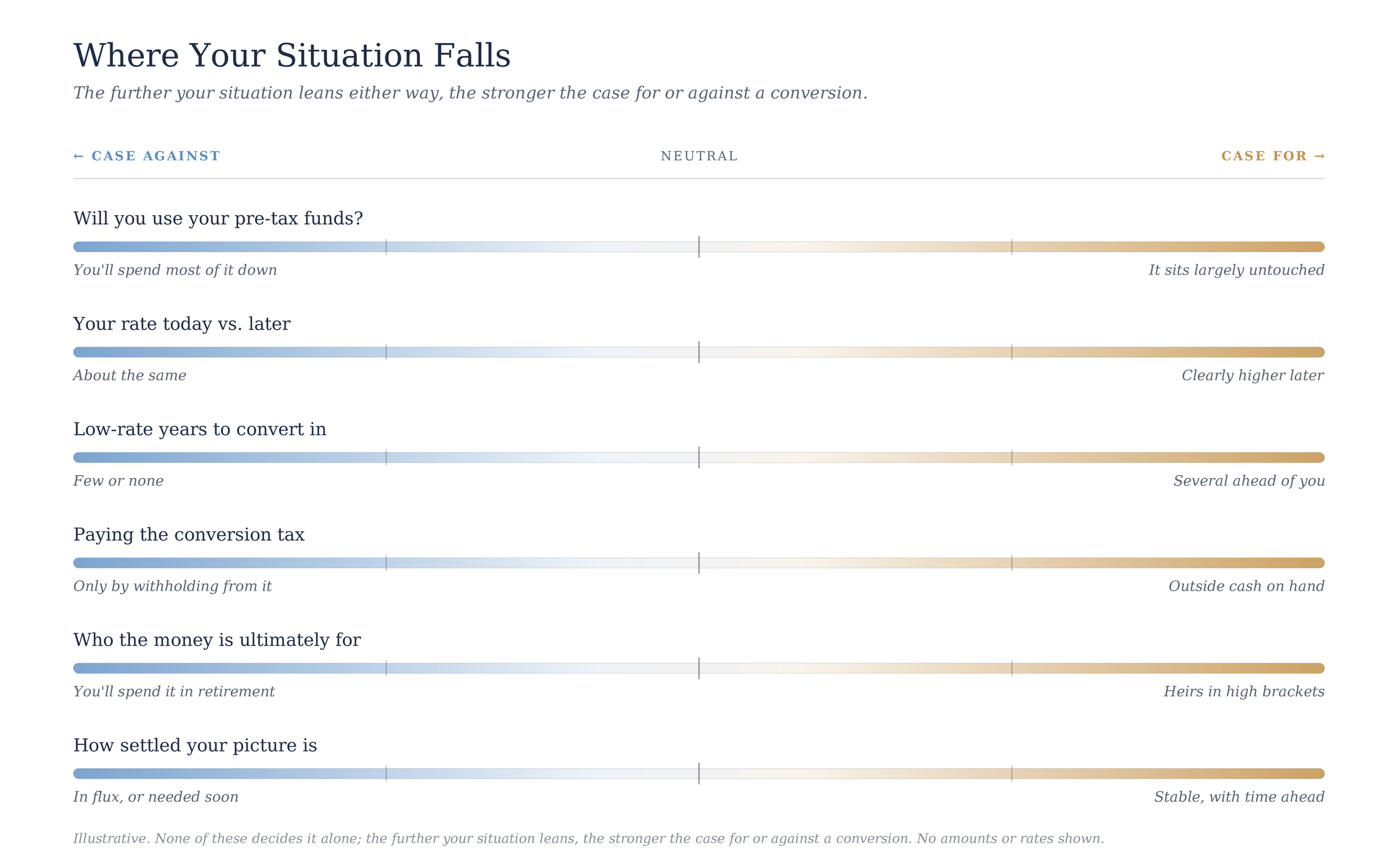
Illustrative. The further each factor leans, the stronger the case for or against a conversion; none decides it alone. No amounts or rates shown.
How much of your pre-tax funds will you be using? This is usually the first thing I look at. If your Social Security, any pension, and your other income are likely to cover your lifestyle, your pre-tax accounts may sit largely untouched and keep growing until required distributions force the money out later, often at a higher rate than you would pay today. The less you expect to lean on those accounts, the more a conversion strategy tends to be relevant.
How big is the gap between your rate today and your rate later? The whole case for a conversion is paying a lower rate now than those dollars would face later. That later rate can be driven up by required minimum distributions, by a surviving spouse filing single, by heirs in high brackets, or by tax rates rising generally. The wider and more confident you are of that gap, the more relevant conversions become.
Do you have low-rate years to work with? The early-retirement “gap years” before Social Security and required distributions begin, or any stretch where your taxable income is unusually low, are when conversions are cheapest. The more of those years you have ahead of you, the more room there is to convert at a favorable rate.
Can you pay the tax from outside the account? A conversion works best when the tax is paid from money outside the retirement account, so you aren’t generating additional income to afford the conversions. If the only way to cover it would be to withhold from the conversion itself, the math likely weakens (and under age 59½ that withholding can carry a penalty). Outside cash to pay the tax makes conversions more workable.
Who is this money ultimately for? If leaving retirement accounts to children or other non-spouse heirs is part of the plan, their likely tax rates push the question toward relevance, since inherited traditional IRA distributions are taxable to them as ordinary income, while qualified inherited Roth distributions generally are not.
How settled is the rest of your picture? Because a conversion cannot be undone and rests on assumptions about the future, it fits best when your income and plans are reasonably stable and you have time before you need the money.
Put simply, the household most likely to benefit has a sizable pre-tax balance it will not need to spend all of, lower-income years available to convert in, a taxable brokerage (subject to capital gains) or cash on hand to pay the tax, and good reason to believe its rate will be higher later. The further your situation sits from that picture, the less a conversion is likely to change your outcome, though it is rarely all-or-nothing.
Questions to Ask
If you are weighing a conversion, these are the questions to put on the table, whether you are working through it yourself or with someone:
What is my marginal rate this year, and what is my best estimate of my rate (and my heirs’ rate) in the years the money would otherwise come out?
Which of my upcoming years are the low-income ones, and how many of them are there?
Where are the IRMAA thresholds for the years two years ahead of each conversion?
What would my pre-tax balance and my required minimum distributions look like if I convert nothing?
If I am married, what happens to these numbers for whichever of us is the survivor?
Can I pay the conversion tax from outside the retirement account?
Working Together
Roth conversions sit right at the intersection of tax brackets, Medicare, Social Security timing, estate planning, and investments, which is why they are hard to judge with a simple rule and easier to judge when you can see your own plan modeled over a series of years. I am a fee-only CERTIFIED FINANCIAL PLANNER® professional, and I work with individuals and families weighing exactly these decisions. If you would like to talk through whether a conversion fits your situation, you can book a time below.
Sources
[1] Internal Revenue Service, Publication 590-A, “Contributions to Individual Retirement Arrangements (IRAs)” (recharacterization of a conversion no longer permitted for conversions made after 2017). https://www.irs.gov/forms-pubs/about-publication-590-a
[2] Internal Revenue Service, “Roth IRAs” (https://www.irs.gov/retirement-plans/roth-iras) and Publication 590-B, “Distributions from Individual Retirement Arrangements (IRAs)” (https://www.irs.gov/forms-pubs/about-publication-590-b) (tax treatment of conversions and qualified distributions, five-year rule).
[3] Tax Foundation, “2026 Tax Brackets and Federal Income Tax Rates” (2026 brackets and standard deduction; OBBBA made the TCJA rate structure permanent), citing IRS Revenue Procedure 2025-32. https://taxfoundation.org/data/all/federal/2026-tax-brackets/
[4] Centers for Medicare and Medicaid Services 2026 Medicare Part B and Part D figures, as summarized in Kiplinger, “Medicare Premiums 2026: IRMAA Brackets and Surcharges for Parts B and D” (2026 IRMAA thresholds; two-year MAGI lookback). https://www.kiplinger.com/retirement/medicare/medicare-premiums-2026-irmaa-brackets-and-surcharges-for-parts-b-and-d
[5] Internal Revenue Service, “Retirement plan and IRA required minimum distributions FAQs” (RMD age 73; Roth IRA and designated Roth accounts not subject to lifetime RMDs for the owner; beneficiary rules). https://www.irs.gov/retirement-plans/retirement-plan-and-ira-required-minimum-distributions-faqs
[6] SECURE Act 10-year rule for most non-spouse beneficiaries; see IRS Publication 590-B, “Distributions from Individual Retirement Arrangements (IRAs).” https://www.irs.gov/forms-pubs/about-publication-590-b
[7] Tax Foundation, “2026 Tax Brackets” (2026 standard deduction and additional age-65 deduction) and “How Does the Additional Senior Deduction Compare to No Tax on Social Security?” (OBBBA $6,000 senior deduction for 2025 through 2028, phaseouts, and confirmation that the provisional-income rules for taxing Social Security are unchanged). https://taxfoundation.org/blog/no-tax-on-social-security-senior-tax-deduction/ ; for the provisional-income formula itself, IRS Publication 915, “Social Security and Equivalent Railroad Retirement Benefits.” https://www.irs.gov/forms-pubs/about-publication-915Disclosures
Disclosures
The views and opinions reflected in the content are subject to change at any time without notice. The content speaks only as of the date indicated. Some information was obtained from external sources. The information is believed to be accurate, but there is no guarantee that it is.
This content is for educational purposes only and does not constitute personalized tax, legal, or investment advice. Consult a qualified CFP®, CPA, or attorney before taking action.
Fiduciary Financial Advisors is a registered investment adviser. Nothing here constitutes individualized investment advice. Examples are illustrative only and not recommendations. No guarantee of future results. Third-party data is not independently verified.
CFP® and CERTIFIED FINANCIAL PLANNER® are certification marks owned by the CFP Board.
