
CalPERS Retirement Payment Options
Unmodified Allowance vs. Options 1-4 and How to Think About Survivor Benefits
Most of the decisions you make on the way to retirement can be revisited. You can change how much you put into Savings Plus. You can adjust your investment mix. You can move your retirement date if the math looks better.
The retirement payment option you select on your application works differently. You choose it once, it takes effect when your first check is issued, and outside of a short list of qualifying life events, it stays in place for the rest of your life and your beneficiary’s life. There are ways to change it later, but they are narrow, they are defined in advance, and which ones are open to you depends on the option you picked to begin with. This is one of the few CalPERS decisions I’d tell a client to slow down on.
If you work for SMUD, this applies to you the same way it applies to a state employee in Sacramento. SMUD contracts with CalPERS and contributes on behalf of eligible employees [11], so SMUD retirees make the same irrevocable election on the same application.
What the Option Election Involves
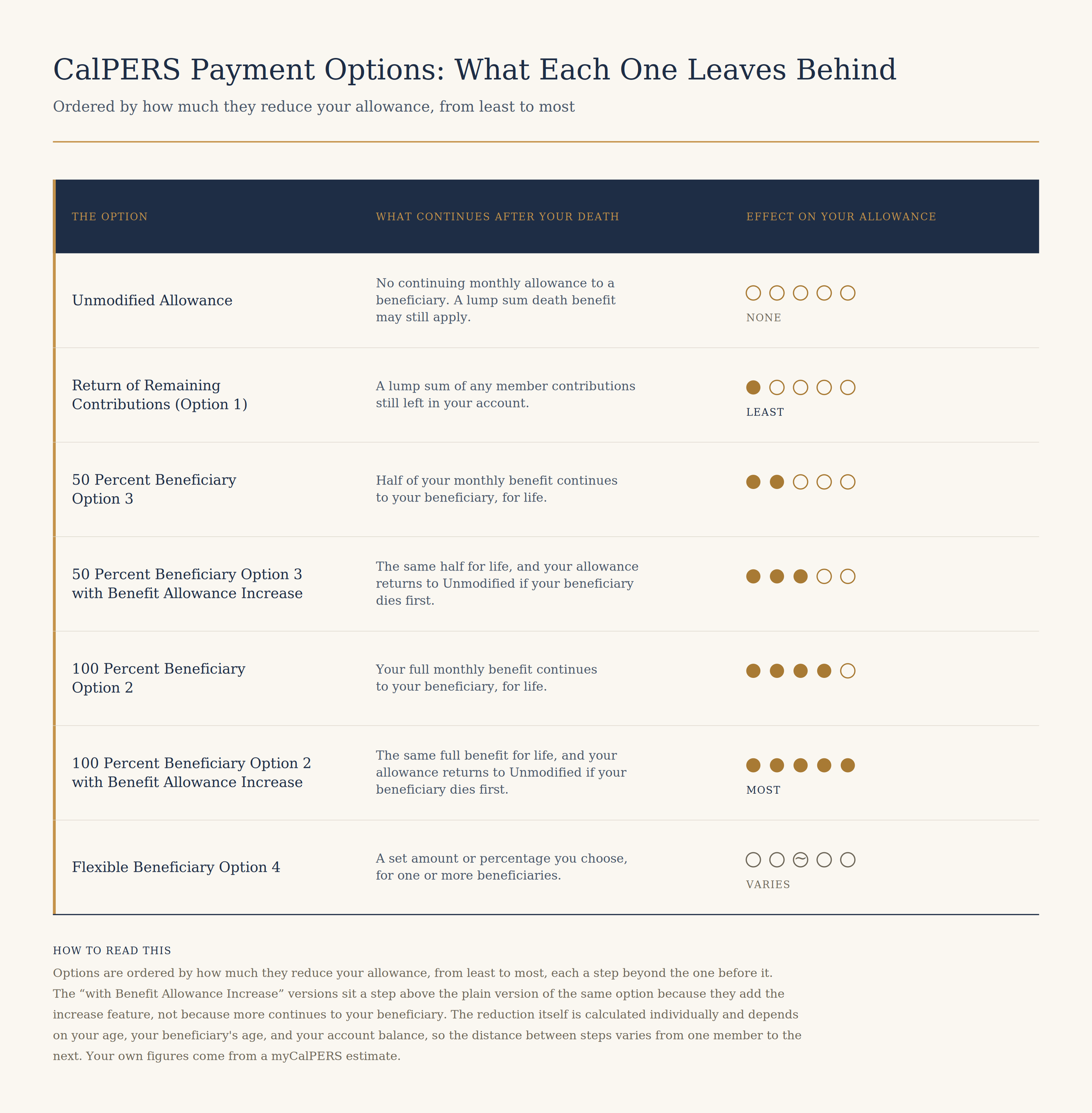
Every option other than the Unmodified Allowance involves the same type of trade-off. You accept a smaller monthly allowance during your lifetime in exchange for something continuing after your death.
The size of that reduction is not a fixed percentage. It depends on your age, your beneficiary’s age, both life expectancies, and how much you have contributed to the plan [1]. A member naming a spouse ten years younger may see a larger reduction than a member naming a spouse of the same age, because CalPERS expects to pay the continued benefit for longer [13].
What you are really doing is shifting income out of your own lifetime and into a joint one, and CalPERS prices that shift to be actuarially close to neutral. So the useful question isn’t whether the trade is a good deal in the abstract. It’s whether this particular income pattern fits for your situation.
The Current Option Menu
The “Options 1 through 4” language most people have heard describes the system through the end of 2017. The Retirement Option Simplification (AB 2404) consolidated and renamed the options for anyone retiring on or after January 1, 2018 [2][3]. If you are retiring now, the current menu runs from the Unmodified Allowance (the largest payment to you) through Option 1, the 50 and 100 percent beneficiary options and their Benefit Allowance Increase variants, to the Flexible Option 4 [1][2].
Two features of that menu may cause some confusion. The “with Benefit Allowance Increase” versions, which older members and some HR staff still call the pop-up, cost more than the plain version and buy one thing: if your beneficiary dies before you, your allowance climbs back to the Unmodified amount instead of staying reduced [1]. And the Flexible Beneficiary Option 4, despite the name, is not an open drafting tool; it lets you name a set dollar amount or percentage for one or more people, and the available forms are fixed [2][3][4].
A Word on Option 1
Return of Remaining Contributions looks like a low-cost middle ground, and the reduction is smaller than some of the other options. The catch is the word “remaining.” Your contributions are drawn down as your allowance is paid, and CalPERS states in its own retiree materials that in most cases nothing remains after roughly ten years of retirement, at which point Option 1 pays your beneficiary nothing while your allowance stays permanently reduced [7]. Think of it as protection against dying early in retirement rather than a way to leave an estate, and it tends to lose value the longer you live. If your goal is really to leave something behind, that’s usually a balance-sheet conversation rather than a pension-election one. (Separately, a small lump sum Retired Death Benefit, from $500 to $5,000 depending on your employer’s contract, is payable under any option and carries its own beneficiary designation you can update anytime [7].)
Survivor Continuance and How It Interacts With Your Election
This benefit sits outside the option election, and it may change the analysis.
Some CalPERS employers contract for a benefit called Survivor Continuance. Where/when it applies, an eligible survivor receives a continuing monthly allowance after your death regardless of which payment option you elected, including the Unmodified Allowance [6]. The amount is generally one half of your Unmodified Allowance if you were not covered by Social Security in your CalPERS service, one quarter if you were, and somewhere between the two if you were covered for part of your career [5].
The continuance and the option benefit are separate portions: elect a beneficiary option and your survivor may receive both, which together could end up equaling what you were receiving [5].
One practical planning nuance: because they are separate, they don’t have to be the same; you can name a child as your option beneficiary while your spouse independently qualifies for the continuance [5]. Two things CalPERS doesn’t spell out are ones to ask about against your own estimate: who exactly qualifies as an eligible survivor (the definition turns on the relationship and how long it has existed), and whether the option reduction is figured on your full Unmodified Allowance or only on the portion above the continuance, which changes the math [5]. Whether your employer contracts for this benefit at all is a fact about your employer, so confirm it in writing before you file.
I get into why this matters for the actual decision in the framework below. For now, the thing to hold onto is that the continuance can act as a floor under the whole election, even if you go with the unmodified allowance.
Retiree Health Coverage for a Surviving Spouse
For a lot of households, this could matter more than the monthly dollars.
Where retiree health coverage runs through CalPERS, a surviving spouse or partner generally keeps that coverage only if they were an eligible dependent at the time of death and they receive a continuing monthly check, either a Survivor Continuance or a monthly benefit from the option you elected [7][9]. CalPERS states the point directly for members who marry after retirement: if you want a new spouse or domestic partner to be eligible for continued health or dental coverage upon your death, you have to choose an option that provides them an ongoing monthly benefit [7]. If neither applies, coverage typically ends, and the survivor may instead be temporarily eligible for COBRA, which depends on certain qualifying events, rather than continuing retiree coverage [6].
If you’re a SMUD retiree, check this separately. SMUD runs its own retiree medical plans and contributes toward premiums on its own schedule [12], so the rule lives in SMUD’s plan documents rather than the CalPERS health program. The question you’re asking is the same; the place you find the answer is different.
What You Can and Cannot Change Later
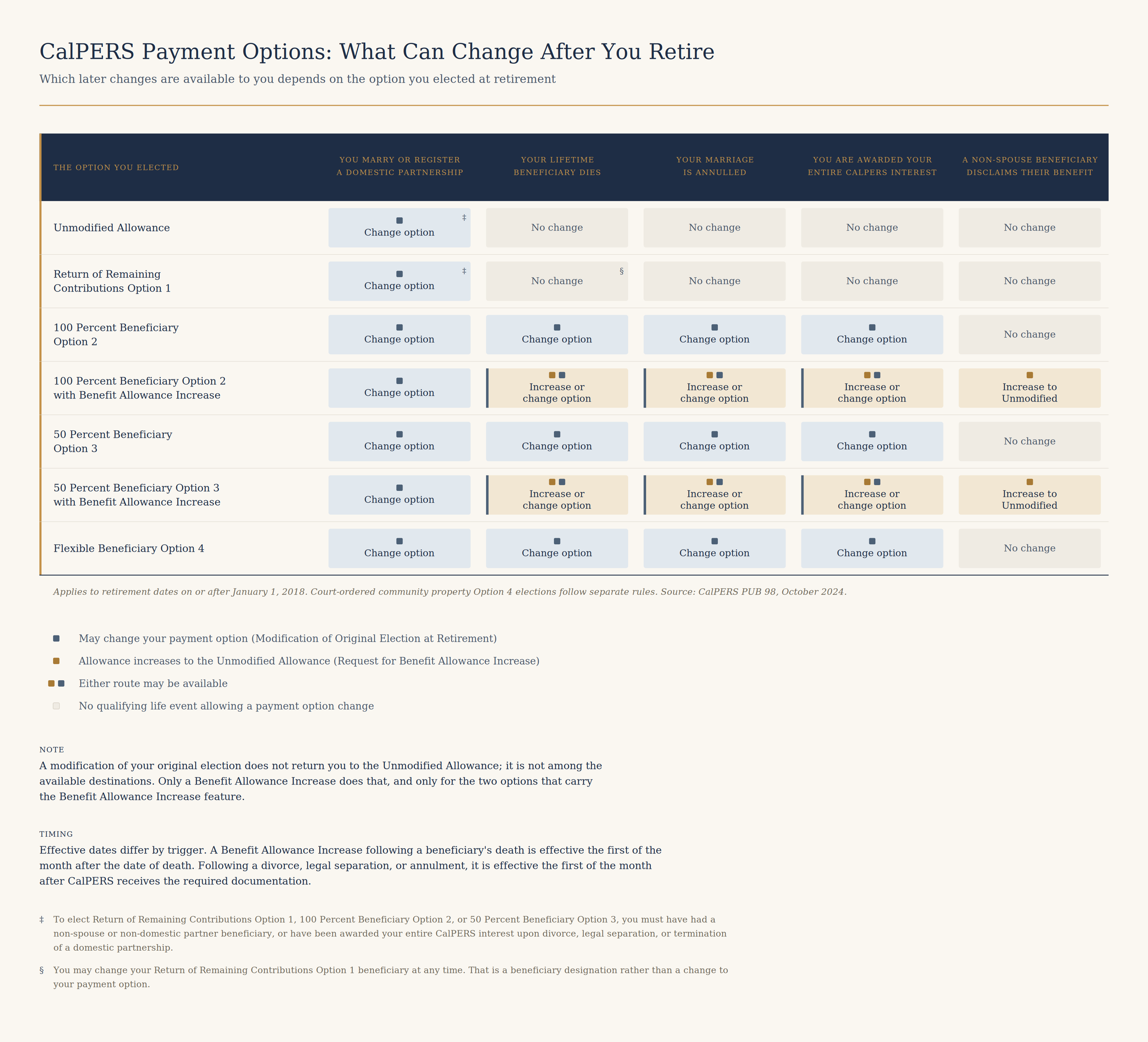
The election is durable, but it technically isn’t permanently sealed. There are limited ways to revisit it, and they depend on what you chose up front. There are really two separate mechanisms here, and they are important to keep straight.
The first mechanism is an automatic increase back to the Unmodified Allowance, available only if you elected one of the “with Benefit Allowance Increase” versions (or plain Option 2 or 3 before January 1, 2018). It triggers when your beneficiary dies, or on divorce, annulment, or a non-spouse beneficiary’s disclaimer, and you file a Request for Benefit Allowance Increase [7]. This is essentially the feature you paid for with a reduction, and effective dates run from the event or from when CalPERS receives your paperwork [7].
The second is a modification of your original election, to name a new lifetime beneficiary or move to a different option, triggered by marriage, a domestic partnership, your beneficiary’s death, annulment, or being awarded your entire CalPERS interest in a divorce [7]. Which of those helps you depends on what you hold. If you elected the Unmodified Allowance or Option 1, marriage or a new domestic partnership is the only event that lets you change your option [7]. If you elected any of the beneficiary options, all of the events are open to you, but with one asymmetry to know about before you file: a member who outlives their beneficiary can name someone new or switch options, but cannot return to the Unmodified Allowance. The permanent reduction stays; only its purpose changes [7].
Three details carry consequences. A modification reduces your allowance again to fund the new beneficiary, and your COLA and Purchasing Power Protection Allowance are recalculated on the new, lower base [7]. The timing rule is the one that catches people. Elect within 12 months of the event, and it takes effect the next month. Elect later than that, and the change is deferred a further 12 months, and both you and your new beneficiary have to be living on that deferred date, or it can’t process [7][8]. And two things that look like they should qualify do not: marrying someone you already named as beneficiary (they are already your beneficiary), and a non-spouse beneficiary disclaiming their benefit, which removes them but does not let you name a replacement [7].
The Spousal Signature Requirement
If you are married or have a registered domestic partner, your spouse or partner generally must sign your retirement application. The exception is narrow. Their signature is not required where the option you elected provides them 100 percent of your monthly allowance, meaning the 100 Percent Beneficiary Option 2 or that option with the Benefit Allowance Increase, and you also named them as sole beneficiary for any lump sum benefits [10].
The Size of the Reduction
CalPERS does not appear to publish a general option factor table in its member materials. The reduction is calculated individually, and the ways to see your own number are a myCalPERS estimate or a Benefit Estimate Letter. The factors themselves are actuarial equivalents built from Board-adopted assumptions, which are revised through an experience study roughly every four years [4].
The Effect of the Beneficiary’s Age
The age difference between you and your beneficiary is one of the larger variables in the reduction.
CalPERS states the relationship plainly in its member education material: the cost depends on the ages of both you and your beneficiary at the time of retirement, and the younger your beneficiary, the greater the reduction to your pension to fund their benefit [13]. The same applies to the Flexible Beneficiary Option 4, where the reduction while you are alive depends on your beneficiary’s age and on the dollar amount or percentage you select [13].
CalPERS does not appear to publish a table showing how much the gap moves the number. The practical workaround is that the myCalPERS Retirement Estimate Calculator accepts a beneficiary date of birth, so running the same estimate more than once with different dates shows the sensitivity in your own case. If you are weighing a continuance against life insurance, run that comparison first, since a large age gap tends to increase the reduction to your pension, which could make life insurance a cost-effective alternative.
For readers who want to see worked numbers, a 2015 CalPERS staff analysis published an illustrative reduction for each option using a single average-retiree profile (Retirement Options Simplification, Agenda Item 5, Attachment 1). Treat it as one dated example rather than a schedule: it predates the 2017 and 2021 experience studies, and it describes one age pairing rather than yours.
A Framework for Deciding
The options aren’t ranked, and I can’t tell you which one is best in the abstract, because it depends entirely on your household. What I can give you is the order I’d think through it in. Work these six questions in sequence, and each one narrows the field before you get to the next.
1. Does anyone actually depend on your pension income?
If no one relies on this income after you’re gone (no spouse, no partner, no dependent), then a reduced option means paying for a lifetime reduction to fund a benefit nobody needs. The Unmodified Allowance is probably the sensible default there, and any wish to leave something behind could be handled on your balance sheet rather than inside the pension. If someone does depend on it, keep going.
2. Is there a Survivor Continuance floor underneath the whole decision?
Some employers contract for Survivor Continuance, which pays an eligible survivor a portion of your allowance (often one half, or one quarter if you were covered by Social Security in your CalPERS service) regardless of which option you pick, including the Unmodified Allowance [5][6]. Where it applies, the Unmodified Allowance does not leave your spouse with zero; it leaves them with the floor. That reframes the entire question: an option is no longer buying your survivor’s whole income, only the gap between the floor and what they would actually need. Confirm in writing whether your employer contracts for it, because it is employer-specific, not a CalPERS default [5].
3. Does your spouse’s health coverage ride on this election?
This is the consequence that potentially dwarfs the monthly dollar consideration. Where retiree health runs through CalPERS, a surviving spouse generally keeps coverage only if they receive a continuing monthly check, either a Survivor Continuance or a benefit from the option you elected [7][9]. Elect the Unmodified Allowance with no continuance underneath it, and coverage can end, with COBRA as a time-limited fallback rather than lifetime retiree coverage [6]. The premium your survivor would pay to replace it can exceed the income the Unmodified Allowance gained you, which means a beneficiary option is sometimes buying health coverage that doesn’t show up anywhere in the income comparison. (SMUD retirees confirm this separately: SMUD runs its own retiree medical plans, so the rules live in SMUD’s documents, though the question is identical [12].)
4. How much does your age gap move the price, and how healthy are you both?
The reduction is individual and grows the younger your beneficiary is relative to you, because CalPERS expects to pay the continuance longer [13]. Run your own myCalPERS estimate more than once, changing the beneficiary date of birth, to see the sensitivity in your case. Then sit with the question the actuarial tables only answer on average: who is likely to outlive whom? The full-continuance options and their pop-up variants are effectively a bet on that answer. That’s fine, as long as you’re making the bet on purpose rather than by default.
5. Does your survivor need lifetime income, a lump sum, or neither?
A spouse with limited independent retirement income and a long life expectancy has a different problem than an adult child who would rather have a lump sum. The first points toward a continuance option sized to the income gap from question 2. The second points toward Option 1, a Flexible Option 4 amount, or leaving the pension unmodified and solving it elsewhere. The goal is to match the benefit to what the person actually needs.
6. Have you priced the alternative before you commit?
The pension continuance is one way to protect a survivor; a life insurance policy is another, and the two are best compared rather than assumed (it’s worth noting here, I am generally not a fan of permanent life insurance, and do not personally sell life insurance, but I do think this is one of the legitimate use cases for it so long as the pricing makes sense). Ask what permanent coverage (not term that may lapse before you die) costs at your current age, whether you are insurable, and, most importantly, whether it solves only the income question or also the health-coverage question from step 3, since a death benefit does not by itself continue a CalPERS health plan. A large age gap tends to raise the cost of the continuance, which is part of why it could make sense to price out a life insurance policy (it works a little like Option 1, except the residual benefit is locked in instead of declining over time).
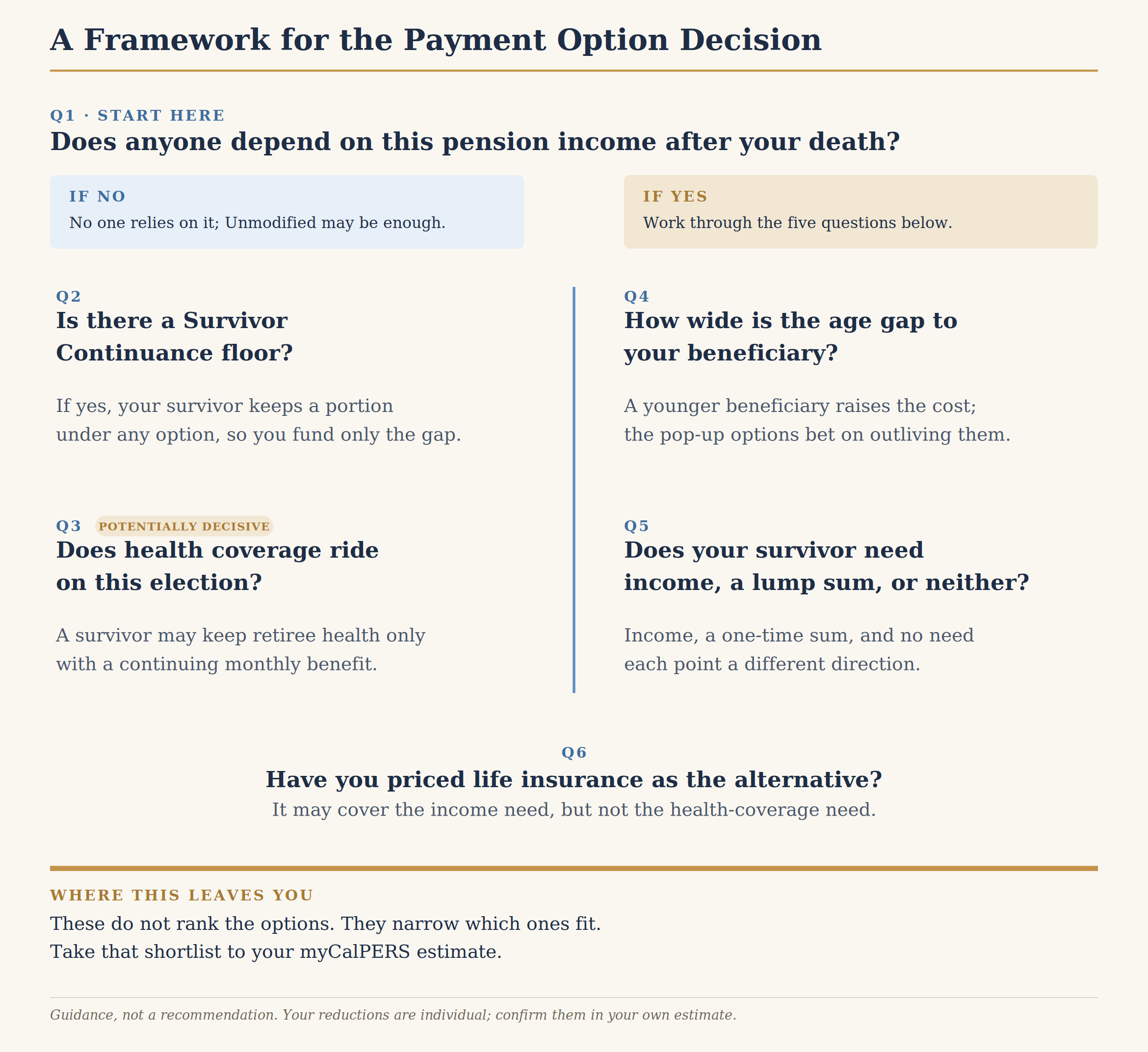
Work those six in order and hopefully you’ll usually be down to one or two options that fit your situation, instead of seven that all look plausible on paper. The estimate CalPERS gives you shows the reductions, but it can’t show you the household consequences, and in my experience the consequences are what the decision actually turns on. It’s also where working with someone tends to help, since the right answer shifts with your retirement date, your Savings Plus and 457 balances, how each spouse claims Social Security, and any coverage you’re already carrying.
If you want to work with someone who does this for CalPERS members
I'm a fee-only CFP® professional, and I work with CalPERS members across California on exactly these decisions: the timing, the tier interactions, and how the pension fits with everything saved beside it. If you'd like a second set of eyes on your own numbers, you can book a time below.
Sources
[1] CalPERS, “Curious About CalPERS Retirement Payment Options?” PERSpective, July 10, 2025.
[2] CalPERS Circular Letter 200-054-17, “2018 Retirement Options,” September 6, 2017, and the attached 2018 Retirement Options Quick Reference Sheet.
[3] Assembly Bill 2404 (Cooley), Retirement Option Simplification, 2016.
[4] CalPERS Pension & Health Benefits Committee, Agenda Item 4b, February 13, 2018 (Option 4 additional-forms staff recommendation); and Agenda Item 5, “Retirement Options Simplification,” October 20, 2015, Attachment 1 (illustrative per-option reduction amounts for one average-retiree profile), calpers.ca.gov/documents/201510-pension-item-5-attach-1/download. Actuarial assumptions underlying optional settlement factors are reviewed in the CalPERS Experience Study and Review of Actuarial Assumptions.
[5] CalPERS, Post-Retirement Survivor Benefits: Retired Member Death Benefits (PUB 60), and Post-Retirement Survivor Benefits: For Retired Members, Non-Spouse Claim (PUB 61).
[6] CalPERS, “Benefits Payable,” Death Benefits.
[7] CalPERS, What You Need to Know About Changing Your Beneficiary or Monthly Benefit After Retirement (PUB 98), October 2024, including the Retirement Option Reference Charts and the Request for Benefit Allowance Increase form.
[8] CalPERS, “Getting Hitched After Retirement? Update Your Life Option Beneficiary,” PERSpective.
[9] CalPERS, CalPERS Health Benefits Into Retirement, member education learning guide.
[10] California Government Code section 21261.
[11] SMUD, Employee Benefits, and SMUD Retiree website, Pension.
[12] SMUD, Retiree Benefit Guide.
[13] CalPERS, Your Retirement Estimate and Payment Options, member education learning guide, revised March 2023; and myCalPERS and Your Retirement Options, member education learning guide.
Disclosures
Fiduciary Financial Advisors does not accept any liability for the use of the information discussed. Consult with a qualified financial, legal, or tax professional prior to taking any action. Before investing, consider investment objectives, risks, fees, and expenses. Investments in securities involve the risk of loss, including loss of principal. Past performance is no guarantee of future returns. The views and opinions reflected in the content are subject to change at any time without notice. The content speaks only as of the date indicated. Some information was obtained from external sources. The information is believed to be accurate, but there is no guarantee that it is.
This content is for educational purposes only and does not constitute personalized tax, legal, or investment advice. Consult a qualified CFP®, CPA, or attorney before taking action.
Fiduciary Financial Advisors is a registered investment adviser. Nothing here constitutes individualized investment advice. Examples are illustrative only and not recommendations. No guarantee of future results. Third-party data is not independently verified.
CFP® and CERTIFIED FINANCIAL PLANNER® are certification marks owned by the CFP Board.
