
Understanding Your CalPERS Retirement Formula: Classic vs. PEPRA and What It Means for You
Your hire date already determined your formula. Here’s what it means for the decisions you can make.

The day you started your covered job dropped you into a retirement formula, and unlike other things in your plan, you cannot renegotiate it, buy your way out of it, or age back into a better one. A 2013 hire date and a 2012 hire date, one week apart, may mean a different pension for the same work. You can't change which formula you're in, so the whole game is reading it correctly and planning around it.

How your formula gets set
Your pension is based on a formula, not an investment balance. Three inputs, multiplied: your years of service (service credit), a benefit factor set by your age when you retire (benefit factor), and your final compensation (your highest average pay over a set window) [3]. Classic and PEPRA members have the same 3 components, but plug different numbers into them (more on that to follow).
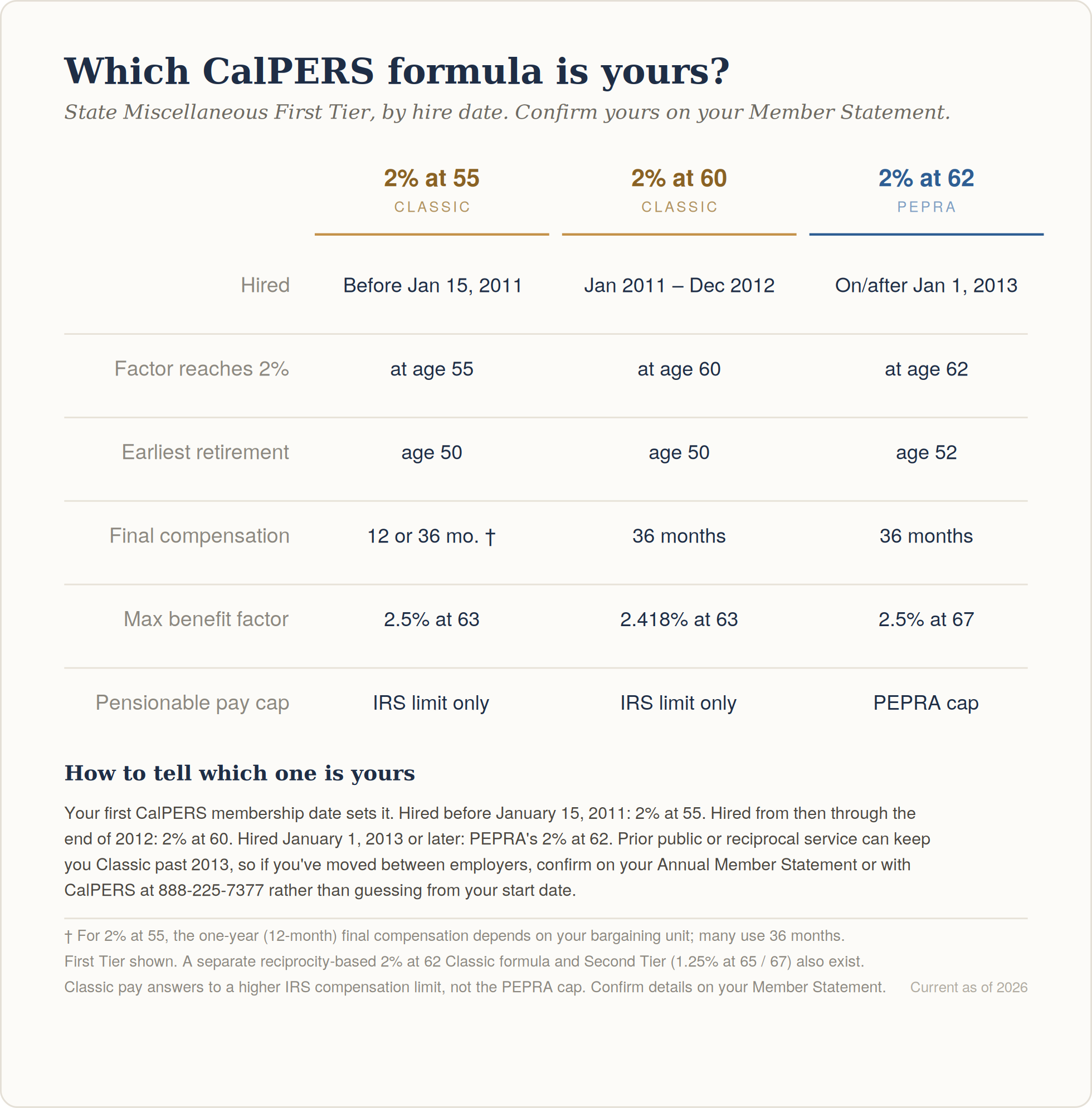
Which set of numbers you get comes down to your first membership date. State Miscellaneous splits mainly three ways. If you were first hired before January 15, 2011, you're generally on 2% at 55. From then through the end of 2012, it's (generally) 2% at 60, which at face value is the same factor but at a later age (but it does cap out at a lower factor of 2.418% instead of 2.5%). And 2013 or later puts you under PEPRA's 2% at 62 [2]. (Two more sit off to the side: a separate 2% at 62 Classic formula for certain reciprocity cases, not the same as PEPRA's despite the shared name, and the lower Second Tier formulas. If either applies to you, the numbers below shift.)
The “at” age is the tell. It's the age where your factor reaches 2% per year of service. Below it, your factor is prorated down; above it, it keeps climbing to a ceiling.
The answer to “which one am I?” is on your CalPERS Annual Member Statement, which names your formula outright. Reach for the rest only if you don't have it handy: your membership date sets the Classic/PEPRA line, your unit and hire era sort the two Classic formulas, and prior public or reciprocal service can keep you Classic past 2013. If you've moved between employers, it adds additional complexity, so confirm it rather than assume.
What your formula changes about the decisions you can still make
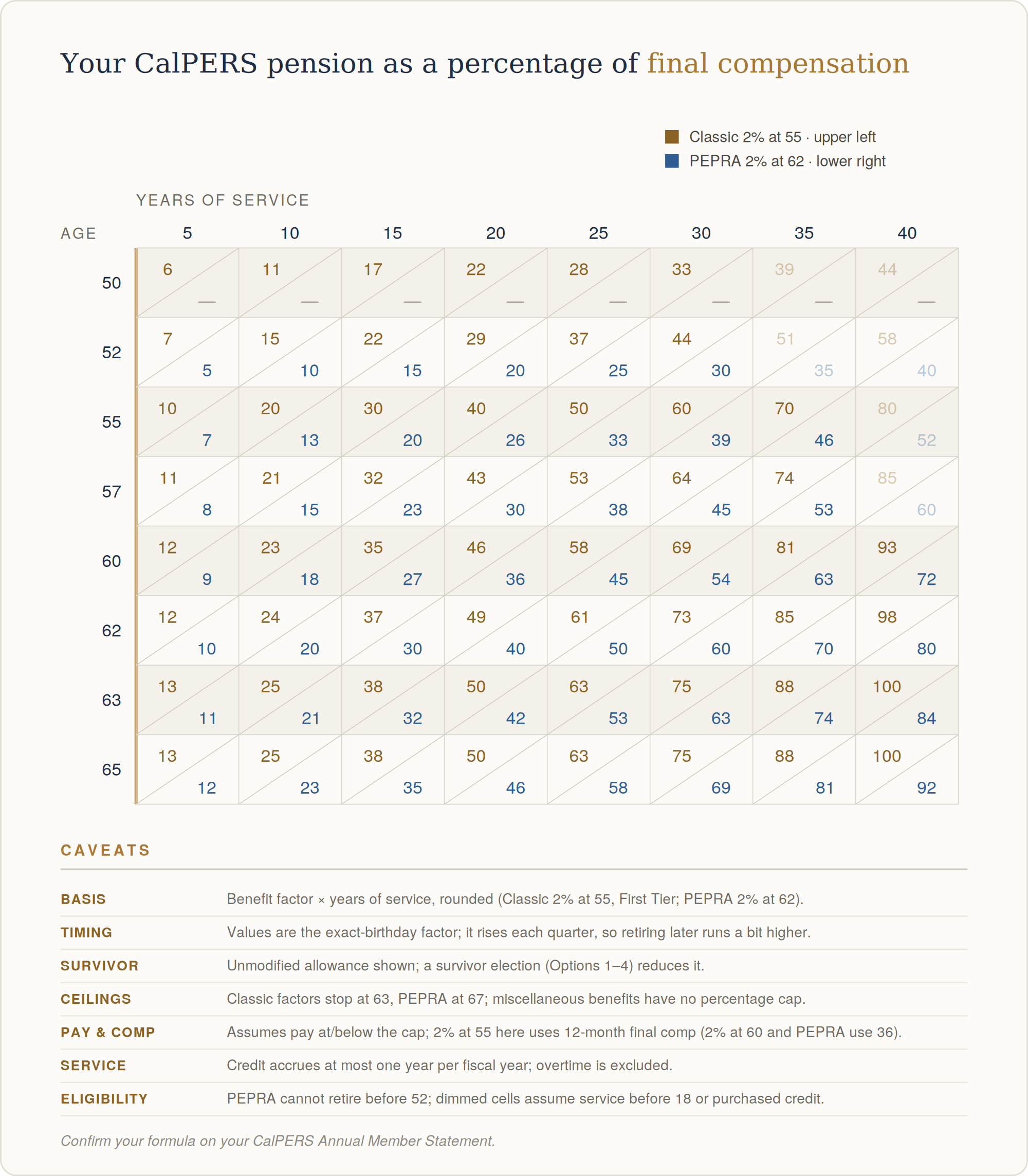
The formula itself is fixed. The three components it sits on are not, and it tilts each one a different way depending on your tier. The grid below puts the whole interaction in one view, and the diagonals are the part to slow down on. The chart shows how much of your final compensation your pension would replace based on the formula. The planning implication is that when you decide to leave, this can help you determine how much of a gap you may still need to make up with other investments and retirement income sources.
ONE-YEAR OR THREE-YEAR FINAL COMP? This isn't necessarily as straightforward as it may seem. There is a Classic-versus-PEPRA split, but also a difference depending on which bargaining unit applies to you. So even if you are a Classic member, it is possible that the Final Comp piece of your formula could be based on your highest 12, or your highest 36 consecutive months [3]. So this is important to keep in mind when you are evaluating when you retire, particularly if you happen to receive a significant pay bump.
It is also important to keep in mind that there is a pay cap that decides whether part of your paycheck is building a pension at all. The PEPRA formula caps the pay that counts toward your pension much earlier on than the Classic formula (which functionally is the IRS limit that is much less likely to even affect you [1]). If you're a PEPRA member earning above the cap, the dollars above it stop growing your pension, though your service credit keeps accruing in those years, and your Benefit factor continues to increase. (PEPRA members also generally pay at least half the normal cost of their benefits, and the employer cannot pick up the member's share [4].)
So, if you ask me, the big planning implication (which I already alluded to) in all of this is knowing how much of your future retirement income can be replaced by your pension, vs other sources. This means that utilizing Savings Plus becomes more important for members who are under the PEPRA formula, and particularly if you are over the income cap or have fewer years of service credits, since your pension benefit will likely not be replacing as much of what you need in retirement. (However, this is at the start of retirement, and you likely will want to have supplemental savings to help replace what is eroded by inflation over time either way).
Questions to Ask
● Which formula and tier apply to you, confirmed against your Annual Member Statement rather than your memory of your hire date?
● At what age does your benefit factor stop climbing, and where does your target retirement date sit relative to that?
● If you're Classic, do your planned exit and your highest 12 (or 36) months of pay actually line up?
● If you're PEPRA, what share of your target retirement income does the pension cover, and what's carrying the rest?
● Is any of your pay above the PEPRA cap, and if so, where is that income going?
If you want to work with someone who does this for CalPERS members
I'm a fee-only CFP® professional, and I work with CalPERS members across California on exactly these decisions: the timing, the tier interactions, and how the pension fits with everything saved beside it. If you'd like a second set of eyes on your own numbers, you can book a time below.
Sources
[1] CalPERS, “2026 Compensation Limits for Classic and PEPRA Members,” Circular Letter 200-001-26 (January 2, 2026).
[2] CalPERS, “Retirement Formulas and Benefit Factors.”
[3] CalPERS, “Your CalPERS Benefits: Planning Your Service Retirement” (Publication 1).
[4] California Government Code section 7522.30.
Disclosures
This article is provided by Fiduciary Financial Advisors, LLC and reflects general information that may not apply to your particular situation. Nothing in it should be relied upon as individualized advice. Please consult a qualified professional regarding your own circumstances before making decisions about your CalPERS benefits, retirement timing, or savings strategy.
The content above is for educational purposes only and is not intended as tax, legal, or investment advice. Illustrations use rounded figures to show general relationships and do not represent results any individual should expect.
Fiduciary Financial Advisors, LLC is a registered investment adviser. Registration does not imply a certain level of skill or training. Advisory services are offered only to clients or prospective clients where Fiduciary Financial Advisors, LLC and its representatives are properly licensed or exempt from licensure.
CFP® and CERTIFIED FINANCIAL PLANNER® are certification marks owned by the Certified Financial Planner Board of Standards, Inc. These marks are awarded to individuals who successfully complete the CFP Board's initial and ongoing certification requirements.
