

The CalPERS Financial Blueprint
Planning around a CalPERS pension works differently than private-sector retirement. The CalPERS Financial Blueprint is a free seven-step guide for California public employees, covering how much you need to save, how to use Savings Plus, when to time your exit, and the pension elections you cannot undo. Download it and see where your plan stands.
SEVEN STEPS to make the most of your pension, your savings, and the decisions in between
Here’s a sneak peak of what’s inside:
Step 1. Know your number
Step 2. Where that income comes from
Step 3. The election you cannot take back
Step 4. Time your exit
Step 5. Build what the pension does not cover
Step 6. Invest it well
Step 7. Do it yourself, or get help
Bonus. Common missteps

Disclosures
Fiduciary Financial Advisors does not accept any liability for the use of the information discussed. Consult with a qualified financial, legal, or tax professional prior to taking any action. Before investing, consider investment objectives, risks, fees, and expenses. Investments in securities involve the risk of loss, including loss of principal. Past performance is no guarantee of future returns. The views and opinions reflected in the content are subject to change at any time without notice. The content speaks only as of the date indicated. Some information was obtained from external sources. The information is believed to be accurate, but there is no guarantee that it is.
This content is for educational purposes only and does not constitute personalized tax, legal, or investment advice. Consult a qualified CFP®, CPA, or attorney before taking action.
Fiduciary Financial Advisors is a registered investment adviser. Nothing here constitutes individualized investment advice. Examples are illustrative only and not recommendations. No guarantee of future results. Third-party data is not independently verified.
CFP® and CERTIFIED FINANCIAL PLANNER® are certification marks owned by the CFP Board.
CalPERS Retirement Payment Options
A framework for the one CalPERS decision you can't take back, how to weigh the Unmodified Allowance against Options 1-4, and protect a survivor's income and health coverage.
Unmodified Allowance vs. Options 1-4 and How to Think About Survivor Benefits
Most of the decisions you make on the way to retirement can be revisited. You can change how much you put into Savings Plus. You can adjust your investment mix. You can move your retirement date if the math looks better.
The retirement payment option you select on your application works differently. You choose it once, it takes effect when your first check is issued, and outside of a short list of qualifying life events, it stays in place for the rest of your life and your beneficiary’s life. There are ways to change it later, but they are narrow, they are defined in advance, and which ones are open to you depends on the option you picked to begin with. This is one of the few CalPERS decisions I’d tell a client to slow down on.
If you work for SMUD, this applies to you the same way it applies to a state employee in Sacramento. SMUD contracts with CalPERS and contributes on behalf of eligible employees [11], so SMUD retirees make the same irrevocable election on the same application.
What the Option Election Involves
Every option other than the Unmodified Allowance involves the same type of trade-off. You accept a smaller monthly allowance during your lifetime in exchange for something continuing after your death.
The size of that reduction is not a fixed percentage. It depends on your age, your beneficiary’s age, both life expectancies, and how much you have contributed to the plan [1]. A member naming a spouse ten years younger may see a larger reduction than a member naming a spouse of the same age, because CalPERS expects to pay the continued benefit for longer [13].
What you are really doing is shifting income out of your own lifetime and into a joint one, and CalPERS prices that shift to be actuarially close to neutral. So the useful question isn’t whether the trade is a good deal in the abstract. It’s whether this particular income pattern fits for your situation.
The Current Option Menu
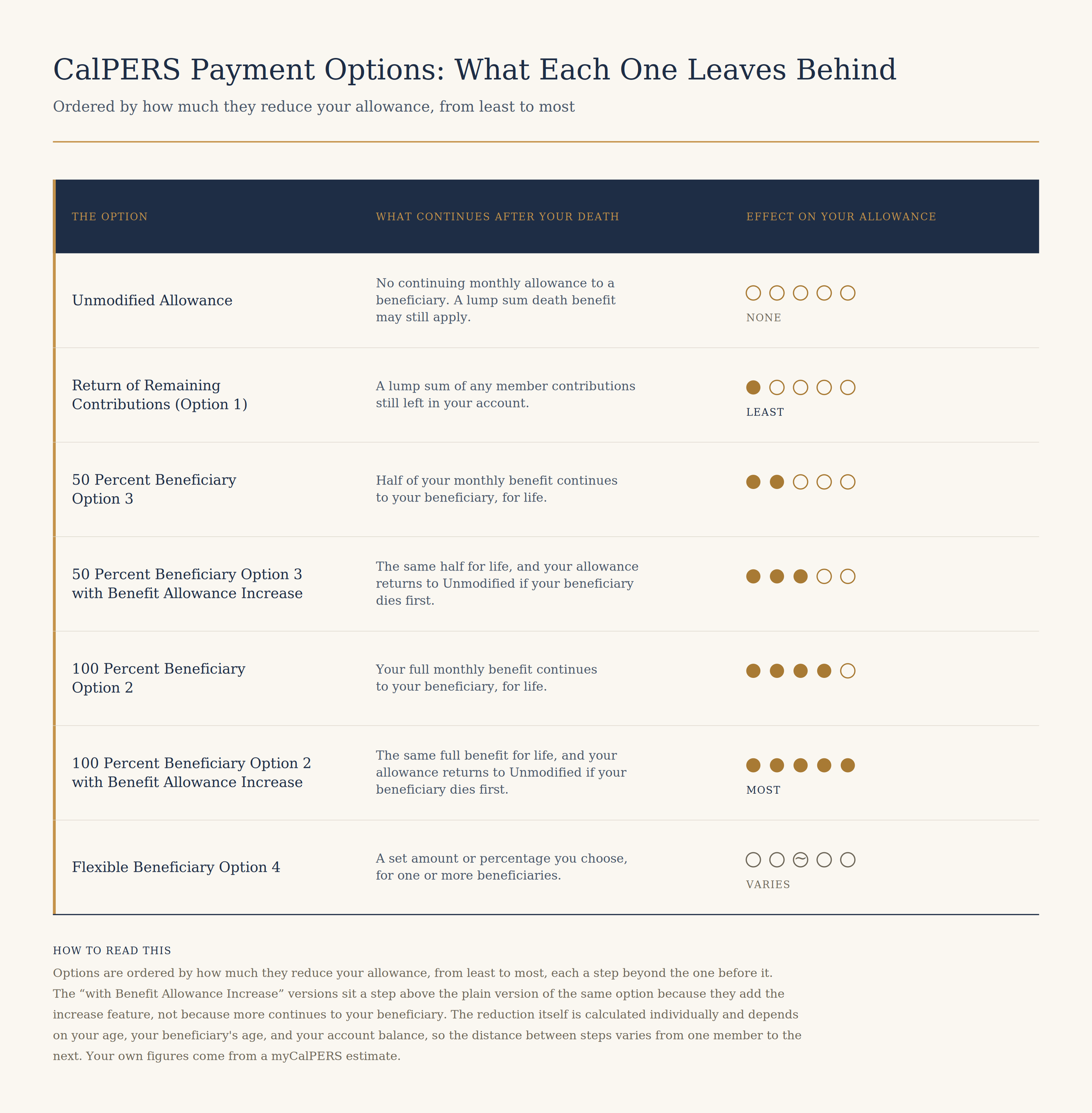
The “Options 1 through 4” language most people have heard describes the system through the end of 2017. The Retirement Option Simplification (AB 2404) consolidated and renamed the options for anyone retiring on or after January 1, 2018 [2][3]. If you are retiring now, the current menu runs from the Unmodified Allowance (the largest payment to you) through Option 1, the 50 and 100 percent beneficiary options and their Benefit Allowance Increase variants, to the Flexible Option 4 [1][2].
Two features of that menu may cause some confusion. The “with Benefit Allowance Increase” versions, which older members and some HR staff still call the pop-up, cost more than the plain version and buy one thing: if your beneficiary dies before you, your allowance climbs back to the Unmodified amount instead of staying reduced [1]. And the Flexible Beneficiary Option 4, despite the name, is not an open drafting tool; it lets you name a set dollar amount or percentage for one or more people, and the available forms are fixed [2][3][4].
A Word on Option 1
Return of Remaining Contributions looks like a low-cost middle ground, and the reduction is smaller than some of the other options. The catch is the word “remaining.” Your contributions are drawn down as your allowance is paid, and CalPERS states in its own retiree materials that in most cases nothing remains after roughly ten years of retirement, at which point Option 1 pays your beneficiary nothing while your allowance stays permanently reduced [7]. Think of it as protection against dying early in retirement rather than a way to leave an estate, and it tends to lose value the longer you live. If your goal is really to leave something behind, that’s usually a balance-sheet conversation rather than a pension-election one. (Separately, a small lump sum Retired Death Benefit, from $500 to $5,000 depending on your employer’s contract, is payable under any option and carries its own beneficiary designation you can update anytime [7].)
Survivor Continuance and How It Interacts With Your Election
This benefit sits outside the option election, and it may change the analysis.
Some CalPERS employers contract for a benefit called Survivor Continuance. Where/when it applies, an eligible survivor receives a continuing monthly allowance after your death regardless of which payment option you elected, including the Unmodified Allowance [6]. The amount is generally one half of your Unmodified Allowance if you were not covered by Social Security in your CalPERS service, one quarter if you were, and somewhere between the two if you were covered for part of your career [5].
The continuance and the option benefit are separate portions: elect a beneficiary option and your survivor may receive both, which together could end up equaling what you were receiving [5].
One practical planning nuance: because they are separate, they don’t have to be the same; you can name a child as your option beneficiary while your spouse independently qualifies for the continuance [5]. Two things CalPERS doesn’t spell out are ones to ask about against your own estimate: who exactly qualifies as an eligible survivor (the definition turns on the relationship and how long it has existed), and whether the option reduction is figured on your full Unmodified Allowance or only on the portion above the continuance, which changes the math [5]. Whether your employer contracts for this benefit at all is a fact about your employer, so confirm it in writing before you file.
I get into why this matters for the actual decision in the framework below. For now, the thing to hold onto is that the continuance can act as a floor under the whole election, even if you go with the unmodified allowance.
Retiree Health Coverage for a Surviving Spouse
For a lot of households, this could matter more than the monthly dollars.
Where retiree health coverage runs through CalPERS, a surviving spouse or partner generally keeps that coverage only if they were an eligible dependent at the time of death and they receive a continuing monthly check, either a Survivor Continuance or a monthly benefit from the option you elected [7][9]. CalPERS states the point directly for members who marry after retirement: if you want a new spouse or domestic partner to be eligible for continued health or dental coverage upon your death, you have to choose an option that provides them an ongoing monthly benefit [7]. If neither applies, coverage typically ends, and the survivor may instead be temporarily eligible for COBRA, which depends on certain qualifying events, rather than continuing retiree coverage [6].
If you’re a SMUD retiree, check this separately. SMUD runs its own retiree medical plans and contributes toward premiums on its own schedule [12], so the rule lives in SMUD’s plan documents rather than the CalPERS health program. The question you’re asking is the same; the place you find the answer is different.
What You Can and Cannot Change Later
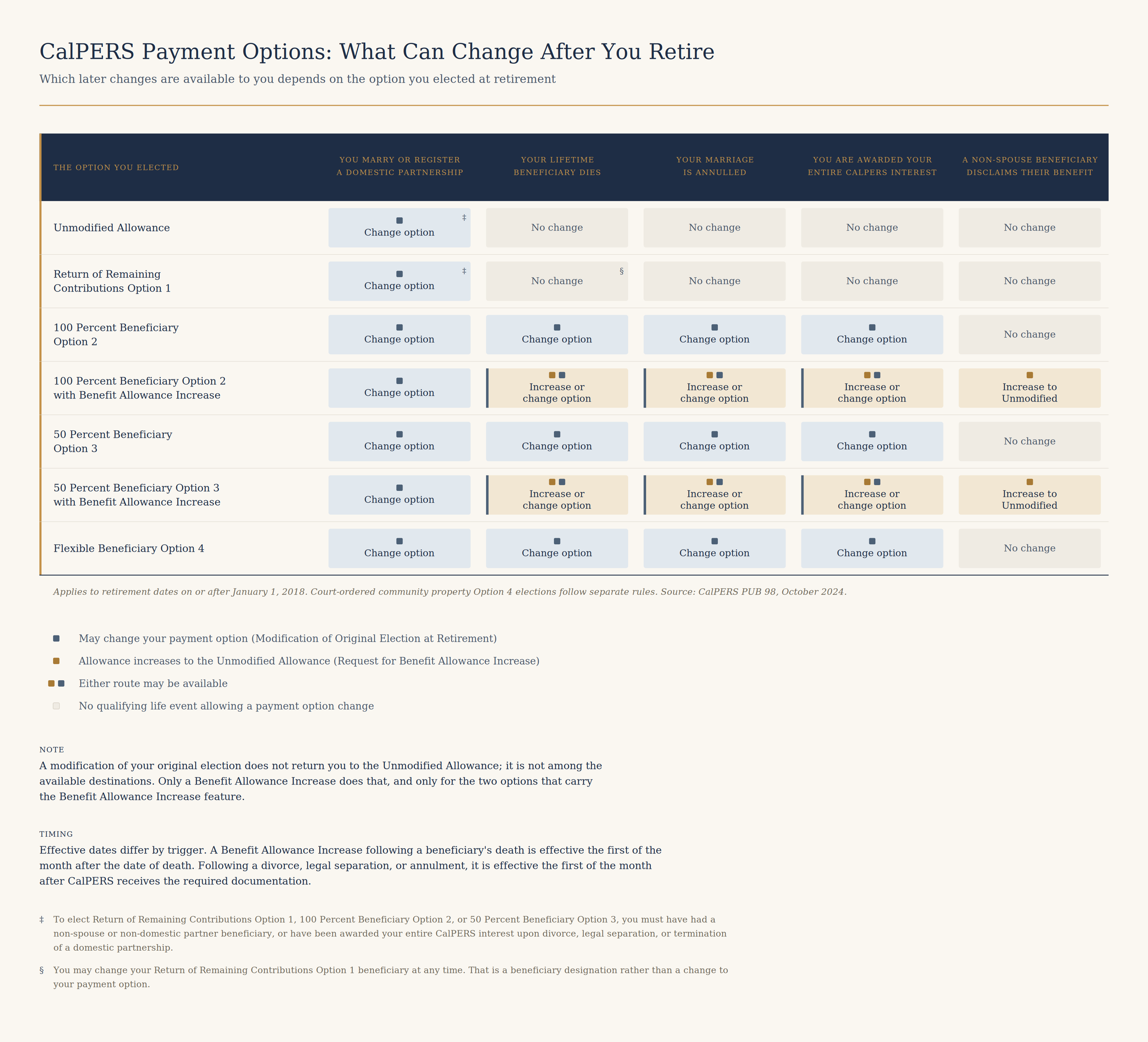
The election is durable, but it technically isn’t permanently sealed. There are limited ways to revisit it, and they depend on what you chose up front. There are really two separate mechanisms here, and they are important to keep straight.
The first mechanism is an automatic increase back to the Unmodified Allowance, available only if you elected one of the “with Benefit Allowance Increase” versions (or plain Option 2 or 3 before January 1, 2018). It triggers when your beneficiary dies, or on divorce, annulment, or a non-spouse beneficiary’s disclaimer, and you file a Request for Benefit Allowance Increase [7]. This is essentially the feature you paid for with a reduction, and effective dates run from the event or from when CalPERS receives your paperwork [7].
The second is a modification of your original election, to name a new lifetime beneficiary or move to a different option, triggered by marriage, a domestic partnership, your beneficiary’s death, annulment, or being awarded your entire CalPERS interest in a divorce [7]. Which of those helps you depends on what you hold. If you elected the Unmodified Allowance or Option 1, marriage or a new domestic partnership is the only event that lets you change your option [7]. If you elected any of the beneficiary options, all of the events are open to you, but with one asymmetry to know about before you file: a member who outlives their beneficiary can name someone new or switch options, but cannot return to the Unmodified Allowance. The permanent reduction stays; only its purpose changes [7].
Three details carry consequences. A modification reduces your allowance again to fund the new beneficiary, and your COLA and Purchasing Power Protection Allowance are recalculated on the new, lower base [7]. The timing rule is the one that catches people. Elect within 12 months of the event, and it takes effect the next month. Elect later than that, and the change is deferred a further 12 months, and both you and your new beneficiary have to be living on that deferred date, or it can’t process [7][8]. And two things that look like they should qualify do not: marrying someone you already named as beneficiary (they are already your beneficiary), and a non-spouse beneficiary disclaiming their benefit, which removes them but does not let you name a replacement [7].
The Spousal Signature Requirement
If you are married or have a registered domestic partner, your spouse or partner generally must sign your retirement application. The exception is narrow. Their signature is not required where the option you elected provides them 100 percent of your monthly allowance, meaning the 100 Percent Beneficiary Option 2 or that option with the Benefit Allowance Increase, and you also named them as sole beneficiary for any lump sum benefits [10].
The Size of the Reduction
CalPERS does not appear to publish a general option factor table in its member materials. The reduction is calculated individually, and the ways to see your own number are a myCalPERS estimate or a Benefit Estimate Letter. The factors themselves are actuarial equivalents built from Board-adopted assumptions, which are revised through an experience study roughly every four years [4].
The Effect of the Beneficiary’s Age
The age difference between you and your beneficiary is one of the larger variables in the reduction.
CalPERS states the relationship plainly in its member education material: the cost depends on the ages of both you and your beneficiary at the time of retirement, and the younger your beneficiary, the greater the reduction to your pension to fund their benefit [13]. The same applies to the Flexible Beneficiary Option 4, where the reduction while you are alive depends on your beneficiary’s age and on the dollar amount or percentage you select [13].
CalPERS does not appear to publish a table showing how much the gap moves the number. The practical workaround is that the myCalPERS Retirement Estimate Calculator accepts a beneficiary date of birth, so running the same estimate more than once with different dates shows the sensitivity in your own case. If you are weighing a continuance against life insurance, run that comparison first, since a large age gap tends to increase the reduction to your pension, which could make life insurance a cost-effective alternative.
For readers who want to see worked numbers, a 2015 CalPERS staff analysis published an illustrative reduction for each option using a single average-retiree profile (Retirement Options Simplification, Agenda Item 5, Attachment 1). Treat it as one dated example rather than a schedule: it predates the 2017 and 2021 experience studies, and it describes one age pairing rather than yours.
A Framework for Deciding
The options aren’t ranked, and I can’t tell you which one is best in the abstract, because it depends entirely on your household. What I can give you is the order I’d think through it in. Work these six questions in sequence, and each one narrows the field before you get to the next.
1. Does anyone actually depend on your pension income?
If no one relies on this income after you’re gone (no spouse, no partner, no dependent), then a reduced option means paying for a lifetime reduction to fund a benefit nobody needs. The Unmodified Allowance is probably the sensible default there, and any wish to leave something behind could be handled on your balance sheet rather than inside the pension. If someone does depend on it, keep going.
2. Is there a Survivor Continuance floor underneath the whole decision?
Some employers contract for Survivor Continuance, which pays an eligible survivor a portion of your allowance (often one half, or one quarter if you were covered by Social Security in your CalPERS service) regardless of which option you pick, including the Unmodified Allowance [5][6]. Where it applies, the Unmodified Allowance does not leave your spouse with zero; it leaves them with the floor. That reframes the entire question: an option is no longer buying your survivor’s whole income, only the gap between the floor and what they would actually need. Confirm in writing whether your employer contracts for it, because it is employer-specific, not a CalPERS default [5].
3. Does your spouse’s health coverage ride on this election?
This is the consequence that potentially dwarfs the monthly dollar consideration. Where retiree health runs through CalPERS, a surviving spouse generally keeps coverage only if they receive a continuing monthly check, either a Survivor Continuance or a benefit from the option you elected [7][9]. Elect the Unmodified Allowance with no continuance underneath it, and coverage can end, with COBRA as a time-limited fallback rather than lifetime retiree coverage [6]. The premium your survivor would pay to replace it can exceed the income the Unmodified Allowance gained you, which means a beneficiary option is sometimes buying health coverage that doesn’t show up anywhere in the income comparison. (SMUD retirees confirm this separately: SMUD runs its own retiree medical plans, so the rules live in SMUD’s documents, though the question is identical [12].)
4. How much does your age gap move the price, and how healthy are you both?
The reduction is individual and grows the younger your beneficiary is relative to you, because CalPERS expects to pay the continuance longer [13]. Run your own myCalPERS estimate more than once, changing the beneficiary date of birth, to see the sensitivity in your case. Then sit with the question the actuarial tables only answer on average: who is likely to outlive whom? The full-continuance options and their pop-up variants are effectively a bet on that answer. That’s fine, as long as you’re making the bet on purpose rather than by default.
5. Does your survivor need lifetime income, a lump sum, or neither?
A spouse with limited independent retirement income and a long life expectancy has a different problem than an adult child who would rather have a lump sum. The first points toward a continuance option sized to the income gap from question 2. The second points toward Option 1, a Flexible Option 4 amount, or leaving the pension unmodified and solving it elsewhere. The goal is to match the benefit to what the person actually needs.
6. Have you priced the alternative before you commit?
The pension continuance is one way to protect a survivor; a life insurance policy is another, and the two are best compared rather than assumed (it’s worth noting here, I am generally not a fan of permanent life insurance, and do not personally sell life insurance, but I do think this is one of the legitimate use cases for it so long as the pricing makes sense). Ask what permanent coverage (not term that may lapse before you die) costs at your current age, whether you are insurable, and, most importantly, whether it solves only the income question or also the health-coverage question from step 3, since a death benefit does not by itself continue a CalPERS health plan. A large age gap tends to raise the cost of the continuance, which is part of why it could make sense to price out a life insurance policy (it works a little like Option 1, except the residual benefit is locked in instead of declining over time).
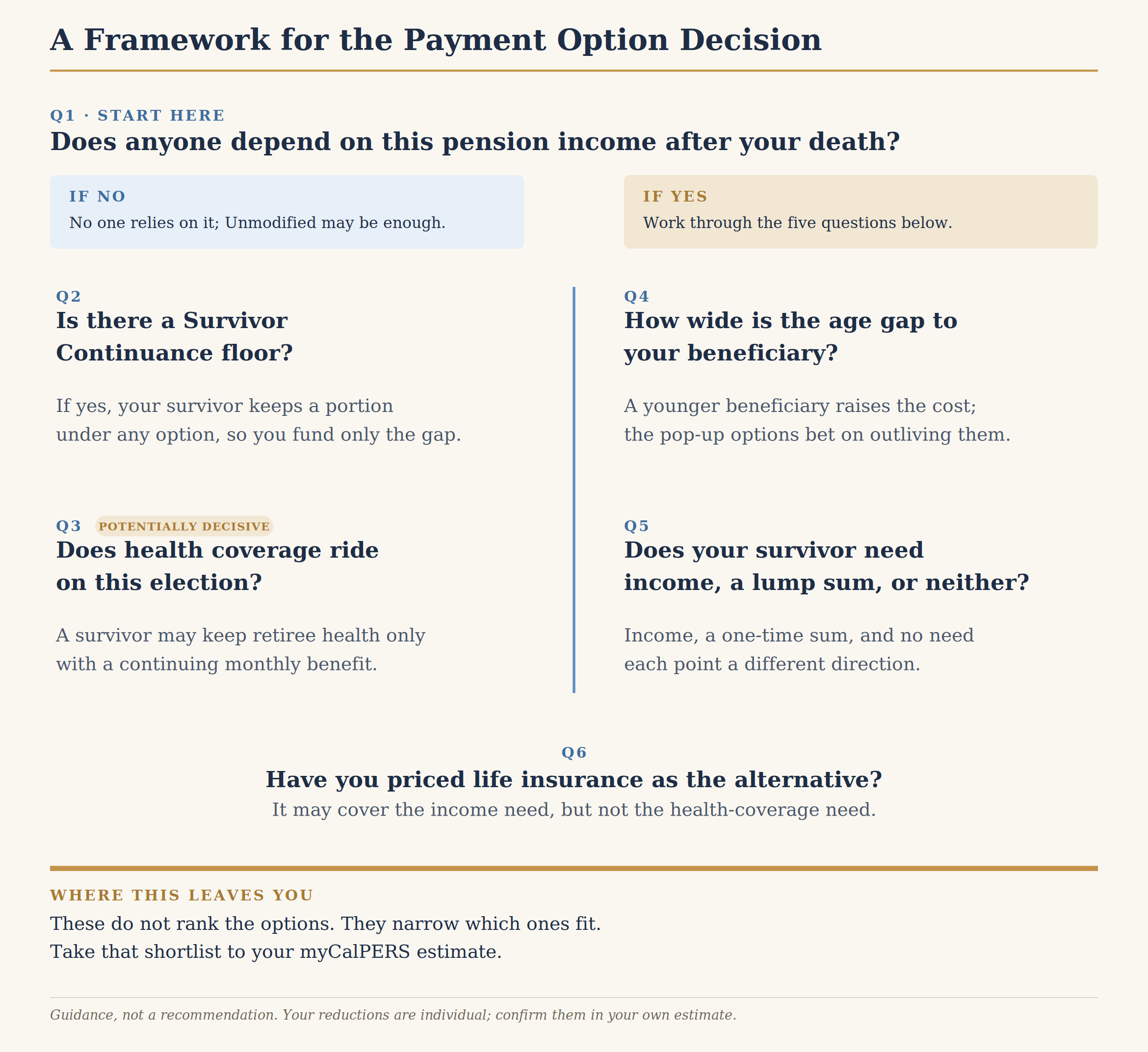
Work those six in order and hopefully you’ll usually be down to one or two options that fit your situation, instead of seven that all look plausible on paper. The estimate CalPERS gives you shows the reductions, but it can’t show you the household consequences, and in my experience the consequences are what the decision actually turns on. It’s also where working with someone tends to help, since the right answer shifts with your retirement date, your Savings Plus and 457 balances, how each spouse claims Social Security, and any coverage you’re already carrying.
If you want to work with someone who does this for CalPERS members
I'm a fee-only CFP® professional, and I work with CalPERS members across California on exactly these decisions: the timing, the tier interactions, and how the pension fits with everything saved beside it. If you'd like a second set of eyes on your own numbers, you can book a time below.
Sources
[1] CalPERS, “Curious About CalPERS Retirement Payment Options?” PERSpective, July 10, 2025.
[2] CalPERS Circular Letter 200-054-17, “2018 Retirement Options,” September 6, 2017, and the attached 2018 Retirement Options Quick Reference Sheet.
[3] Assembly Bill 2404 (Cooley), Retirement Option Simplification, 2016.
[4] CalPERS Pension & Health Benefits Committee, Agenda Item 4b, February 13, 2018 (Option 4 additional-forms staff recommendation); and Agenda Item 5, “Retirement Options Simplification,” October 20, 2015, Attachment 1 (illustrative per-option reduction amounts for one average-retiree profile), calpers.ca.gov/documents/201510-pension-item-5-attach-1/download. Actuarial assumptions underlying optional settlement factors are reviewed in the CalPERS Experience Study and Review of Actuarial Assumptions.
[5] CalPERS, Post-Retirement Survivor Benefits: Retired Member Death Benefits (PUB 60), and Post-Retirement Survivor Benefits: For Retired Members, Non-Spouse Claim (PUB 61).
[6] CalPERS, “Benefits Payable,” Death Benefits.
[7] CalPERS, What You Need to Know About Changing Your Beneficiary or Monthly Benefit After Retirement (PUB 98), October 2024, including the Retirement Option Reference Charts and the Request for Benefit Allowance Increase form.
[8] CalPERS, “Getting Hitched After Retirement? Update Your Life Option Beneficiary,” PERSpective.
[9] CalPERS, CalPERS Health Benefits Into Retirement, member education learning guide.
[10] California Government Code section 21261.
[11] SMUD, Employee Benefits, and SMUD Retiree website, Pension.
[12] SMUD, Retiree Benefit Guide.
[13] CalPERS, Your Retirement Estimate and Payment Options, member education learning guide, revised March 2023; and myCalPERS and Your Retirement Options, member education learning guide.
Disclosures
Fiduciary Financial Advisors does not accept any liability for the use of the information discussed. Consult with a qualified financial, legal, or tax professional prior to taking any action. Before investing, consider investment objectives, risks, fees, and expenses. Investments in securities involve the risk of loss, including loss of principal. Past performance is no guarantee of future returns. The views and opinions reflected in the content are subject to change at any time without notice. The content speaks only as of the date indicated. Some information was obtained from external sources. The information is believed to be accurate, but there is no guarantee that it is.
This content is for educational purposes only and does not constitute personalized tax, legal, or investment advice. Consult a qualified CFP®, CPA, or attorney before taking action.
Fiduciary Financial Advisors is a registered investment adviser. Nothing here constitutes individualized investment advice. Examples are illustrative only and not recommendations. No guarantee of future results. Third-party data is not independently verified.
CFP® and CERTIFIED FINANCIAL PLANNER® are certification marks owned by the CFP Board.

Understanding Your CalPERS Retirement Formula: Classic vs. PEPRA and What It Means for You
One number in your CalPERS pension was set before your first day, and it's permanent. Here's how to tell which formula you have, and why it shapes when you retire.
Your hire date already determined your formula. Here’s what it means for the decisions you can make.

The day you started your covered job dropped you into a retirement formula, and unlike other things in your plan, you cannot renegotiate it, buy your way out of it, or age back into a better one. A 2013 hire date and a 2012 hire date, one week apart, may mean a different pension for the same work. You can't change which formula you're in, so the whole game is reading it correctly and planning around it.

How your formula gets set
Your pension is based on a formula, not an investment balance. Three inputs, multiplied: your years of service (service credit), a benefit factor set by your age when you retire (benefit factor), and your final compensation (your highest average pay over a set window) [3]. Classic and PEPRA members have the same 3 components, but plug different numbers into them (more on that to follow).
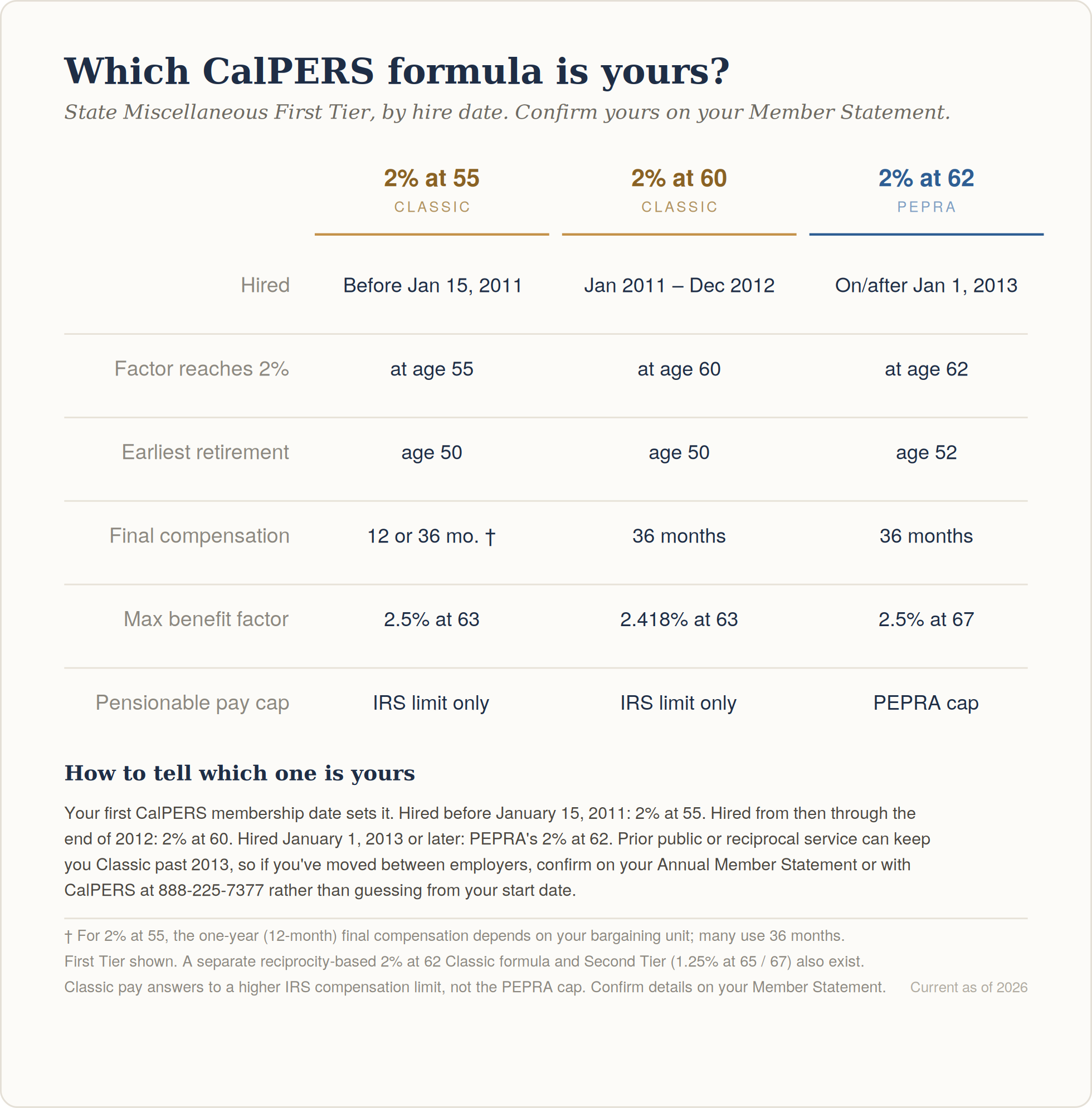
Which set of numbers you get comes down to your first membership date. State Miscellaneous splits mainly three ways. If you were first hired before January 15, 2011, you're generally on 2% at 55. From then through the end of 2012, it's (generally) 2% at 60, which at face value is the same factor but at a later age (but it does cap out at a lower factor of 2.418% instead of 2.5%). And 2013 or later puts you under PEPRA's 2% at 62 [2]. (Two more sit off to the side: a separate 2% at 62 Classic formula for certain reciprocity cases, not the same as PEPRA's despite the shared name, and the lower Second Tier formulas. If either applies to you, the numbers below shift.)
The “at” age is the tell. It's the age where your factor reaches 2% per year of service. Below it, your factor is prorated down; above it, it keeps climbing to a ceiling.
The answer to “which one am I?” is on your CalPERS Annual Member Statement, which names your formula outright. Reach for the rest only if you don't have it handy: your membership date sets the Classic/PEPRA line, your unit and hire era sort the two Classic formulas, and prior public or reciprocal service can keep you Classic past 2013. If you've moved between employers, it adds additional complexity, so confirm it rather than assume.
What your formula changes about the decisions you can still make
The formula itself is fixed. The three components it sits on are not, and it tilts each one a different way depending on your tier. The grid below puts the whole interaction in one view, and the diagonals are the part to slow down on. The chart shows how much of your final compensation your pension would replace based on the formula. The planning implication is that when you decide to leave, this can help you determine how much of a gap you may still need to make up with other investments and retirement income sources.
ONE-YEAR OR THREE-YEAR FINAL COMP? This isn't necessarily as straightforward as it may seem. There is a Classic-versus-PEPRA split, but also a difference depending on which bargaining unit applies to you. So even if you are a Classic member, it is possible that the Final Comp piece of your formula could be based on your highest 12, or your highest 36 consecutive months [3]. So this is important to keep in mind when you are evaluating when you retire, particularly if you happen to receive a significant pay bump.
It is also important to keep in mind that there is a pay cap that decides whether part of your paycheck is building a pension at all. The PEPRA formula caps the pay that counts toward your pension much earlier on than the Classic formula (which functionally is the IRS limit that is much less likely to even affect you [1]). If you're a PEPRA member earning above the cap, the dollars above it stop growing your pension, though your service credit keeps accruing in those years, and your Benefit factor continues to increase. (PEPRA members also generally pay at least half the normal cost of their benefits, and the employer cannot pick up the member's share [4].)
So, if you ask me, the big planning implication (which I already alluded to) in all of this is knowing how much of your future retirement income can be replaced by your pension, vs other sources. This means that utilizing Savings Plus becomes more important for members who are under the PEPRA formula, and particularly if you are over the income cap or have fewer years of service credits, since your pension benefit will likely not be replacing as much of what you need in retirement. (However, this is at the start of retirement, and you likely will want to have supplemental savings to help replace what is eroded by inflation over time either way).

Questions to Ask
● Which formula and tier apply to you, confirmed against your Annual Member Statement rather than your memory of your hire date?
● At what age does your benefit factor stop climbing, and where does your target retirement date sit relative to that?
● If you're Classic, do your planned exit and your highest 12 (or 36) months of pay actually line up?
● If you're PEPRA, what share of your target retirement income does the pension cover, and what's carrying the rest?
● Is any of your pay above the PEPRA cap, and if so, where is that income going?
If you want to work with someone who does this for CalPERS members
I'm a fee-only CFP® professional, and I work with CalPERS members across California on exactly these decisions: the timing, the tier interactions, and how the pension fits with everything saved beside it. If you'd like a second set of eyes on your own numbers, you can book a time below.
Sources
[1] CalPERS, “2026 Compensation Limits for Classic and PEPRA Members,” Circular Letter 200-001-26 (January 2, 2026).
[2] CalPERS, “Retirement Formulas and Benefit Factors.”
[3] CalPERS, “Your CalPERS Benefits: Planning Your Service Retirement” (Publication 1).
[4] California Government Code section 7522.30.
Disclosures
This article is provided by Fiduciary Financial Advisors, LLC and reflects general information that may not apply to your particular situation. Nothing in it should be relied upon as individualized advice. Please consult a qualified professional regarding your own circumstances before making decisions about your CalPERS benefits, retirement timing, or savings strategy.
The content above is for educational purposes only and is not intended as tax, legal, or investment advice. Illustrations use rounded figures to show general relationships and do not represent results any individual should expect.
Fiduciary Financial Advisors, LLC is a registered investment adviser. Registration does not imply a certain level of skill or training. Advisory services are offered only to clients or prospective clients where Fiduciary Financial Advisors, LLC and its representatives are properly licensed or exempt from licensure.
CFP® and CERTIFIED FINANCIAL PLANNER® are certification marks owned by the Certified Financial Planner Board of Standards, Inc. These marks are awarded to individuals who successfully complete the CFP Board's initial and ongoing certification requirements.

Choosing Your CalPERS Retirement Date
Your retirement date sets several CalPERS numbers at once: service credit, your benefit factor, your first COLA, and your leave-payout taxes. They rarely point to the same day. Here's how to time it.
Birthday Quarters, Fiscal Years, and COLA Timing

Your retirement date may feel more sentimental than financial, but for a CalPERS member, it also sets several (financial) numbers at once. Service credit, your benefit factor, when your first cost-of-living adjustment arrives, and how your final leave payout is taxed all move with the date you pick.
Most of this article is about windows, not deadlines. You don’t necessarily have to walk out on June 30 or December 31 to capture the benefits people tie to those dates (those exact dates may not even be exactly optimal for you). If you work for SMUD, Caltrans, a school district, or another CalPERS-covered employer, the pension mechanics apply the same way, since you retire through the same system. A few tax and payroll specifics are keyed to State of California payroll, so where those come up, confirm the equivalents with your own HR.
What the date controls
Your pension comes out of one formula, and it helps to keep its three pieces straight before we get into timing.
CalPERS runs on a fiscal year of July 1 through June 30, and service credit (the first piece of the formula above) accrues in tenths, not twelfths. For a full-time member paid monthly, about ten months of work inside that year earns a full year of credit.[1] If you start in July, the full year of service credit is likely earned by the next spring. So within the fiscal year, once you have banked a full year of service credit, staying on through June doesn’t add anything with respect to service credits.
Your benefit factor (the second piece of the formula above), steps up with each quarter-year of age, every three months, until it reaches the maximum for your formula.[1] So if you retire just after a birthday quarter, you lock in a higher factor than if you retire just before it. This matters while you are below that maximum benefit factor, and additionally, your formula and top age depend on your membership date and classification, so check the factor chart for your own formula.[1]
Your first COLA is where the exact day actually matters. It is tied to the second calendar year after the year you retire, and the adjustment is in the May 1 payment, not on a rolling clock from your retirement date.[1][2] That means retiring in late December rather than the first days of January makes a full year difference on when you receive your first COLA adjustment, even if the difference in your retirement date would just be days apart.[1]
Two ways to time it
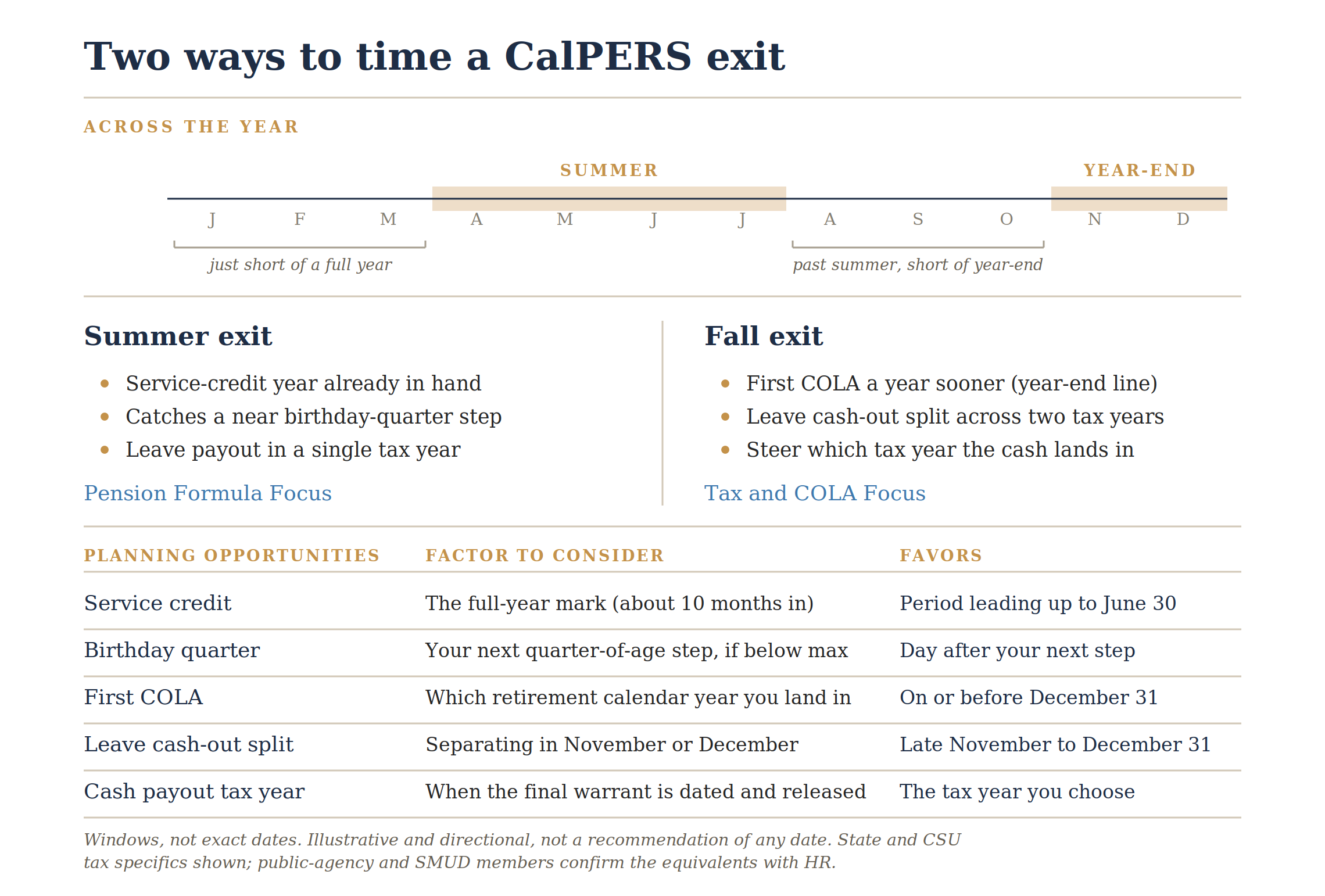
Line these up on a calendar and they cluster into two windows. One is a summer exit, sometime in late spring into summer, based around the pension formula itself. The other is a fall exit, from November into year-end, based around your COLA and the tax treatment of your leave payout. The stretches between them are (in my opinion) the weak spots. This is because if you leave in the earliest part of the year, you end up just short of earning another service credit, and if you leave late in the year, but before November, you lose out on being able to take advantage of the potential year-end benefits. In practice, the decision usually comes down to which part of the year makes more sense for you to retire in, then fine-tuning the exact day.
A summer exit focuses on service credit. Because the full year is banked about ten months into the fiscal year, you can leave in spring without giving up credit, and you don’t necessarily have to retire on exactly June 30 to get there. If your next birthday-quarter step also falls in this stretch, you may want to work long enough into summer to capitalize on it. The leave payout lands in a single tax year, which keeps that part simple. It suits members who have already banked the service-credit year and have more to gain from the pension math than from tax timing.
If you wait until the fall you will want to keep your COLA and your leave taxes in mind. By retiring before December 31, you’d get your first COLA a full year sooner than waiting until retiring after crossing into the new year. Then a late-year separation also opens a leave-payout option a summer date does not. State and CSU employees can direct a lump-sum leave payout into their Savings Plus 457(b) and 401(k) rather than take it all as cash, up to the annual limits (and those two plans carry separate limits).[3][5] For 2026 that is $24,500 of elective deferral per plan, plus an $8,000 catch-up once you are 50 (or $11,250 for the year you are 60 to 63).[4] Then so long as you separate near the end of the year, roughly from November on, the deferral can be split across two calendar years, each with its own limits, spreading a large payout over two tax returns instead of stacking it on one (there is also another catch-up unique to the 457(b) that I will get into another time).[3]
Two cautions come with that route. The election is irrevocable once you sign it, because the tax rules treat the money as yours the moment you could have taken it, so the choice has to be made before you separate, and the form has to reach your personnel office at least five working days ahead, in practice, you should probably plan on closer to a month.[3][6] And for whatever you take as cash, the tax year is set by when the payment is issued, not by your last day, so near year-end a few days of processing can carry the cash from one tax year into the next.[7] So if you choose to retire later in the year, you should make sure to give enough lead time to get your paperwork processed on time.
Matching the exit to the facts
To make this a little less abstract, let’s talk about a potential scenario. Let’s say there is a member who is 61, already at the top of their benefit factor, sitting on a large vacation balance, with a birthday quarter that passed back in the spring. At this point, the pension formula would be mostly settled for them, with the benefit factor around the max and the service-credit year now banked. What is still open is the determination of when they will receive their first COLA and what happens with the leave payout. By waiting until later in the year, they would potentially benefit from the increase in flexibility on how they handle the leave payout.
The flip side would likely be someone still climbing toward their factor maximum or with little leave saved, and may get more out of the summer window, or rather, give up less by going earlier in the year.
Neither window is a one-size-fits-all choice, so rank what applies to you and think about which season makes more sense, then settle on the exact day. Sorting out how a maxed factor, a leave balance, and a two-year tax split add up for your own situation is where personalized analysis may help before you file paperwork that you cannot easily undo.
The bigger question:
All of this optimizes the exit, but none of it answers whether you can afford to leave in the first place. Before you spend much energy on the perfect date, you may consider running the numbers on whether your pension, savings, and expenses support retiring at all. A well-timed exit does not help much if you are not ready to make it.
Disclosures
Fiduciary Financial Advisors does not accept any liability for the use of the information discussed. Consult with a qualified financial, legal, or tax professional prior to taking any action. Before investing, consider investment objectives, risks, fees, and expenses. Investments in securities involve the risk of loss, including loss of principal. Past performance is no guarantee of future returns. The views and opinions reflected in the content are subject to change at any time without notice. The content speaks only as of the date indicated. Some information was obtained from external sources. The information is believed to be accurate, but there is no guarantee that it is.
This content is for educational purposes only and does not constitute personalized tax, legal, or investment advice. Consult a qualified CFP®, CPA, or attorney before taking action.
Fiduciary Financial Advisors is a registered investment adviser. Nothing here constitutes individualized investment advice. Examples are illustrative only and not recommendations. No guarantee of future results. Third-party data is not independently verified.
CFP® and CERTIFIED FINANCIAL PLANNER® are certification marks owned by the CFP Board.
Sources
[1] CalPERS PERSpective, “Timing Your Retirement: Fiscal Years and Birthday Quarters Matter,” April 14, 2026.
[2] CalPERS, “Cost-of-Living Adjustment (COLA),” Retirees / Cost of Living.
[3] California Department of Human Resources (CalHR), Human Resources Manual § 1802, Transfer Leave Credits and Catch-Up (Savings Plus lump-sum separation pay deferral; two-tax-year election for late-year separations; irrevocable under Treas. Reg. § 1.451-2(a)).
[4] Internal Revenue Service, “401(k) limit increases to $24,500 for 2026,” Notice 2025-67.
[5] CalHR, Human Resources Manual § 1801, Contribution Rates (IRS annual limits apply separately to each plan, 401(k) and 457(b)).
[6] Savings Plus, “Lump Sum Separation Pay” (savingsplusnow.com); five-working-day filing requirement per California Labor Code §§ 201 and 202.
[7] California State Controller’s Office, Personnel and Payroll Services Division, year-end lump-sum separation processing guidance and payroll letters (processing cutoffs; warrant issuance timing).

Perks and Lesser-Known Benefits California State Employees Are Talking About Online
A lighter roundup for state employees curious about the small stuff beyond the pension and health plan. Here are the perks and discounts that kept coming up on r/CAStateWorkers, from travel and subscription deals to on-site amenities, plus how to confirm what actually applies to your department and bargaining unit.
A lighter roundup for state employees curious about the small stuff beyond the pension and health plan

Most of what I write focuses on the bigger financial decisions that tend to keep people up at night. This one is a little different. I read through the CA State Workers Reddit page, and pulled together a list of the perks and discounts that kept coming up. None of this is official guidance, and availability appears to vary by department, bargaining unit, and even which building you work in. Think of it as a starting point for questions to ask your own HR office or union rep, not a promise of what you'll get.
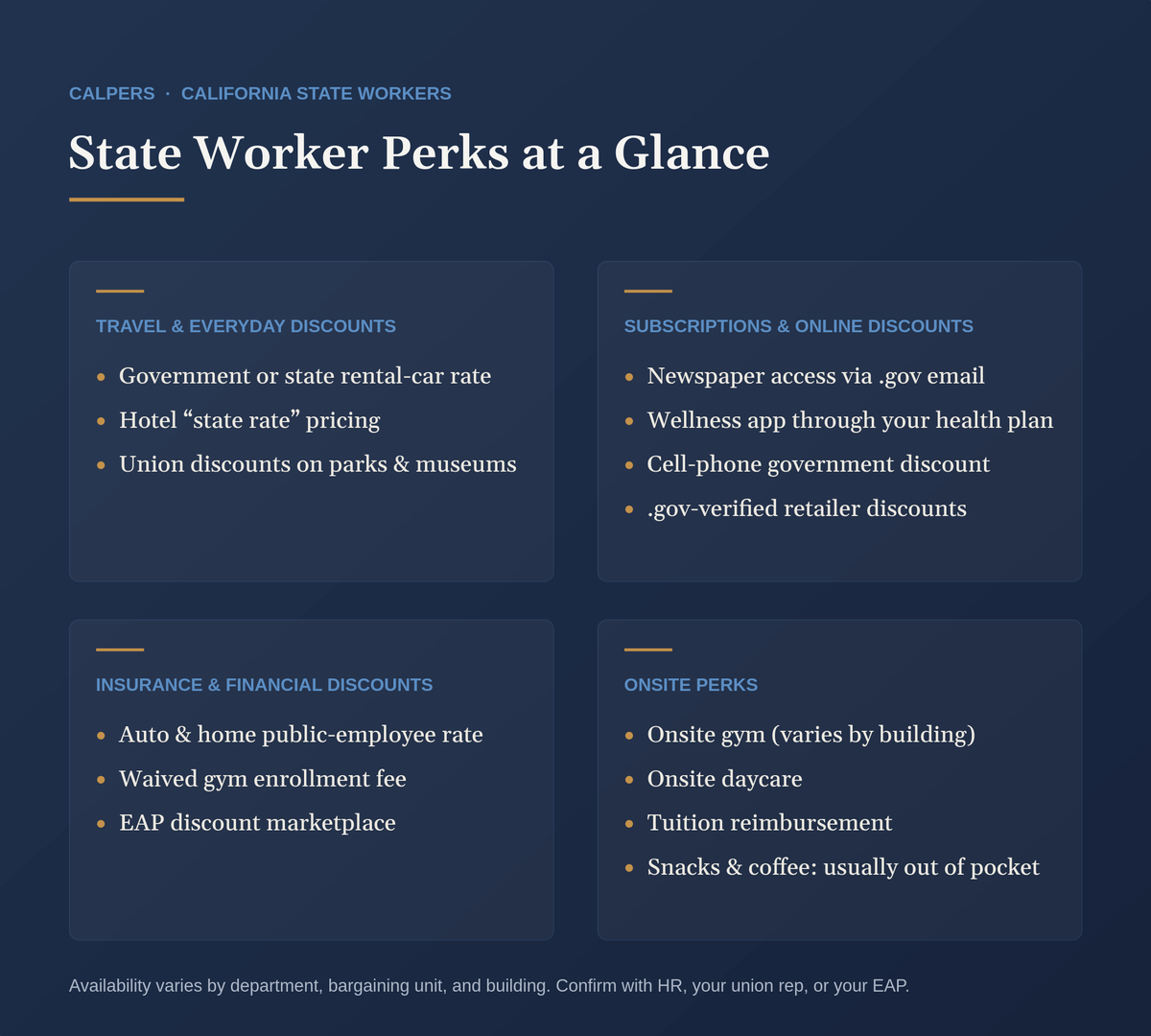
Travel and Everyday Discounts
A few state employees mentioned saving money on travel by using employee rates that many companies don't advertise widely.
● Some rental car companies offer a government or state employee rate that can be selected at booking, with ID shown at pickup. One commenter mentioned saving a few hundred dollars on an upcoming rental this way.
● Hotel “state rate” pricing sometimes shows up as an option on a hotel's own booking site, though whether it applies to personal (non-work) travel seems to depend on the hotel and how your agency books travel.
● Union membership may come with discounts of its own on top of any statewide perks, including reduced-price tickets to state parks, museums, and other attractions.
Subscriptions and Online Discounts
Some perks are tied less to being a state employee and more to having a .gov email address or a particular health plan.
● Several employees mentioned getting a no-cost digital subscription to a major national newspaper using a .gov email address.
● Some health plans include a premium subscription to a meditation or wellness app as part of enrollment, at no added cost.
● Cell phone carriers frequently offer a discount for government employees, even on a personal line not tied to work.
● Some retailers and outdoor/sports brands offer a government or .gov-verified discount online, which may apply to something you already planned to buy.
Insurance and Financial Discounts
These came up often enough that a quick check with your current providers may make sense, even if the discount ends up being modest.
● Some insurance carriers offer a reduced rate on auto or homeowners policies for public employees. Ask your current provider whether this applies to you, since it often isn't advertised.
● Gym chains sometimes waive the enrollment or initiation fee for state employees, even when they don't offer an ongoing discount on monthly dues.
● Your Employee Assistance Program (EAP) may include access to a broader discount marketplace covering retail, entertainment, and travel, in addition to the counseling services EAP is best known for.
Onsite Perks (Your Building May Vary)
This is where things get the most department-specific, and a few commenters were quick to point out that many of these amenities carry a cost even when they look like a perk on paper.
● Some buildings have an onsite gym, though quality and equipment varied depending on the department and building.
● A few state buildings offer onsite daycare, though cost was mentioned as a limiting factor for many families rather than something heavily subsidized.
● Water bottle filling stations, small honor-system snack setups, and even a shared herb garden came up as examples of building-level culture rather than anything centrally provided or guaranteed.
● Tuition reimbursement programs exist at some departments, typically covering a portion of costs up to an annual cap, though this tends to be a department-level policy rather than a statewide benefit.
NOTE A few commenters clarified that snacks, coffee, and office celebrations are almost always paid for out of pocket by a manager or coworkers, not the state. If your building has a parking lot that's technically state-run, it may still come with a modest monthly fee.
A Few Things to Check Yourself
If any of these sound useful, the fastest way to confirm details is usually a quick check with your HR office, your union representative, or your Employee Assistance Program provider, since much of this depends on your specific bargaining unit and department rather than a single statewide policy.
None of this replaces the bigger financial picture: your pension, your health benefits, and how much you're setting aside in Savings Plus tend to matter more over the long run than a waived gym fee or a newspaper subscription. But a small discount here and there is a nice bonus while you're working out the larger plan.
This list was compiled by reading through publicly available discussion threads on r/CAStateWorkers, an unofficial online community for California state employees. It reflects informal, crowdsourced information shared by individual commenters rather than official state or CalPERS guidance, and availability and eligibility for any of the above may have changed or may not apply to your specific department, bargaining unit, or employment status.
Disclosures
Fiduciary Financial Advisors does not accept any liability for the use of the information discussed. Consult with a qualified financial, legal, or tax professional prior to taking any action. Before investing, consider investment objectives, risks, fees, and expenses. Investments in securities involve the risk of loss, including loss of principal. Past performance is no guarantee of future returns. The views and opinions reflected in the content are subject to change at any time without notice. The content speaks only as of the date indicated. Some information was obtained from external sources. The information is believed to be accurate, but there is no guarantee that it is.
This content is for educational purposes only and does not constitute personalized tax, legal, or investment advice. Consult a qualified CFP®, CPA, or attorney before taking action.
Fiduciary Financial Advisors is a registered investment adviser. Nothing here constitutes individualized investment advice. Examples are illustrative only and not recommendations. No guarantee of future results. Third-party data is not independently verified.
CFP® and CERTIFIED FINANCIAL PLANNER® are certification marks owned by the CFP Board.

Savings Plus, the CalPERS 457, and Your 401(k): Making Sense of Supplemental Retirement Savings as a California State Employee
If your CalPERS pension won't fully fund the retirement you're picturing, Savings Plus (or the CalPERS 457 Plan) gives you two ways to save more: a 401(k) and a 457(b). Here's why funding the 457(b) first tends to make sense for most participants who aren't maxing out both, and the cases where it doesn't.

A CalPERS pension may not fully fund the lifestyle you're picturing in retirement, and closing that gap may mean saving and investing more beyond the pension itself. If you work for the state or CSU (California State University), you have access to Savings Plus, which offers not one but two options, a 401(k) and a 457(b), and it's not always clear which one should carry the bulk of that supplemental saving. If you work for a public agency or school district, it may be the CalPERS 457 Plan instead, but only if your employer has chosen to contract with CalPERS for it (SMUD employees: check with HR, since SMUD is a local agency rather than a state department, and the specific plans on offer vary by employer).
Whichever combination applies to you, the practical takeaway tends to be similar: for most participants who aren't maxing out both plans, funding the 457(b) before the 401(k) may make more sense. Though the reasoning may not be obvious, so here's what's actually driving that (in my opinion).
The Two Plans, Briefly
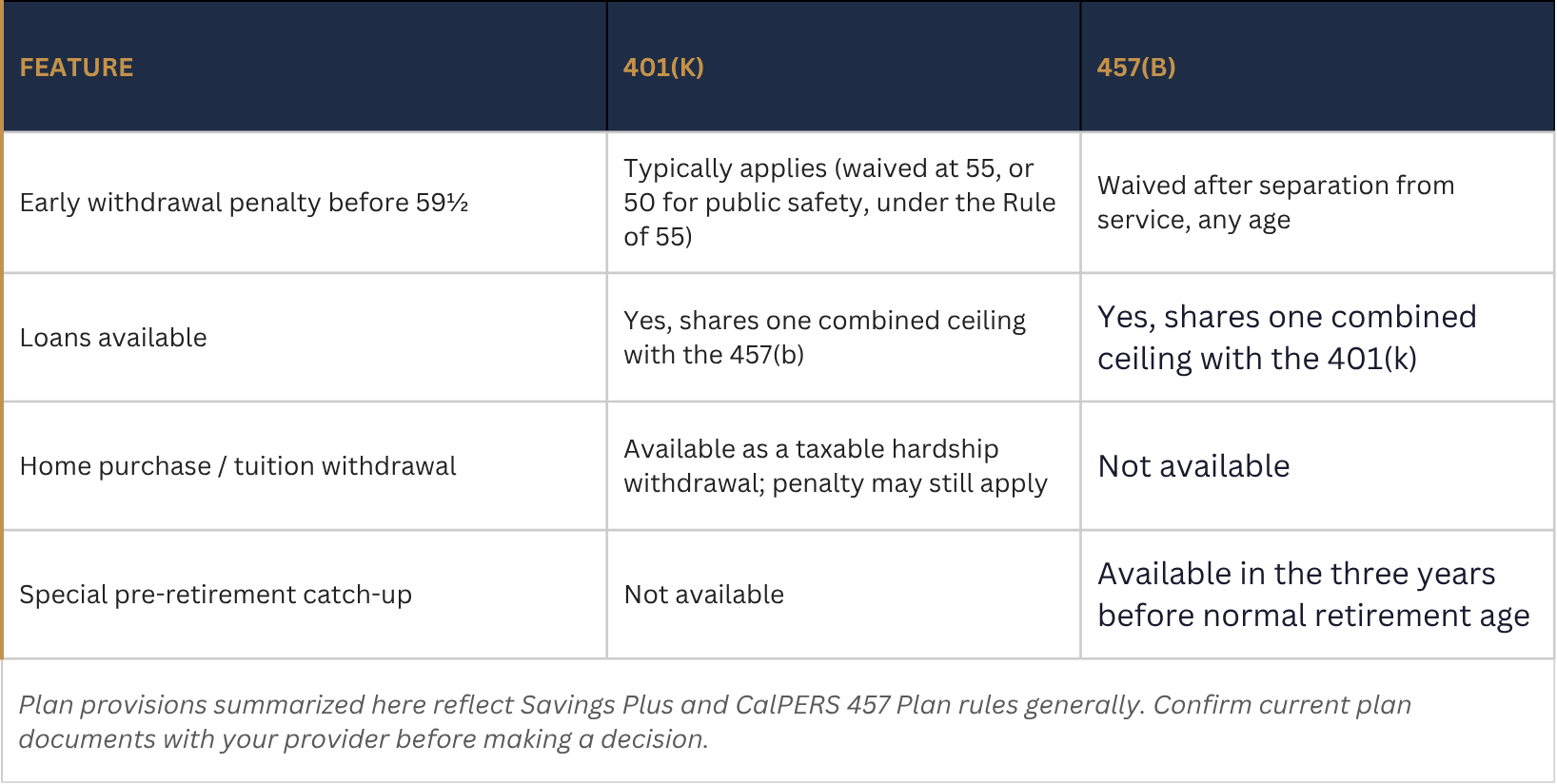
Savings Plus (a 401(k) and 457(b), run by the California Department of Human Resources and Nationwide, not CalPERS) is available to State of California and CSU employees. [1] The CalPERS 457 Plan is a separate 457(b) that CalPERS offers directly to public agencies and school districts that choose to contract for it. [2] Either way, using both a 401(k) and a 457(b) draws on two separate IRS limits, not one: the elective deferral cap (the amount you can contribute from your paycheck) for 2026 is $24,500 per plan (assuming no catch-up), so using both effectively doubles your contribution room to $49,000. [3]
The Loan Ceiling Doesn't Double
Both plans generally offer a loan, but having two accounts doesn't actually double what you can potentially borrow. Federal tax rules treat every plan the same employer maintains as a single plan for this purpose, so there's one combined ceiling, the lesser of $50,000 or 50% of your vested balance (the portion of the account that's fully yours), calculated across the 401(k) and the 457(b) together rather than separately for each. [4][5][6] Reaching the full $50,000 requires $100,000 in vested balance total, whether that's concentrated in one plan or split across both. That removes the main reason to overfund the 401(k) specifically, since the 457(b) counts toward the same shared loan ceiling.
The Hardship Withdrawal's Cost
The 401(k)'s one remaining distinguishing feature is the hardship withdrawal: an in-service withdrawal (meaning you can take the money out while still working) for a first-time home purchase or college tuition. The 457(b) doesn't offer either option. [4] But qualifying for the hardship and avoiding the 10% early withdrawal penalty are separate tests: meeting the hardship criteria doesn't by itself exempt you from the penalty if you're under 59½. [7] The withdrawal is permanent, with no repayment option. If any portion comes from a designated Roth account, the tax treatment depends on whether the distribution satisfies the applicable Roth distribution requirements under IRS rules. [8] That mix of cost, taxability, and permanence makes it a last resort, not something to plan a 401(k) balance around.
The Rule of 55: A Narrowing Nuance
The 401(k) also has a potential path to penalty-free access before age 59½, known as the Rule of 55. If you separate from service during or after the calendar year you turn 55, withdrawals from your current employer's 401(k) may be exempt from the 10% early withdrawal penalty, although pretax distributions generally remain subject to ordinary income tax. Eligibility depends on your individual circumstances and applicable IRS rules. [9] For qualified public safety employees under a governmental plan, police, firefighters, and similar roles, that age drops to 50. [9] This narrows the 457(b)'s advantage for anyone separating at or after that age; the edge is largest for someone leaving earlier, whether by choice or otherwise. The exception applies only to the plan of the employer you just left, so rolling that 401(k) into an IRA before 59½ gives it up (though there is another way to get funds out of an IRA before 59½ called the 72(t) or SEPP, but it comes with its own nuances). [9]
What's easy to miss: if you leave that job before the year you turn 55, the Rule of 55 doesn't apply at all, even if you wait until 55 or later to actually take the withdrawal. What matters is the age you were when you separated, not the age you are when you withdraw. [9][10] In that case, the 401(k) reverts to the standard 59½ threshold, the same result as if the Rule of 55 didn't exist, which strengthens the case for prioritizing the 457(b) for anyone who might leave public service earlier than that.
NOTE Confirm specifics with your plan administrator: the loan lookback calculation, whether the CalPERS 457 Plan and a local agency's 401(k) count as the “same employer” for aggregation, whether your role qualifies for the age-50 exception, and how the plan treats money rolled in from a 401(k) or IRA (which generally loses the 457(b)'s blanket penalty exemption) can all vary. [10]
Catch-Up Contributions and the 2026 Roth Rule
If you're 50 or older, both plans allow a catch-up on top of the standard limit: $8,000 for 2026 ($32,500 total per plan), or $11,250 if you'll turn 60 through 63 during the year ($35,750 total). [11] The 457(b) has one more option: a special catch-up in the three years before your plan's normal retirement age (the age your plan sets for this, not necessarily when you plan to retire) that may allow contributions up to double the standard limit, $49,000 for 2026, though it can't be combined with the age-based catch-up in the same year. [12]
NOTE One more 2026 change: if your prior-year FICA wages (wages subject to Social Security and Medicare tax) from your employer exceeded $150,000, age-based catch-up contributions must now be made as Roth rather than pretax; the 457(b)'s special three-year catch-up is currently exempt from that requirement. [13]
The Bottom Line
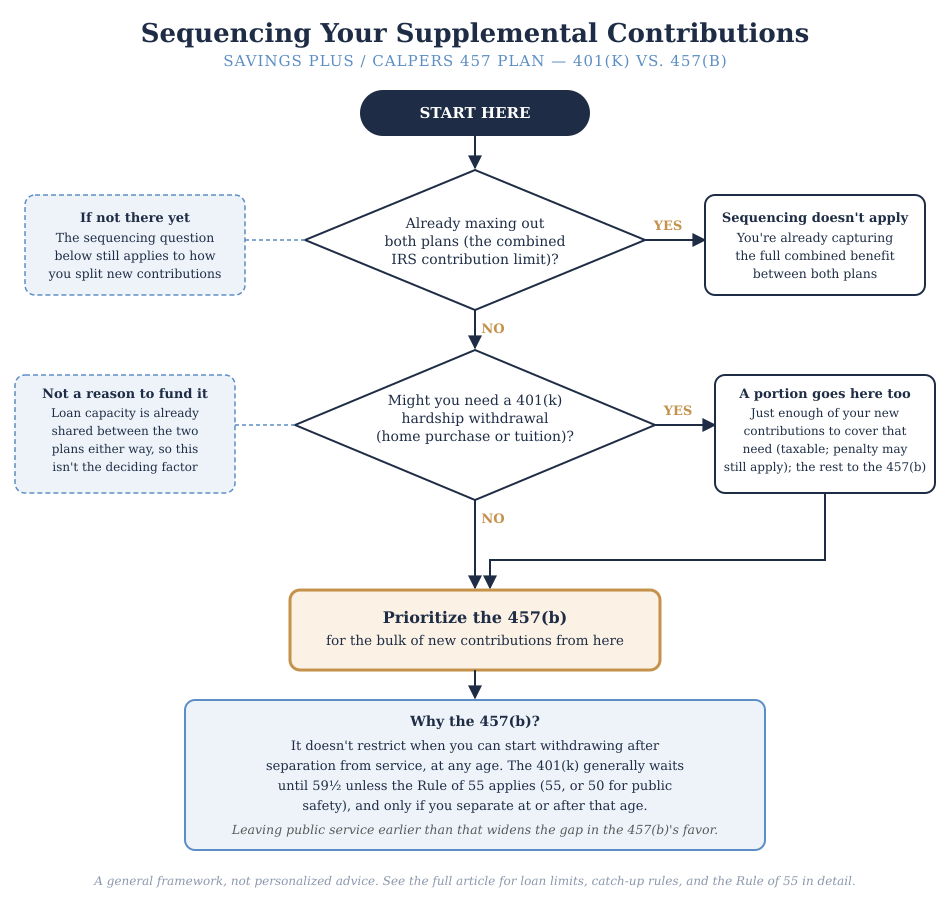
Put together, a workable framework looks like this: direct enough to the 401(k) to cover a plausible home purchase or tuition need, in case the hardship withdrawal option is ever necessary, and prioritize the 457(b) for the bulk of new contributions after that. The reasoning comes down to access, not capacity: the loan ceiling is shared between the two plans either way, so it doesn't favor one over the other. What favors the 457(b) is that it doesn't restrict when you can start withdrawing after separation from service, while the 401(k) generally does until 59½, unless the Rule of 55 applies (55 for most participants, 50 for qualified public safety employees). That difference matters most if you're aiming for an earlier retirement: the 457(b) removes the waiting period entirely, while the 401(k) only catches up once you reach the applicable age.
This is a framework, not a formula, and it assumes you're not already maxing out both plans. If you are, the sequencing question doesn't really apply, and deferring the full $49,000 combined, more with catch-up contributions, is a notable opportunity in its own right for higher-income households looking for more ways to defer current income. Otherwise, how this applies depends on your income, your timeline, whether the Rule of 55 or its public safety equivalent applies to you, and your plan's specific rules for catch-up contributions. This is where personalized analysis tends to matter.
Sources
[1] California Department of Human Resources, “Savings Plus Program,” calhr.ca.gov.
[2] CalPERS, “Deferred Compensation,” calpers.ca.gov/members/retirement-benefits/deferred-compensation.
[3] California State University, Fresno, Administration and Finance, “2026 Comparison Chart: 401(k) vs. 457(b).”
[4] California State University, Northridge, Human Resources, “Savings Plus Program.”
[5] Internal Revenue Service, “Issue Snapshot: Borrowing Limits for Participants with Multiple Plan Loans,” irs.gov (IRC §72(p)(2)(A)).
[6] Nationwide Retirement Solutions, “Savings Plus Loan Fact Sheet,” nrsforu.com.
[7] Internal Revenue Service, “401(k) Plan Hardship Distributions: Consider the Consequences,” irs.gov.
[8] Internal Revenue Service, “Retirement Plans FAQs on Designated Roth Accounts,” irs.gov.
[9] Internal Revenue Service, “Retirement Topics: Exceptions to Tax on Early Distributions,” irs.gov.
[10] Fidelity, “What Is the Rule of 55?” fidelity.com.
[11] Internal Revenue Service, “401(k) limit increases to $24,500 for 2026, IRA limit increases to $7,500,” irs.gov/newsroom.
[12] Nationwide Retirement Solutions, “IRS Contribution Limits,” nrsforu.com.
[13] Internal Revenue Service, “Retirement Topics: Catch-up Contributions,” irs.gov; Quarles Law Firm, “SECURE 2.0 Act Retirement Plan Update: Roth Catch-Up Contributions in 2026.”
Disclosures
Fiduciary Financial Advisors does not accept any liability for the use of the information discussed. Consult with a qualified financial, legal, or tax professional prior to taking any action. Before investing, consider investment objectives, risks, fees, and expenses. Investments in securities involve the risk of loss, including loss of principal. Past performance is no guarantee of future returns. The views and opinions reflected in the content are subject to change at any time without notice. The content speaks only as of the date indicated. Some information was obtained from external sources. The information is believed to be accurate, but there is no guarantee that it is.
This content is for educational purposes only and does not constitute personalized tax, legal, or investment advice. Consult a qualified CFP®, CPA, or attorney before taking action.
Fiduciary Financial Advisors is a registered investment adviser. Nothing here constitutes individualized investment advice. Examples are illustrative only and not recommendations. No guarantee of future results. Third-party data is not independently verified.
CFP® and CERTIFIED FINANCIAL PLANNER® are certification marks owned by the CFP Board.

You Left Your CalPERS Employer. Now What?
You've left your CalPERS-covered job before retirement, and now your benefits are in question. This plain-language guide walks through vesting, your three options at separation (leave contributions on account, take a refund or rollover, or retire now), and how reciprocity works if you're heading to another California public employer.
A plain-language guide to your options when you leave a CalPERS-covered job before you're ready to retire

Maybe you landed a role in the private sector. Maybe you relocated for family reasons. Maybe the job just wasn't the right fit anymore. Whatever happened, you've left your CalPERS-covered employer before retirement, and now you have the question: what actually happens to the benefits you've been building?
The short answer is that CalPERS doesn't disappear from your life. This article walks through those choices in plain language so you can make an informed decision rather than a default one.
What You've Built
When you work for a CalPERS-covered employer, two things are happening in your account at the same time. First, you're making employee contributions, which are a percentage of your salary set by your retirement formula and membership tier. Second, your employer is making its own contributions on your behalf into the broader fund. Only the first bucket (your own contributions plus the interest they've earned) is refundable to you. Employer contributions aren't yours to take with you; they go toward funding pension benefits for current and future retirees across the system.[1]
The pension benefit itself, that lifetime monthly payment you've heard described as "2% at 62" or "2.7% at 57" or some similar formula, isn't funded from a personal account the way a 401(k) is. It's a defined benefit: a promise from CalPERS to pay you a calculated amount for life once you reach eligibility.[2]
Are You Vested?
Your vesting status is the key factor in understanding your options. CalPERS uses a two-part test: you need both sufficient service credit and minimum age to collect.[3]
The Service Credit Side
For most CalPERS members, the vesting threshold is five years of CalPERS-credited service. There are some exceptions, most notably for State of California Second Tier employees, who generally need 10 years, but the five-year mark applies to the large majority of members working for state agencies, cities, counties, etc.[3]
If you've crossed that five-year threshold, you're considered vested in the pension side of things, meaning the right to a future benefit is locked in regardless of where you work next. If you haven't yet hit five years, you don't have a right to a future pension unless you return to CalPERS-covered employment, use reciprocity with another qualifying public retirement system, or had part-time status that qualifies under a specific exception.
The Age Side
Vesting in the service credit sense doesn't mean you can start collecting tomorrow. You also have to reach the minimum retirement age for your formula, which varies depending on when you became a CalPERS member:[4]
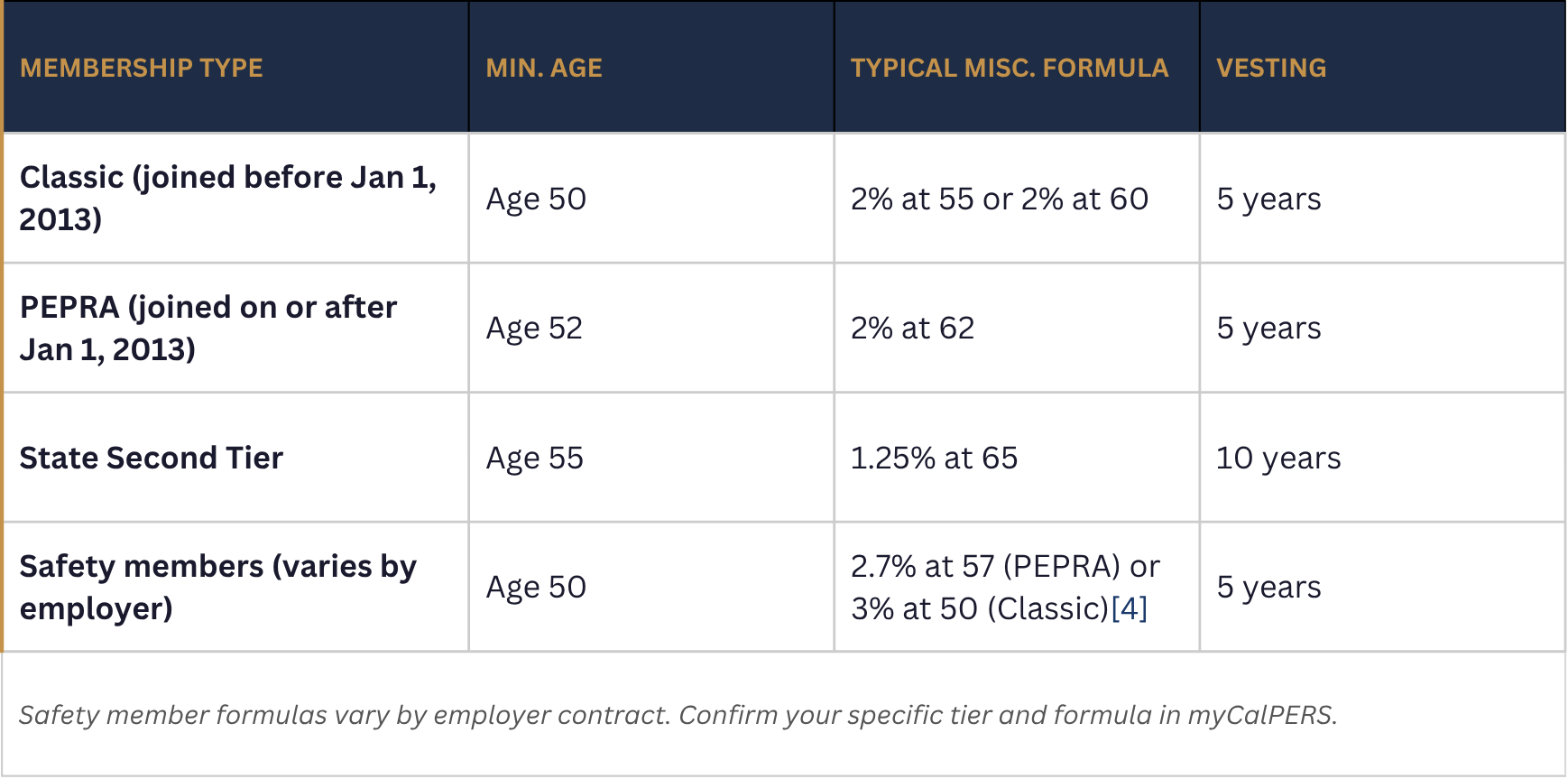
So, for example, if you're a 38-year-old Classic miscellaneous member with eight years of service credit and you leave your employer today, you're vested in the service credit sense, but you can't collect until you reach at least age 50. That gap, between your separation date and your earliest retirement eligibility date, is what makes the decisions below so consequential.
Your Three Main Options at Separation
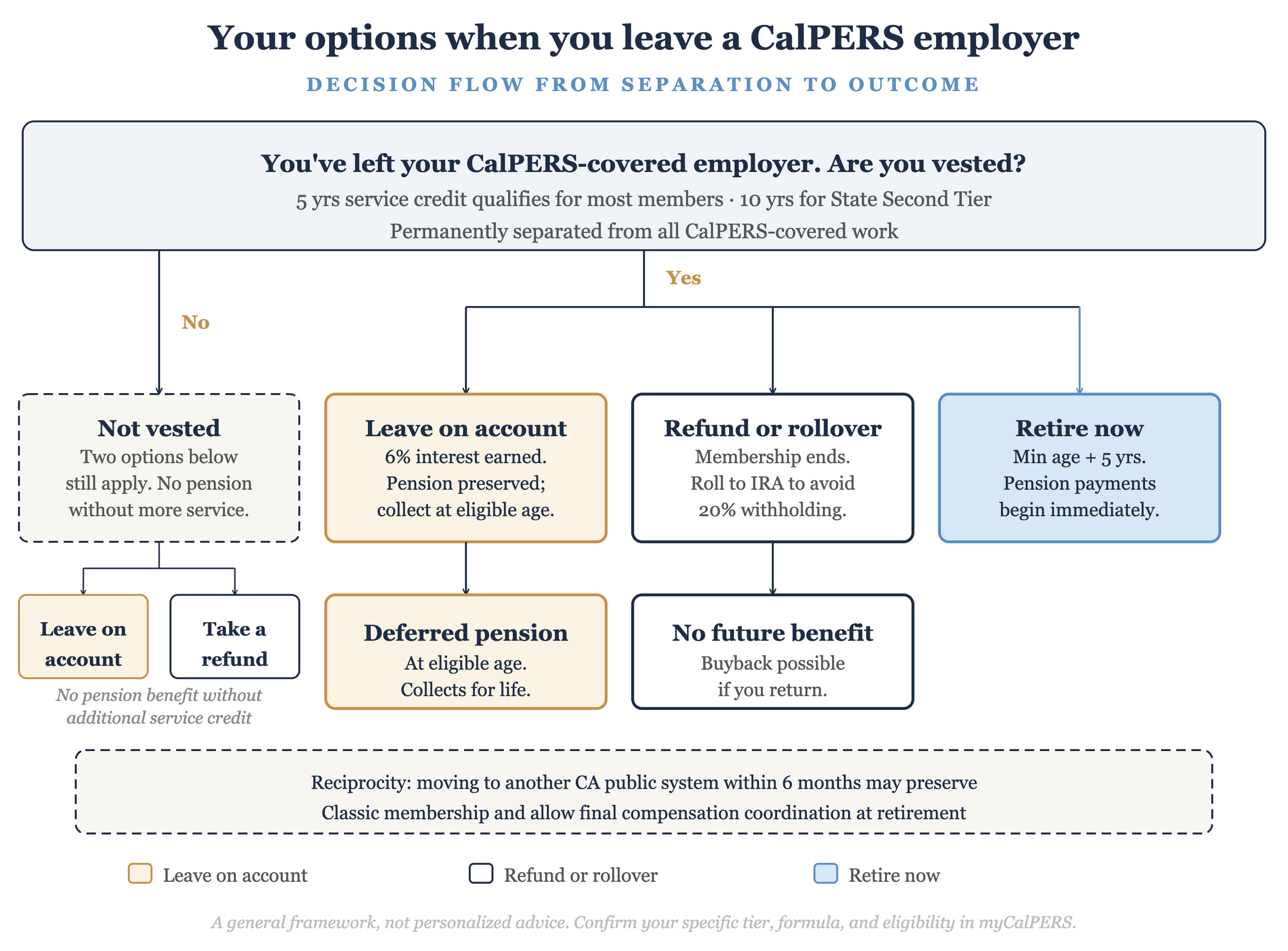
Once you've permanently left all CalPERS-covered employment, CalPERS will mail you a document called Options at Separation. It lays out what comes next. In practice, you have three paths.[5]
Option 1: Leave Your Contributions on Account
You can leave your employee contributions exactly where they are, earning interest, until you reach minimum retirement age and choose to retire. CalPERS credits accounts left on deposit with interest at a rate of 6% per year, and your membership and service credit remain fully intact.[6]
If you're vested, this approach preserves your right to a lifetime pension payment starting at minimum retirement age. The pension amount you'd eventually receive is based on your service credit at separation, your final compensation, and your age when you actually retire. You won't earn additional CalPERS service credit during the years you're working elsewhere, but the credit you built doesn't evaporate.
One thing to know about this option: under federal Required Minimum Distribution rules, if you haven't retired or refunded your account, CalPERS will eventually require a distribution. The age threshold depends on your birth year: age 73 for those born between 1951 and 1959, and age 75 for those born in 1960 or later.[7] If you're leaving public employment mid-career, that deadline is likely far enough away to not be a factor in the initial decision.
Option 2: Take a Refund or Roll Over Your Contributions
You can request a refund of your employee contributions and the interest they've earned. This terminates your CalPERS membership. Once you choose this path, you forfeit your right to any future pension benefit, disability retirement, or survivor benefits under CalPERS.[8]
The refund is taxable as ordinary income unless you roll it over into a qualified retirement account (an IRA or an eligible employer plan that accepts rollovers). If you receive the money directly, CalPERS is required to withhold 20% for federal income tax, and you may face an additional 10% early withdrawal penalty if you're under 59½ and don't roll the funds over.[9]
If you later return to CalPERS-covered employment and want to buy back your prior service credit, you can do so, but the cost is typically higher than what you were originally refunded, and it increases over time as interest accrues.[8]
Option 3: Retire Immediately (If You're Eligible)
If you've reached minimum retirement age and have at least five years of service credit, you may be eligible to apply for retirement now rather than deferring it.[4] This tends to come up most often for members who've spent a longer career in public service, or who are separating later in their working years.
Retiring at the minimum age typically means accepting a lower benefit factor than if you waited, since most CalPERS formulas are structured to reward retiring later. It also means your CalPERS health benefits question comes into focus immediately (more on that below). For many people, the timing question of when to start CalPERS benefits involves a breakeven analysis that intersects with Social Security timing, other savings, and healthcare coverage, so it pays to run those numbers before making the call.
Reciprocity With Another Public Retirement System
If you're leaving one public employer and heading to another, or you're considering it, CalPERS has reciprocal agreements with most other California public retirement systems. Reciprocity allows you to coordinate benefits between systems in a way that tends to be more favorable than treating them as entirely separate.[14]
The mechanics work like this: there's no transfer of funds or service credit between systems. Instead, when you retire from both systems simultaneously (using the same retirement date), your highest final compensation from either system can be used to calculate the pension from each. You draw separate retirement payments from each system.[14]
To establish reciprocity, the main rule to know is the six-month window: you need to move from one reciprocal system to the next within six months, without a gap in active membership.[15] If you take more than six months off before joining a new public employer, reciprocity likely won't apply.
Reciprocity also affects your CalPERS membership tier. Classic members who move to another CalPERS-covered employer within six months typically retain their Classic membership status, which matters quite a bit given the more generous formulas Classic tiers carry relative to PEPRA.[16]
Reciprocal systems include, but are not limited to Other CalPERS-covered employers (which automatically share membership); CalSTRS (California State Teachers’ Retirement System); County “1937 Act” systems such as LACERA, SCERS, and others; San Francisco Employees’ Retirement System (SFERS); and various other qualifying California public retirement systems. If you’re moving to a position under one of these systems, ask both systems about reciprocity before your start date.
What to Think Through Before You Decide
The options at separation aren't equally consequential for everyone. Here is what you should think through:
• Are you vested? If you haven't hit five years of service credit, your options look different than if you have. A non-vested member taking a refund isn't forfeiting a pension they'd otherwise have. A vested member doing the same often is.[3]
• How long until minimum retirement age? The longer the runway, the more you want to think carefully about whether leaving contributions on account makes sense.[4]
• Will you return to public sector work? If there's any realistic chance you'll come back to a CalPERS employer, keeping your membership intact is probably the better decision. Service credit is additive, and buying it back later is expensive.[8]
• What's the reciprocity picture? If you're heading to another California public employer, verify the six-month window and establish reciprocity before your start date. This is one of the decisions that's easy to get right.[15]
• What does your retirement income picture look like overall? CalPERS pension income, if it's eventually payable, is one piece of a broader picture that often includes Social Security, your Savings Plus Program (which is comprised of a 457(b) and 401(k) plan), or other deferred compensation balance, and non-retirement savings. The refund decision looks different depending on what else is in that picture.
• What's the tax impact of a refund? If you're taking a refund in a year with high other income, the tax drag can add up. If you're in a lower-income year, the impact is more manageable. Rolling into an IRA avoids current taxation but still closes the CalPERS door.[9]
Don't Lose Track of Your Account
CalPERS will send you an Annual Member Statement every fall, but those go to the address on file. Keep your contact information current in myCalPERS, and check your account periodically, especially as you approach your eligible retirement window.[17]
This is where it gets personal.
The choice between leaving contributions on account, taking a refund, and establishing reciprocity intersects with your tax situation, your other retirement savings, your career plans, and how you model lifetime income. The right answer depends on the details of your situation. If you've recently left a CalPERS-covered employer and want to think through your specific numbers, I'm happy to help you work through it.
Sources
1. CalPERS. "Refund Member Contributions." calpers.ca.gov/page/active-members/retirement-benefits/refund-member-contributions
2. CalPERS. "Service & Disability Retirement." calpers.ca.gov/members/retirement-benefits/service-disability-retirement
3. CalPERS PERSpective. "CalPERS 101: Your Pension and the Vesting System." news.calpers.ca.gov/your-calpers-pension-is-on-a-vesting-system-heres-what-that-means
4. CalPERS. "Options at Separation" (PDF). calpers.ca.gov/documents/options-at-separation/download
5. CalPERS. "Options at Separation" letter (PDF). calpers.ca.gov/documents/options-at-separation/download
6. CalPERS. "A Benefits Guide for Public Agency Members" (PDF). calpers.ca.gov/documents/new-member-public-agency-guide/download
7. SECURE 2.0 Act of 2022; IRS Final Regulations on Required Minimum Distributions (89 Federal Register 58886, eff. Jan. 1, 2025). federalregister.gov/documents/2024/07/19/2024-14542/required-minimum-distributions
8. CalPERS. "Refund Member Contributions." calpers.ca.gov/page/active-members/retirement-benefits/refund-member-contributions
9. CalPERS. "Refund Election Form Packet — Special Tax Notice: Your Rollover Options" (PDF). calpers.ca.gov/documents/refund-election-form-packet/download
10. CalPERS. "Eligibility & Enrollment (Active Members)." calpers.ca.gov/members/health-benefits/eligibility-and-enrollment
11. CalPERS. "COBRA Coverage." calpers.ca.gov/members/health-benefits/eligibility-and-enrollment/cobra
12. CalPERS. "Eligibility & Enrollment (Retirees)." calpers.ca.gov/retirees/health-and-medicare/eligibility-and-enrollment
13. CalPERS PERSpective. "Health Vesting 101." news.calpers.ca.gov/health-vesting-101/
14. CalPERS. "Reciprocity (Linking Retirement Systems)." calpers.ca.gov/members/retirement-benefits/reciprocity
15. CalPERS PERSpective. "What You Need to Know About Reciprocity." news.calpers.ca.gov/what-you-need-to-know-about-reciprocity-2/
16. CalPERS. "Public Employees' Pension Reform Act (PEPRA)." calpers.ca.gov/page/about/laws-legislation-regulations/public-employees-pension-reform-act
17. CalPERS. "A Benefits Guide for Public Agency Members" (PDF). calpers.ca.gov/documents/new-member-public-agency-guide/download
Disclosures
Fiduciary Financial Advisors does not accept any liability for the use of the information discussed. Consult with a qualified financial, legal, or tax professional prior to taking any action. Before investing, consider investment objectives, risks, fees, and expenses. Investments in securities involve the risk of loss, including loss of principal. Past performance is no guarantee of future returns. The views and opinions reflected in the content are subject to change at any time without notice. The content speaks only as of the date indicated. Some information was obtained from external sources. The information is believed to be accurate, but there is no guarantee that it is.
This content is for educational purposes only and does not constitute personalized tax, legal, or investment advice. Consult a qualified CFP®, CPA, or attorney before taking action.
Fiduciary Financial Advisors is a registered investment adviser. Nothing here constitutes individualized investment advice. Examples are illustrative only and not recommendations. No guarantee of future results. Third-party data is not independently verified.
CFP® and CERTIFIED FINANCIAL PLANNER® are certification marks owned by the CFP Board.

86% of California State Employees Are Handling Their Finances Alone.
A CSEA survey of nearly 5,000 California state employees found that 86% handle their own financial and retirement planning, relying on friends, family, and online resources. Here's the confidence gap between DIY planners and those who work with an advisor, and the CalPERS-specific decisions (pension timing, Savings Plus, Social Security, and tax planning) where going it alone may cost you.
Here’s What They May Be Missing.

If you work for the State of California, SMUD, Caltrans, CDCR, or any other CalPERS-covered employer, you have access to a strong retirement benefit package. A defined benefit pension, Savings Plus 401(k) and 457(b) options, and (depending on your role) Social Security coordination that often requires careful planning.
And yet, according to a recent financial preparedness survey of nearly 5,000 California state employees, the overwhelming majority of you are navigating all of that on your own.[1]
That’s not a judgment. It’s a data point. And it’s worth understanding why it matters.
What the Research Actually Says
The 2024 California State Employees Financial Preparedness Report, published by the California State Employees Association (CSEA) and based on a survey of active and retired state workers, found some numbers that are hard to ignore:[1]
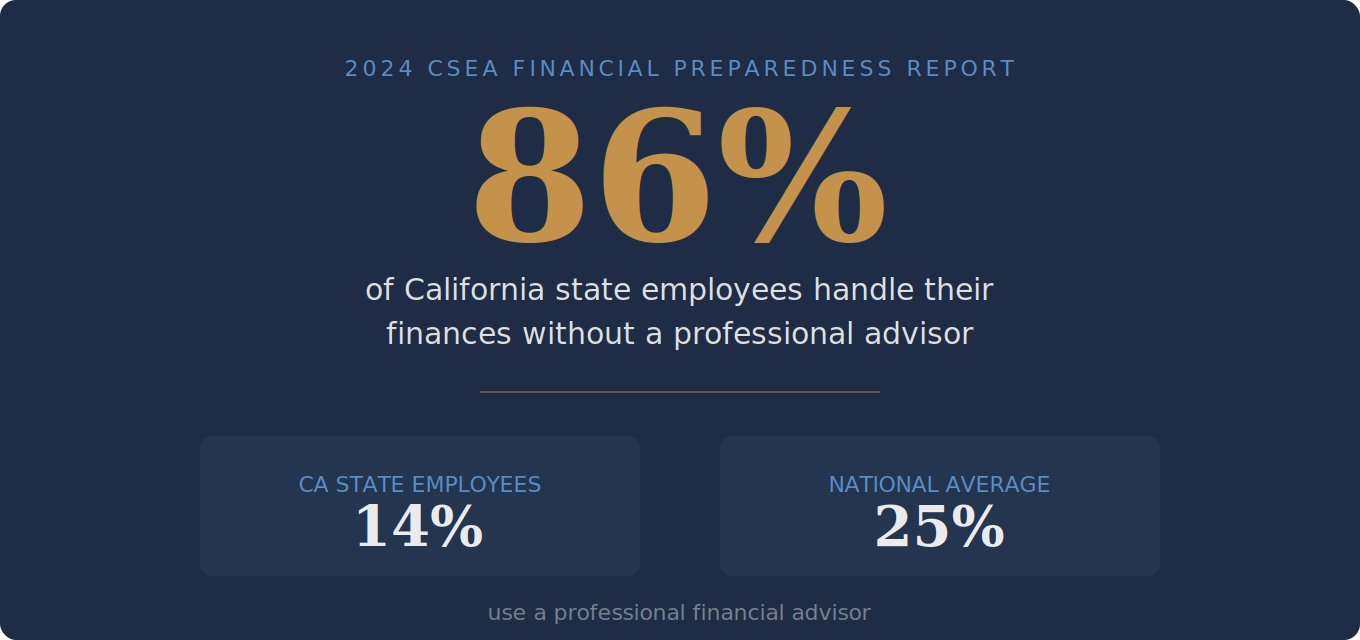
86% of California state employees handle their own financial and retirement planning, relying on friends, family, and online resources rather than a professional advisor.
Only 14% use a professional financial advisor, compared to roughly 25% of Americans nationally.
When researchers asked why, the answers were familiar: it costs too much, I don’t have enough saved, I haven’t found someone I trust, or I just don’t think I need one.[1]
Those are all reasonable-sounding explanations. But here’s where the data gets interesting, because the same survey measured how those two groups actually feel about their financial lives.
The Confidence Gap You Can Measure
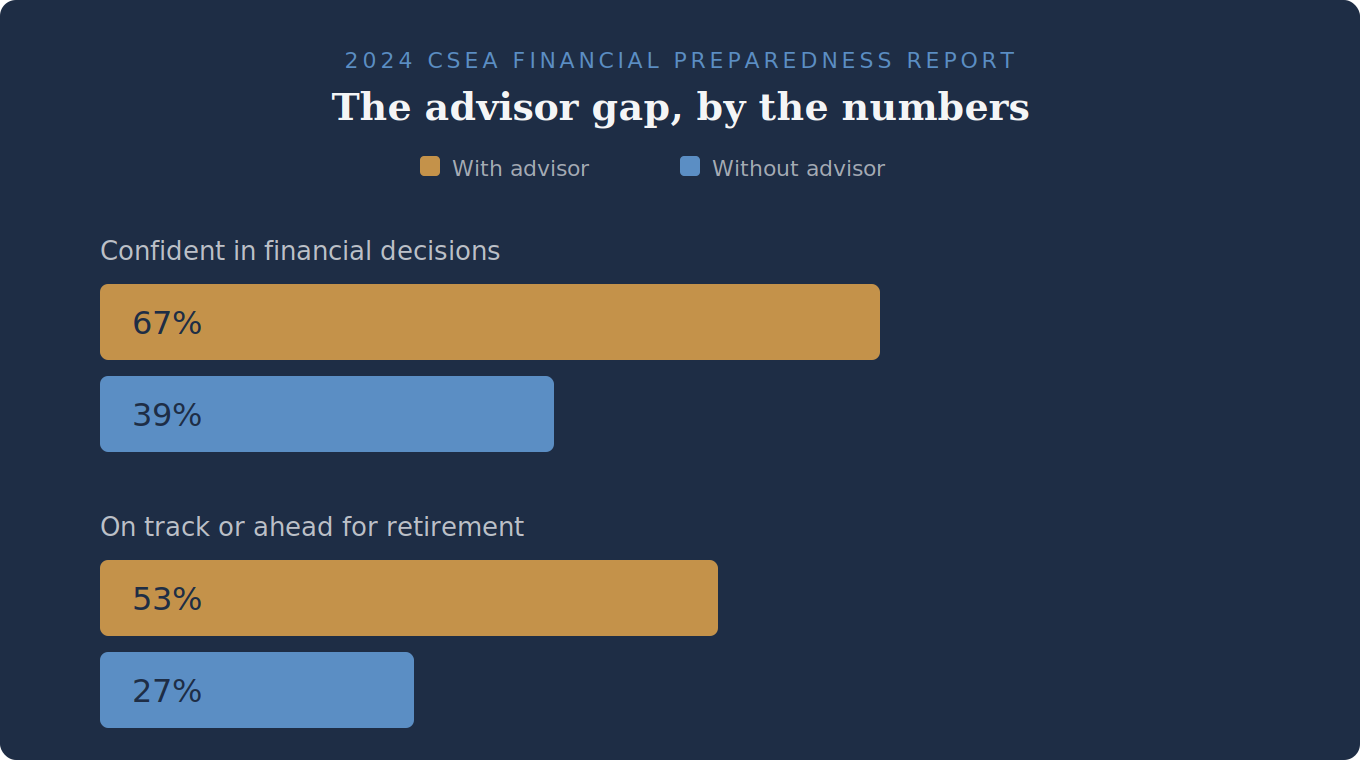
State employees with an advisor: 67% felt confident in their financial decision-making. State employees without an advisor: 39%.
State employees with an advisor: 53% said they were on track or ahead of schedule for retirement. State employees without an advisor: 27%.
That’s not a marginal difference. That’s roughly double the confidence and nearly double the retirement readiness, at least as self-reported.[2]
Now, correlation is not causation (people who seek out advisors may already be more financially engaged). But the gap is wide enough to raise a question worth sitting with: if you’re in the 86% handling your finances without professional guidance, what are the odds there are opportunities you haven’t fully considered?
What DIY Planning May Miss for CalPERS Employees
The reason this matters more for public employees than, say, someone with a basic 401(k) and no pension is that your benefits stack is notably complex. There are moving parts that interact with each other, and because some of those decisions (like your pension option election or retirement date) are difficult or impossible to undo, the cost of a misstep may compound over time.
Here are some of the areas where a qualified advisor tends to help clarify the picture for CalPERS members:
Pension Timing and Retirement Date Optimization
Your CalPERS benefit is calculated using a formula, and the timing of when you retire may significantly affect your monthly benefit for life. Retiring right before versus right after a birthday quarter, for example, may change your benefit factor. Many employees look at their pension estimate and assume that’s the number, without realizing that a few strategic adjustments to timing could increase their monthly income (or overlook the impact that a prior divorce may have if the pension benefit was part of the settlement).
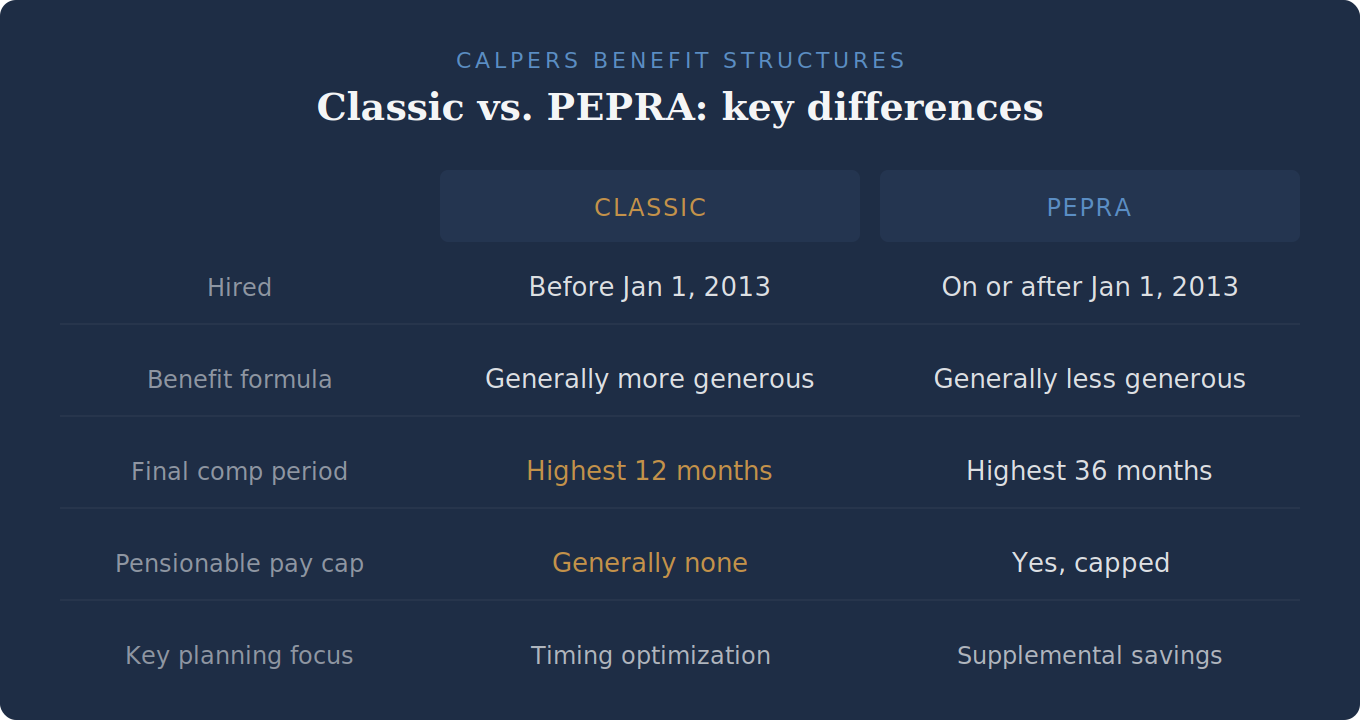
And the stakes here differ depending on when you were hired. If you started with a CalPERS-covered employer before January 1, 2013, you’re a “Classic” member with a generally more generous benefit formula, and your final compensation is based on your highest 12 consecutive months of pay. If you were hired on or after that date, you fall under PEPRA (the Public Employees’ Pension Reform Act), which uses a generally less generous formula, a 36-month final compensation period, and a cap on the salary that counts toward your pension. (For simplicity, this overview focuses on miscellaneous members. Safety members and State Second Tier members have different formulas and benefit structures.)[3]
That’s a significant difference. A Classic member nearing retirement may have a richer benefit, but that also means more complex optimization decisions around timing, final comp windows, and retirement option elections. A PEPRA member, on the other hand, is generally working with a less generous formula, which may make supplemental savings strategy and tax planning that much more important for closing the gap between their pension income and the retirement lifestyle they want. Either way, understanding which set of rules applies to you (and how to work within them) is one of the areas where professional guidance may be worth exploring.
Savings Plus Strategy (the 401(k)/457(b) Decision)
If you’re a state employee, you have access to both a 401(k) and a 457(b) through Savings Plus, which means you may be able to contribute up to $49,000 per year in 2026 (or more if you’re over 50 or nearing retirement and eligible for catch-up provisions).[4] But many employees may not be maximizing both plans, and may not be thinking strategically about whether to use pre-tax, Roth, or a combination. The right answer depends on your current tax bracket, your expected pension income, your other sources of retirement income, and your timeline. This is especially true for PEPRA members, whose pension formula and pensionable pay cap may make supplemental savings through Savings Plus an important lever for building retirement security.
And if you work for an employer like SMUD that offers its deferred compensation through Fidelity rather than the Savings Plus/Nationwide platform, the investment options and fee structures are different, which may matter for how you allocate.
Social Security Coordination
Not every CalPERS member pays into Social Security (it depends on your employer’s specific arrangement).[5] For those who do, coordinating your pension income, Savings Plus distributions, and Social Security claiming strategy may noticeably affect your total after-tax retirement income. For those who don’t, understanding how that gap affects your overall plan may be just as important.
Tax Planning Around Retirement
Your CalPERS pension is fully taxable as ordinary income. So are distributions from your Savings Plus accounts (unless they’re Roth). If you’re retiring in California, where state income tax rates may run above 9% for many retirees, the difference between a tax-aware withdrawal strategy and just taking money as you need it may be larger than you’d think.
This is where Roth conversion planning in the years leading up to retirement tends to be especially valuable, and where DIY planners may not realize what options are available to them.
Why Most People Put This Off
(Even When They Know Better)
If you’ve been meaning to get your financial plan together "someday," you’re in very large company. Financial procrastination isn’t laziness. It’s usually one of a few predictable things:
The complexity feels overwhelming. CalPERS alone has multiple benefit formulas, PEPRA vs. Classic distinctions, reciprocity rules, and different employer contracts. Add in Savings Plus, Social Security, tax planning, and retirement timing decisions, and it’s understandable that many people just default to "I’ll figure it out later."
There’s no forcing function until retirement is close. Unlike a leaky roof or a check engine light, the consequences of not having a plan often don’t show up right away. But by the time they do (often in the form of a tax surprise, a suboptimal pension election, or a realization that you can’t retire when you planned), the window to fix things has narrowed.
Trust is a real barrier. The CSEA survey confirmed this.[1] Many state employees haven’t found an advisor they trust, and that’s an understandable concern. Not every advisor understands CalPERS benefits, Savings Plus options, or the specific planning challenges that come with public sector employment. Working with someone who doesn’t know your benefits package well can sometimes feel worse than doing it yourself.
What to Look for If You’re Considering Working with Someone
If you’re a CalPERS member who’s been thinking about getting professional guidance (even if you’ve been thinking about it for a while), here are a few things that tend to matter most:
Fiduciary standard. Look for an advisor who is legally required to act in your best interest, sometimes referred to as a fiduciary. That’s an important distinction worth understanding when evaluating any advisor relationship.
Familiarity with public sector employees and pension benefits. There’s a difference between a generalist financial planner and one who has experience working with pension benefits and public sector employees. Ask whether they’ve worked through pension optimization, deferred compensation strategy, and retirement tax planning with people whose benefits look like yours. Ask how many clients they serve in similar situations.
A comprehensive approach, not just one piece of the puzzle. A good financial plan for a CalPERS member doesn’t stop at a retirement projection. It connects your pension, your supplemental savings, your tax situation, and your investment strategy into a coordinated approach. Look for someone who ties these pieces together rather than addressing them in isolation.
The Bottom Line
You’ve built a career in public service, and the benefits you’ve earned along the way are valuable. But they’re also complex, and the gap between a good plan and no plan may be wider than you’d expect over the course of a retirement.
If you’re one of the 86% who’s been going it alone, that doesn’t mean you’ve been doing it wrong. It might just mean you haven’t found the right fit yet.
Interested in talking through your CalPERS benefits and how they fit into your bigger financial picture? You can schedule a no-obligation introductory conversation below.
Sources
California State Employees Association (CSEA). “2024 California State Employees Financial Preparedness Report.” Published 2024. Survey of nearly 5,000 active and retired California state employees conducted November 2023. N=3,817 active employees (95% confidence, ±2%), N=1,172 retirees (95% confidence, ±2%). Available at cseabenefitsprogram.com.
CSEA. “DIYing Your Own Retirement Savings Plan? Here’s What You Need to Know.” cseabenefitsprogram.com, 2024. National advisor usage estimate (25%) cited from 2022 Harris Poll. Confidence and retirement readiness comparisons derived from the 2024 Financial Preparedness Report.
CalPERS. “Public Employees’ Pension Reform Act (PEPRA).” calpers.ca.gov. PEPRA took effect January 1, 2013, establishing new benefit formulas, final compensation periods, and pensionable compensation caps for members hired on or after that date.
Internal Revenue Service. “401(k) limit increases to $24,500 for 2026; IRA limit increases to $7,500.” irs.gov, November 2025. The 401(k) and governmental 457(b) elective deferral limits are separate, allowing combined contributions of up to $49,000 ($24,500 each) before catch-up provisions.
CalPERS. “Social Security & Your CalPERS Pension.” calpers.ca.gov. Social Security coverage varies by employer arrangement. Non-covered positions (often safety classifications and certain State of California roles) do not withhold Social Security taxes. The Windfall Elimination Provision (WEP) and Government Pension Offset (GPO) were repealed by the Social Security Fairness Act, signed into law January 5, 2025.
Disclosures
This post is for educational purposes only and does not constitute tax, legal, or investment advice. Please consult a qualified financial planner, CPA, and/or attorney before making decisions about your investments.
Investment advisory services are offered through Fiduciary Financial Advisors, a registered investment adviser. This material is for educational and informational purposes only and is not individualized investment, tax, or legal advice. Equity compensation rules are complex and outcomes depend on plan terms, trading windows, holding periods, and individual tax circumstances. Consult your CPA and/or attorney regarding your situation. Any performance shown is historical, for illustrative purposes, and does not indicate future results. Examples are not representative of all securities or outcomes and are not recommendations to buy or sell any security. Data may be obtained from third-party sources believed to be reliable but not independently verified.
Certified Financial Planner Board of Standards, Inc. (CFP Board) owns the CFP® certification mark in the United States, which it authorizes use of by individuals who successfully complete CFP Board’s initial and ongoing certification requirements.