
Choosing Your CalPERS Retirement Date
Birthday Quarters, Fiscal Years, and COLA Timing

Your retirement date may feel more sentimental than financial, but for a CalPERS member, it also sets several (financial) numbers at once. Service credit, your benefit factor, when your first cost-of-living adjustment arrives, and how your final leave payout is taxed all move with the date you pick.
Most of this article is about windows, not deadlines. You don’t necessarily have to walk out on June 30 or December 31 to capture the benefits people tie to those dates (those exact dates may not even be exactly optimal for you). If you work for SMUD, Caltrans, a school district, or another CalPERS-covered employer, the pension mechanics apply the same way, since you retire through the same system. A few tax and payroll specifics are keyed to State of California payroll, so where those come up, confirm the equivalents with your own HR.
What the date controls
Your pension comes out of one formula, and it helps to keep its three pieces straight before we get into timing.
CalPERS runs on a fiscal year of July 1 through June 30, and service credit (the first piece of the formula above) accrues in tenths, not twelfths. For a full-time member paid monthly, about ten months of work inside that year earns a full year of credit.[1] If you start in July, the full year of service credit is likely earned by the next spring. So within the fiscal year, once you have banked a full year of service credit, staying on through June doesn’t add anything with respect to service credits.
Your benefit factor (the second piece of the formula above), steps up with each quarter-year of age, every three months, until it reaches the maximum for your formula.[1] So if you retire just after a birthday quarter, you lock in a higher factor than if you retire just before it. This matters while you are below that maximum benefit factor, and additionally, your formula and top age depend on your membership date and classification, so check the factor chart for your own formula.[1]
Your first COLA is where the exact day actually matters. It is tied to the second calendar year after the year you retire, and the adjustment is in the May 1 payment, not on a rolling clock from your retirement date.[1][2] That means retiring in late December rather than the first days of January makes a full year difference on when you receive your first COLA adjustment, even if the difference in your retirement date would just be days apart.[1]

Two ways to time it
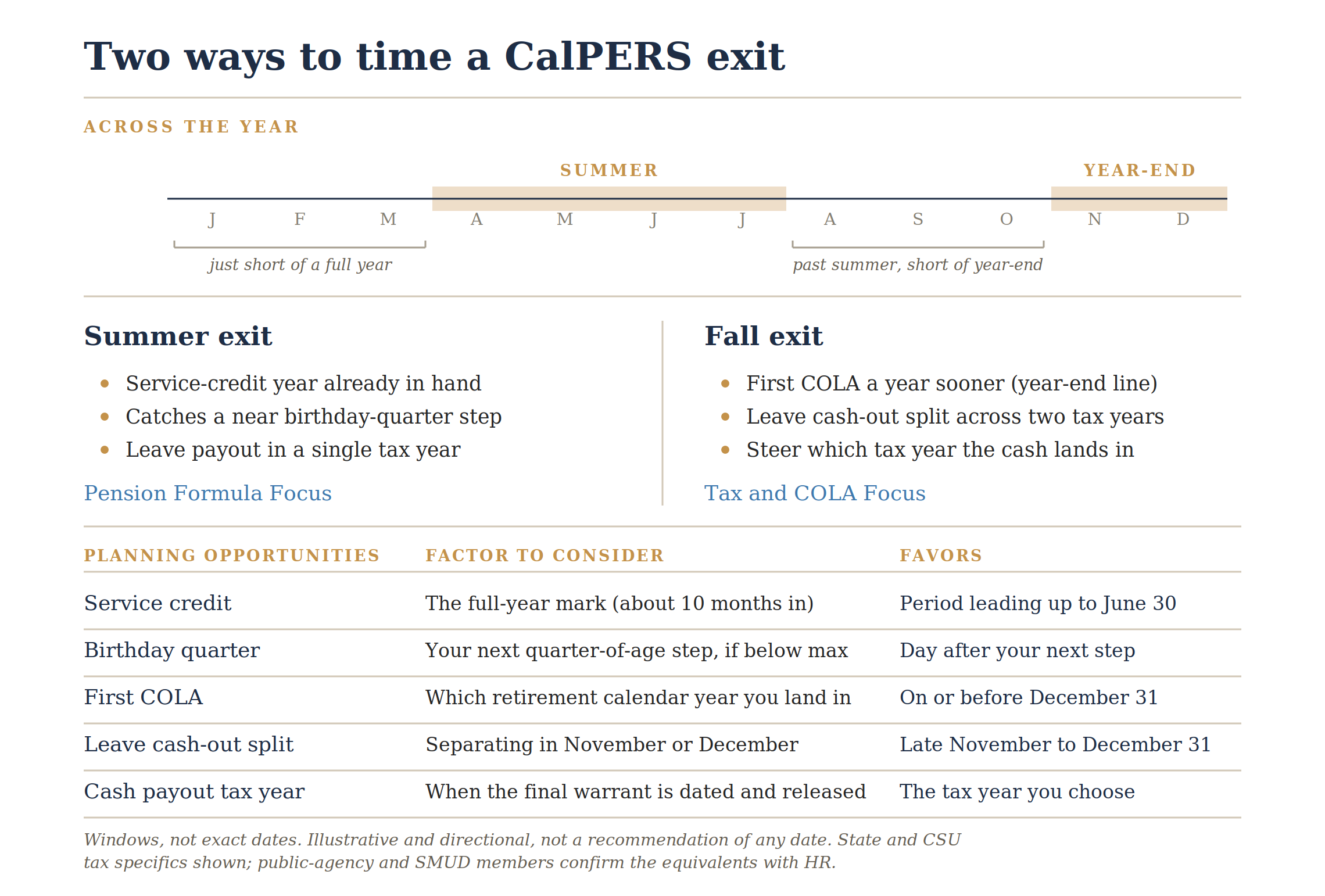
Line these up on a calendar and they cluster into two windows. One is a summer exit, sometime in late spring into summer, based around the pension formula itself. The other is a fall exit, from November into year-end, based around your COLA and the tax treatment of your leave payout. The stretches between them are (in my opinion) the weak spots. This is because if you leave in the earliest part of the year, you end up just short of earning another service credit, and if you leave late in the year, but before November, you lose out on being able to take advantage of the potential year-end benefits. In practice, the decision usually comes down to which part of the year makes more sense for you to retire in, then fine-tuning the exact day.
A summer exit focuses on service credit. Because the full year is banked about ten months into the fiscal year, you can leave in spring without giving up credit, and you don’t necessarily have to retire on exactly June 30 to get there. If your next birthday-quarter step also falls in this stretch, you may want to work long enough into summer to capitalize on it. The leave payout lands in a single tax year, which keeps that part simple. It suits members who have already banked the service-credit year and have more to gain from the pension math than from tax timing.
If you wait until the fall you will want to keep your COLA and your leave taxes in mind. By retiring before December 31, you’d get your first COLA a full year sooner than waiting until retiring after crossing into the new year. Then a late-year separation also opens a leave-payout option a summer date does not. State and CSU employees can direct a lump-sum leave payout into their Savings Plus 457(b) and 401(k) rather than take it all as cash, up to the annual limits (and those two plans carry separate limits).[3][5] For 2026 that is $24,500 of elective deferral per plan, plus an $8,000 catch-up once you are 50 (or $11,250 for the year you are 60 to 63).[4] Then so long as you separate near the end of the year, roughly from November on, the deferral can be split across two calendar years, each with its own limits, spreading a large payout over two tax returns instead of stacking it on one (there is also another catch-up unique to the 457(b) that I will get into another time).[3]
Two cautions come with that route. The election is irrevocable once you sign it, because the tax rules treat the money as yours the moment you could have taken it, so the choice has to be made before you separate, and the form has to reach your personnel office at least five working days ahead, in practice, you should probably plan on closer to a month.[3][6] And for whatever you take as cash, the tax year is set by when the payment is issued, not by your last day, so near year-end a few days of processing can carry the cash from one tax year into the next.[7] So if you choose to retire later in the year, you should make sure to give enough lead time to get your paperwork processed on time.
Matching the exit to the facts
To make this a little less abstract, let’s talk about a potential scenario. Let’s say there is a member who is 61, already at the top of their benefit factor, sitting on a large vacation balance, with a birthday quarter that passed back in the spring. At this point, the pension formula would be mostly settled for them, with the benefit factor around the max and the service-credit year now banked. What is still open is the determination of when they will receive their first COLA and what happens with the leave payout. By waiting until later in the year, they would potentially benefit from the increase in flexibility on how they handle the leave payout.
The flip side would likely be someone still climbing toward their factor maximum or with little leave saved, and may get more out of the summer window, or rather, give up less by going earlier in the year.
Neither window is a one-size-fits-all choice, so rank what applies to you and think about which season makes more sense, then settle on the exact day. Sorting out how a maxed factor, a leave balance, and a two-year tax split add up for your own situation is where personalized analysis may help before you file paperwork that you cannot easily undo.
The bigger question:
All of this optimizes the exit, but none of it answers whether you can afford to leave in the first place. Before you spend much energy on the perfect date, you may consider running the numbers on whether your pension, savings, and expenses support retiring at all. A well-timed exit does not help much if you are not ready to make it.
Disclosures
Fiduciary Financial Advisors does not accept any liability for the use of the information discussed. Consult with a qualified financial, legal, or tax professional prior to taking any action. Before investing, consider investment objectives, risks, fees, and expenses. Investments in securities involve the risk of loss, including loss of principal. Past performance is no guarantee of future returns. The views and opinions reflected in the content are subject to change at any time without notice. The content speaks only as of the date indicated. Some information was obtained from external sources. The information is believed to be accurate, but there is no guarantee that it is.
This content is for educational purposes only and does not constitute personalized tax, legal, or investment advice. Consult a qualified CFP®, CPA, or attorney before taking action.
Fiduciary Financial Advisors is a registered investment adviser. Nothing here constitutes individualized investment advice. Examples are illustrative only and not recommendations. No guarantee of future results. Third-party data is not independently verified.
CFP® and CERTIFIED FINANCIAL PLANNER® are certification marks owned by the CFP Board.
Sources
[1] CalPERS PERSpective, “Timing Your Retirement: Fiscal Years and Birthday Quarters Matter,” April 14, 2026.
[2] CalPERS, “Cost-of-Living Adjustment (COLA),” Retirees / Cost of Living.
[3] California Department of Human Resources (CalHR), Human Resources Manual § 1802, Transfer Leave Credits and Catch-Up (Savings Plus lump-sum separation pay deferral; two-tax-year election for late-year separations; irrevocable under Treas. Reg. § 1.451-2(a)).
[4] Internal Revenue Service, “401(k) limit increases to $24,500 for 2026,” Notice 2025-67.
[5] CalHR, Human Resources Manual § 1801, Contribution Rates (IRS annual limits apply separately to each plan, 401(k) and 457(b)).
[6] Savings Plus, “Lump Sum Separation Pay” (savingsplusnow.com); five-working-day filing requirement per California Labor Code §§ 201 and 202.
[7] California State Controller’s Office, Personnel and Payroll Services Division, year-end lump-sum separation processing guidance and payroll letters (processing cutoffs; warrant issuance timing).
