
Your Finances Called. They've Been Waiting (Right Behind That New Year's Resolution)
Let's just say it out loud: you already know what you need to do with your money. You've known for a while. Maybe months. Maybe longer. Get that investment account set up. Actually look at your retirement contributions. Make a plan. Talk to someone. You've thought about it in the shower, during your commute, at 2 a.m. when the ceiling won't stop staring back at you. And yet here you are. Still thinking about it.
You're in excellent company, by the way. A tragically enormous amount of company.
The New Year's Resolution Hall of Shame
How's that working out?
Spoiler: it's not.
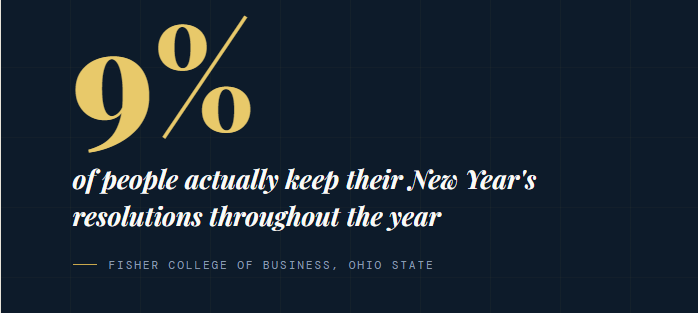
Research shows that only 9% of people actually keep their New Year's resolutions throughout the year.[1] Nine. Percent. That means 91 out of every 100 people who made a big, bold declaration on January 1st are quietly abandoning ship. And it doesn't take long: 23% quit within the first week, and 64% have thrown in the towel by the end of the first month.[2] Strava, a fitness tracking app with hundreds of millions of data points, named the second Friday of January "Quitter's Day," because it's the single most popular day for people to give up on their goals.[2]
The second Friday of January. We can't even make it three weeks.
Among those who set resolutions in 2024, 49% said they had abandoned them entirely by the end of February (and let me remind you, it's already April), with 40% having done so in January alone.[3] And here's the kicker: 80% of goal-setters feel completely confident they'll stick to their resolutions throughout the year.[4] The confidence isn't the problem. The follow-through is.
Sound familiar? That's because it's the same story playing out in personal finance, year after year.
The Financial Version Is So Much Worse
Here's where the New Year's resolution problem and the financial inaction problem converge into something genuinely uncomfortable.
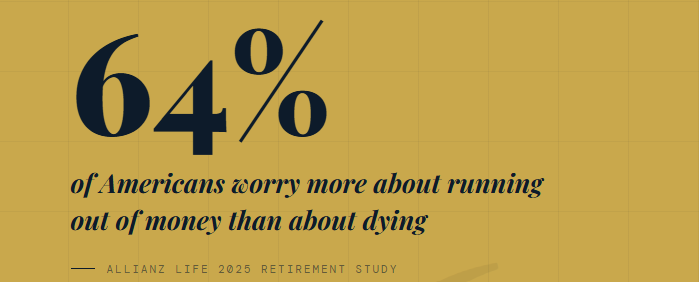
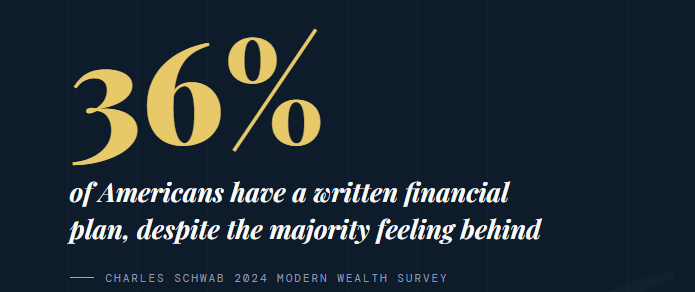
According to a CNBC survey, 53% of Americans say they're behind schedule on retirement planning and savings.[5] More than half. (I'll say it again. More than half....) A separate study from Allianz Life found that 64% of Americans worry more about running out of money than they worry about dying.[6] (Turns out the old joke about dying with your last check bouncing isn't so funny when it starts to feel like a real possibility.) And yet, according to a Schwab study, only 36% of Americans have a written financial plan.[7]
People are scared. They know they're behind. And they still aren't doing anything about it.
Meanwhile, 68% of Americans near or in retirement say they will need to delay retirement because they don't have enough saved,[8] and 64% of Americans wish they had started saving before age 25, even though the average starting age is 28.[8] A handful of years doesn't sound like much until you remember the 8th wonder of the world: compound interest. (Now ask yourself: how much longer can you afford to wait?)
And before you say "it's too late for me anyway," no. It's not. You just could have started sooner.
Research on procrastination and personal finance confirms what the data shows: procrastinators are significantly less likely to participate in savings plans, tend to initiate saving later, and are less likely to save a fixed amount every month. Procrastinators are also about nine percentage points less likely to have a will or trust, and report lower retirement satisfaction overall.[10] The delay doesn't just cost money. It costs peace of mind. (Funny enough, I wrote about exactly this. Read it here.)
You're Not Lazy. You're Human. (But Also, Come On.)
Here's what the research actually says about why we don't do the things we know we should do with our money.
Experts define financial procrastination as voluntarily delaying planning or implementing finance-related decisions, despite expecting to be worse off for the delay.[11] One researcher at Carleton University described the core problem this way: "You know what you ought to do and you're not able to bring yourself to do it. It's that gap between intention and action."[12]
That gap? It's enormous. And in personal finance, it can be expensive. (Ah, expensive. Maybe that's the word that finally gets you moving.)
The psychology behind it is called "present bias," which is our brain's tendency to prioritize immediate rewards over future benefits. Saving for retirement thirty years from now doesn't trigger the same urgency as whatever is happening right now. The future version of you who needs that money feels abstract. The discomfort of sitting down and actually dealing with it feels very, very real.[11] (Which is probably why it's easier to replay every financial decision you wish you could take back than to actually sit down and make a plan. That can't just be me.)
Meanwhile, 35% of people cite losing motivation as their top reason for giving up on goals, followed by being too busy (19%) and shifting priorities (18%).[2] Too busy. Too tired. Too overwhelmed. (Time to consider hiring a pro yet??) The reasons are real, and they will always be there. There will never be a perfect window of time when everything clears up, your inbox is empty, and the stars align for you to finally sort out your financial life. Waiting for that window is its own financial strategy. A terrible one. (Which is probably why the IRS has an annual deadline on April 15th... unlike your financial plan.)

"I'll Start When the Market Settles Down": A Love Story
You know what's fascinating about financial procrastination? It never feels like procrastination while you're doing it. We tell ourselves it's prudence. Like waiting for the right moment. Like doing more research first. Like waiting to see what the market does.
There is always a reason to wait. Markets are too volatile. Markets are too calm. The economy is uncertain. Tax laws might change. You don't have enough saved to make it worth starting yet. You're not sure which account to open. You want to understand it better before you commit.
Research confirms that the gap between intention and action grows the further the action is placed in the future.[11] Translation: the longer you wait to deal with your finances, the easier it gets to keep waiting. And each month of delay represents compounding growth potential that has passed. It doesn't come back. (And please don't tell me you're waiting to buy the dip...)
The research also notes that procrastination in financial decisions is essentially irrational behavior: a core characteristic is the realization by the actor that one will be worse off because of the delay, yet the delay happens anyway.[10]
You already know this.
You've probably known it for years.
And yet, still waiting.
Probably still thinking about it.
What Actually Changes Things

Studies show that people who set up a way to be accountable for their financial goals are far more likely to achieve them.[1] Not just more motivated. More likely to actually follow through. (Ahem... funny how that works.)
Accountability. Structure. Someone who can provide perspective, ask relevant questions, and help you evaluate potential next steps.
That's exactly what a consultation is. It's not a commitment to overhaul your entire financial life in one afternoon. It's not signing anything or locking yourself into anything. It's a conversation, a structured one, where you stop spinning in your own head and start actually moving. Where someone helps you figure out what's most important to address first, and what a realistic path forward actually looks like.
Columbia University research shows that while nearly half of Americans make New Year's resolutions, only about 25% stay committed after just 30 days, and fewer than 10% accomplish their goals.[13] (Now contrast that with the 94% of households advised by a CFP® professional who feel confident in their ability to achieve their financial goals.[14] Funny how having a plan and a pro in your corner tends to change things.) The people who do succeed don't have more willpower or more money or more time than you. They have a system. They have support. They stopped trying to figure it all out alone.
So Here's the Part Where I Call You Out (Lovingly)
You've read this far. Which means some part of you is nodding along, maybe a little uncomfortably, thinking yeah, this is me. Good. That recognition is the first step.
The second step is embarrassingly simple: schedule the consultation.
Not "look into it." Not "think about reaching out soon." Not "maybe after things calm down a little." Now, seriously.... While the itch is still there. Because the data is brutally clear: the longer the gap between intention and action (remember that study I just referenced above), the wider it gets, until one day you look up and realize you've been "meaning to get your finances sorted out" for five years, and the compounding you missed doesn't care about your intentions.
You deserve more than five more years of thinking about it. (And realize, I've been trying to reach some of you for almost that long already.)
The hardest part is genuinely just making the appointment. Everything after that? That's what I'm here for.
(This post was lovingly inspired by that tax return that I kept putting off. Which I got to eventually... remember... there's an actual deadline... unlike your financial plan.)
References & Sources
Fisher College of Business, Ohio State University. "Why Most New Year's Resolutions Fail." Lead Read Today. fisher.osu.edu
Inside Out Mastery. "19 Surprising New Year's Resolution Statistics (2024 Updated)." insideoutmastery.com
The Harris Poll, conducted on behalf of Origin Financial, January 13–15, 2025 (n=3,059 U.S. adults). Published by Origin Financial: "The New Year Called – It Wants Its Resolutions Back." useorigin.com
Drive Research. "New Year's Resolutions Statistics and Trends." driveresearch.com
CNBC / SurveyMonkey. "53% of Americans Surveyed Feel They Are Behind on Their Retirement Savings." cnbc.com
Allianz Life Insurance Company of North America. "Americans Are More Worried About Running Out of Money Than Death." 2025 Annual Retirement Study, Allianz Center for the Future of Retirement (January/February 2025, n=1,000). allianzlife.com
Charles Schwab. "2024 Modern Wealth Survey." Conducted by Logica Research, March 2024 (n=1,000). aboutschwab.com
Voya Financial / F&G Annuities. "Facing Delayed Retirement, Many Americans Wish They Had Started Saving Sooner." PLANADVISER. planadviser.com
Ahead App. "Why Procrastination in Retirement Planning Costs You a Comfortable Future." ahead-app.com
Shah, R. & Mukherjee, A. "Procrastination in Personal Finance: Implications for Estate Planning and Retirement Satisfaction." ScienceDirect, 2025. sciencedirect.com
Svartdal, F. et al. "Procrastination and Personal Finances: Exploring the Roles of Planning and Financial Self-Efficacy." Frontiers in Psychology, 2019. frontiersin.org
Pychyl, T. "Why Wait? The Science Behind Procrastination." Association for Psychological Science. psychologicalscience.org
CBS News / Columbia University. "New Year's Resolutions Often Don't Last. Here's Why They Fail." cbsnews.com
CFP Board. "Trust. Confidence. Impact: 2025 Financial Planning Longitudinal Study." cfp.net
Certified Financial Planner Board of Standards, Inc. (CFP Board) owns the CFP® certification mark in the United States, which it authorizes use of by individuals who successfully complete CFP Board's initial and ongoing certification requirements.
Investment advisory services are offered through Fiduciary Financial Advisors, a registered investment adviser. This article is for informational and educational purposes only and should not be construed as personalized investment, tax, or legal advice. Any references to scheduling a consultation are for general informational purposes and do not create an advisory relationship. Third-party research, statistics, and survey data cited are believed to be reliable but have not been independently verified. All data is subject to change. References to CFP® professionals relate to industry research and do not imply that any specific outcome will be achieved.
